KYB in the Netherlands 2026: Business Verification Under Wwft and EU AML Rules
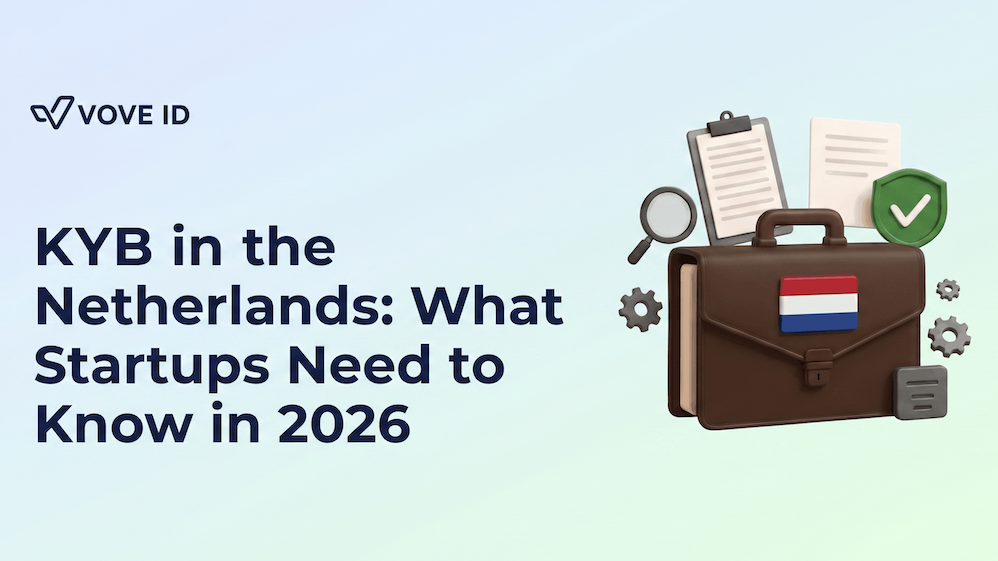
In 2026, Netherlands KYB means verifying the legal entity, identifying and validating UBOs, screening directors and owners, and monitoring the relationship under the Wwft.
VOVE ID helps fintech teams turn business onboarding into a repeatable compliance workflow instead of a manual registry check. That matters in the Netherlands, where the Wwft requires institutions to understand who they are onboarding, who ultimately owns or controls the company, and whether the risk profile changes over time.
For B2B fintechs, SME lenders, embedded finance platforms, and payment providers, Dutch KYB is not a single check. It is a chain of checks.
The Netherlands KYB Framework: Wwft First, Registry Data Second
In the Netherlands, business verification sits inside the broader anti-money laundering framework under the Wet ter voorkoming van witwassen en financieren van terrorisme (Wwft).
That framework expects regulated firms to perform customer due diligence before entering a business relationship and to keep monitoring that relationship afterward. For legal entities, that means confirming the company exists, understanding its ownership and control structure, identifying the ultimate beneficial owners, and assessing whether the customer makes sense for the expected activity.
The Dutch Chamber of Commerce, or KVK, is central to this process because it maintains the Handelsregister. But a KVK extract is not the whole KYB file. It is one input into a wider due diligence process.
This distinction matters. A fintech can verify that a company is registered and still fail Wwft expectations if it cannot explain beneficial ownership, high-risk counterparties, or unusual transaction patterns.
What a Netherlands KYB Check Should Include
A practical Netherlands KYB flow usually includes five core layers.
1. KVK Entity Verification
Start with the company record in the Dutch Business Register. At a minimum, teams should confirm:
- Legal name
- KVK number
- Legal form
- Registered address
- Incorporation or registration status
- Directors or authorized representatives
This establishes that the entity exists and gives the base record against which the rest of the onboarding file can be tested.
2. UBO Identification and Verification
Under the Wwft, institutions must identify and verify the ultimate beneficial owner. For Dutch entities, UBO registration remains part of the compliance landscape, but access to the KVK UBO register is restricted rather than public.
That means two things in practice:
- Firms cannot assume public self-service access to UBO information
- UBO register data should support, not replace, the firm's own customer due diligence
If the ownership picture coming from the customer does not match the register information available to the institution, that mismatch needs to be handled as a compliance issue rather than waved through as an admin discrepancy.
3. Director and Representative Verification
The people acting for the company need to be tied back to the legal entity. A strong Dutch KYB process verifies the identity of directors, authorized signatories, and any representative submitting documents or opening the account.
This is where individual KYC and business verification meet. A business record without validated humans behind it is not enough.
4. Sanctions, PEP, and Adverse Media Screening
Business onboarding under the Wwft is not limited to corporate registry checks. Beneficial owners, directors, and controlling persons should be screened against sanctions and politically exposed person lists, with adverse media review where the risk profile justifies it.
For fintechs serving cross-border merchants, investment structures, or higher-risk sectors, this is often the step that determines whether standard due diligence is enough or enhanced due diligence is needed.
5. Ongoing Monitoring
Dutch AML obligations do not stop once the company is approved. Institutions are expected to conduct ongoing monitoring so the business relationship remains consistent with what was learned at onboarding.
In practice, that means watching for changes such as:
- A new director or controlling shareholder
- A shift in legal status
- Transaction behavior that no longer fits the declared business model
- Sanctions or PEP hits after onboarding
This is why one-time KYB is rarely enough for lenders, payment platforms, or marketplaces onboarding business customers.
The Dutch UBO Register in 2026: Still Important, But Access Is Limited
The Netherlands introduced UBO registration years ago, and companies still have obligations around filing beneficial ownership data with KVK. But after the European Court of Justice ruling that ended broad public access, the Dutch UBO register became a more restricted source.
As of April 2026, recognized institutions covered by the Wwft and Sanctions Act can access more UBO data through KVK for statutory tasks, but the register is still not a general public search tool.
For fintech teams, the operational takeaway is straightforward:
- Use the UBO register where your institution is authorized to do so
- Keep evidence from the customer's own disclosures and supporting documents
- Resolve ownership discrepancies instead of relying on one source
A Dutch KYB process should treat beneficial ownership as an evidence exercise, not a single-field lookup.
AML Obligations When Onboarding Dutch Businesses
Once a fintech enters a business relationship with a Dutch company, onboarding risk becomes an AML operations question as well.
Depending on the product, this can include:
- Risk-based customer due diligence before activation
- Enhanced due diligence for higher-risk structures or jurisdictions
- Screening of owners and controllers
- Transaction monitoring tied to the expected business profile
- Reporting unusual transactions to FIU-Nederland where required
The reporting standard in the Netherlands is unusual transactions, not only proven criminal conduct. That means firms need workflows that escalate activity early enough for a reporting decision to be made while evidence is still available.
Why Netherlands KYB Gets Operationally Messy
On paper, Dutch business verification looks simple because the registry infrastructure is mature. In practice, teams still run into four recurring problems:
- Ownership structures are not always simple
- Registry data does not answer every risk question
- Business onboarding often spans multiple jurisdictions
- Ongoing due diligence is easy to postpone
How VOVE ID Helps Automate Netherlands KYB
VOVE ID gives fintech teams a way to operationalize Dutch business onboarding without splitting the workflow across disconnected tools.
A typical Netherlands KYB flow with VOVE ID can include:
- Business verification anchored to company registry data
- UBO and control-structure capture
- Identity verification for directors and representatives
- Sanctions, PEP, and adverse media screening
- Risk scoring and decision rules
- Ongoing monitoring and re-verification triggers
That matters for platforms onboarding Dutch SMEs, merchants, investment entities, or marketplace sellers at scale. The goal is not only to collect data. It is to produce a defendable decision trail.
Netherlands KYB Checklist for Fintech Teams
Before going live, make sure your process can answer these questions:
- Can you verify the Dutch entity from reliable registry data?
- Can you identify and verify each UBO or explain why no natural person crosses the ownership threshold?
- Can you tie the onboarding representative to the company?
- Are directors and owners screened before activation?
- Do you have a workflow for unusual transaction escalation to FIU-Nederland?
- Can you detect ownership or status changes after onboarding?
If the answer to any of those is no, the issue is not document collection. It is KYB design.
Conclusion
Netherlands KYB in 2026 is not just a KVK lookup with a PDF attached. Under the Wwft, fintechs need a business verification process that covers entity data, UBO verification, director checks, sanctions screening, and ongoing monitoring.
The Dutch market is attractive because the corporate infrastructure is well organized. But that same maturity raises the bar for what regulators expect from onboarding controls.
Teams that treat KYB as a live compliance workflow, not a one-time registry check, are the ones that stay scalable.
Need to automate Dutch business verification, UBO checks, and ongoing monitoring in one workflow? Talk to the team
Sources
- KVK, business registers and UBO register access guidance
- Dutch Tax Administration guidance on verifying UBO identity under the Wwft
- FIU-Nederland guidance on unusual transaction reporting under the Wwft