Sanctions List Coverage: Which Lists Matter for Africa and MENA Fintechs
A "global sanctions list" isn't an operating rule — here's how to map exposure and document which official lists actually apply to a relationship.
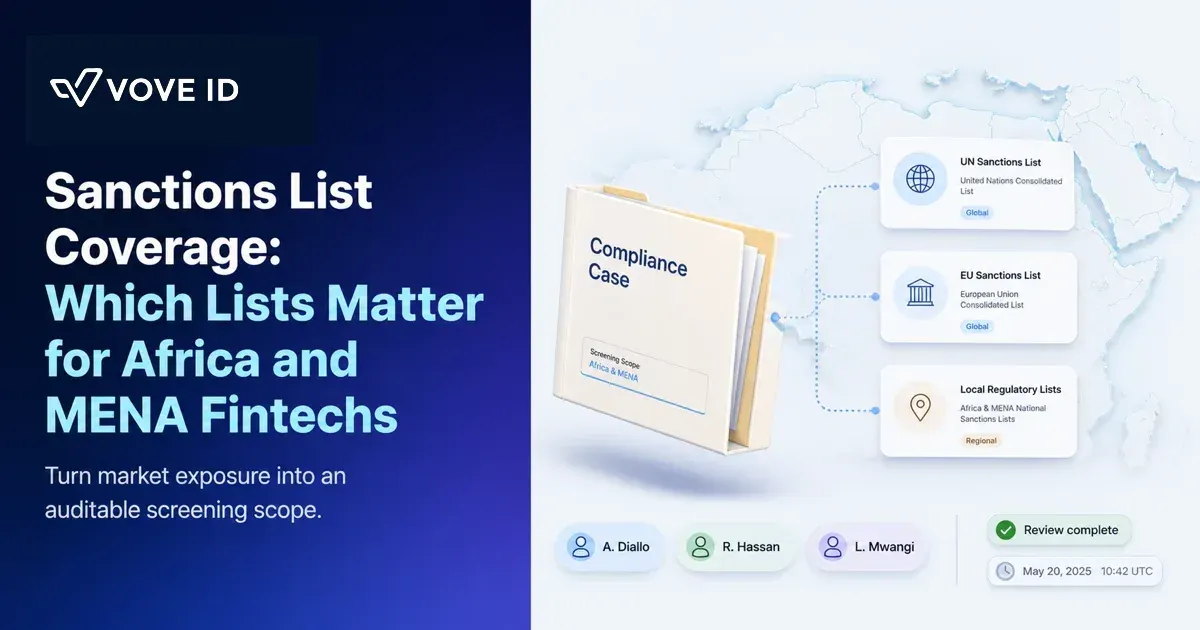
Fintech sanctions coverage is not a universal list bundle. It is a documented decision about the lists a team must screen for its jurisdictions, counterparties, products, and exposure to foreign sanctions regimes.
VOVE ID helps fintech compliance teams screen identity and business information in cross-border operating environments. The difficult part is not finding a list online. It is deciding which authoritative sources govern a particular relationship, keeping them current, and retaining the evidence behind every alert decision.
Sanctions screening turns into a checkbox instead of a control at exactly this point — when "which lists" gets treated as a settled question instead of a documented one.
Direct answer: For many Africa and MENA fintechs, the baseline starts with applicable domestic lists and United Nations measures, then adds the EU, UK, and US lists where a legal obligation, customer relationship, currency corridor, correspondent relationship, ownership link, or risk policy makes them relevant. The correct scope is not determined by geography alone; it needs documented legal and risk ownership.
As of August 11, 2026, this is a general operational guide, not legal advice. List obligations and restrictions change, so teams should confirm scope with qualified counsel and relevant regulators.
The baseline: official lists and their different consequences
The UN Security Council Consolidated List brings together individuals and entities subject to measures imposed under Security Council sanctions regimes. The UN states that member states are obliged to implement the measures applicable to each listed name. That makes UN implementation a starting question for any jurisdiction in scope, not a reason to assume every customer result has the same consequence.
The European Commission's consolidated financial sanctions list reflects EU financial-sanctions designations and is updated when necessary. The UK's UK Sanctions List and the US Treasury's OFAC Sanctions List Service are separate official sources. OFAC distinguishes its SDN List from consolidated non-SDN lists, which can carry different restrictions.
A "global sanctions list" is not an operating rule. Screening coverage must identify the source, the screening population, the applicable restriction, and the team responsible for disposition.
Africa and MENA exposure: map the relationship before the list
An Africa or MENA label does not determine a fintech's sanctions obligations. A platform may have local licensing rules, regional customers, remittance corridors, US-dollar settlement, EU or UK group entities, correspondent-bank requirements, or suppliers in another jurisdiction. Each can affect which lists and controls deserve attention.
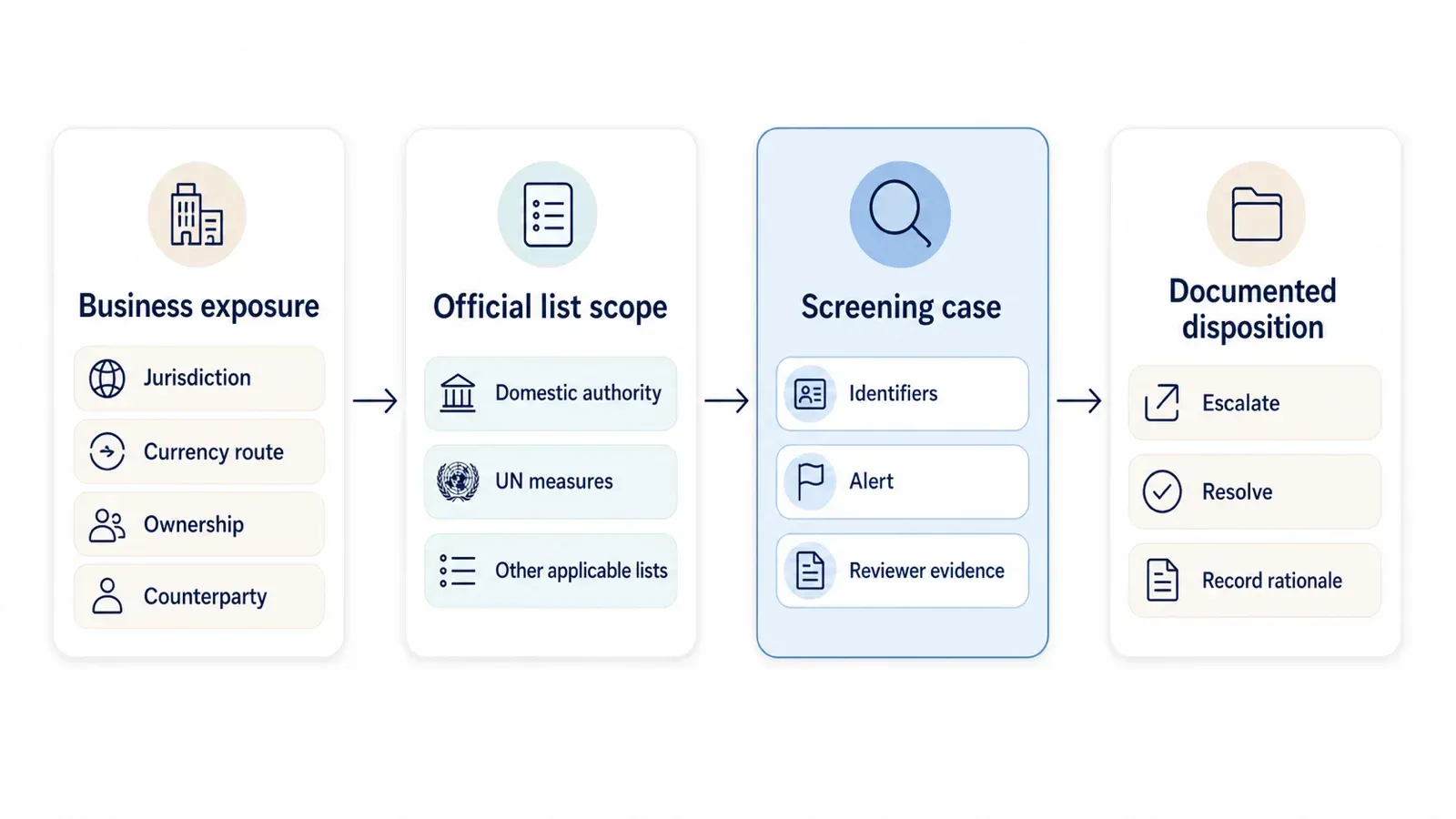
Start by mapping the relationship rather than the country label. Record the entity's place of incorporation, operating markets, ownership and control information, settlement currencies, payment routes, counterparties, and relevant contractual requirements. Then ask legal and compliance owners to define the lists and escalation rules for that exposure.
Local and regional lists matter too. Teams should identify the official sanctions, terrorist-financing, asset-freeze, or designated-person publications issued by each regulator or competent authority that governs their activity. A risk team should not replace that work with a private database name or an assumed regional template.
For the underlying compliance framework, see our AML requirements explained.
Screening mechanics: a name match is a case, not a conclusion
Official lists contain useful identifiers, but their completeness varies. The UN list, for example, includes fields such as aliases, dates of birth, nationality, passport or national-ID details, and addresses where available. A screening result therefore needs a reviewer to compare the alert against the customer or entity record and retain the basis for the decision.
The workflow should capture the source list and version or retrieval time, the attributes compared, the result, the reviewer, and the action taken. A potential match must route to a controlled review path. It should not automatically become a confirmed match, and it should not disappear because a name search scored below an undocumented threshold.
The OFAC service also makes current list data and a search tool available. That is useful operationally, but it does not transfer a fintech's legal analysis or disposition responsibility to a search interface.
A realistic screening failure: the corridor that the list bundle missed
A fintech offers merchant settlement in North Africa and receives a new business customer with a holding company, two beneficial owners, and a planned US-dollar payment corridor. The onboarding team collects:
- Entity registration documents
- Beneficial-owner identity evidence
- Expected payment routes and counterparties
Then the inconsistency appears. The screening configuration covers a local list and a basic international dataset, but the risk assessment never documented the US-dollar corridor or the correspondent requirement. An alert on an owner is treated as an unexplained name similarity because the reviewer cannot see which source list triggered it or what relationship created the relevant exposure.
This is not a search failure. It is a coverage-design failure.
How VOVE ID approaches this: screening inside an evidence-backed case
VOVE ID supports identity verification, biometric liveness, face matching, AML screening, KYB, and transaction monitoring. AML screening coverage is customer-configurable; teams should contact VOVE ID directly for current coverage and update details rather than relying on a published provider list.
For a sanctions workflow, the useful outcome is a case that connects the screened person or business, the available identifiers, the alert, reviewer evidence, and the resulting decision. VOVE ID can support that case workflow, while the fintech remains responsible for its legal scope, list selection, escalation policy, and final action.
Where a compliance team has sufficient evidence, manual review may support an approval decision. That record should state why the alert was resolved, not merely that it was closed.
Practical sanctions-list coverage checklist
Scope
- Map jurisdictions, currencies, payment corridors, ownership links, and contractual screening requirements.
- Document the domestic and international official lists required for each exposure.
- Assign legal and compliance ownership for scope changes.
Screening
- Screen people, businesses, beneficial owners, and relevant counterparties under the documented policy.
- Retain the source, list timestamp, identifiers compared, and disposition for each material alert.
- Route potential matches to reviewers with the information needed to make a reasoned decision.
Monitoring and audit
- Refresh list data and define how newly listed names are re-screened against the relevant population.
- Test exception handling for aliases, incomplete identifiers, and ownership questions.
- Review coverage after entering a new market, corridor, currency, or correspondent arrangement.
FAQ
Do all Africa and MENA fintechs need the same sanctions lists?
No. The required scope depends on applicable domestic law, the fintech's markets and relationships, and any relevant foreign-sanctions exposure or contractual requirement. Document the analysis rather than copying a regional list bundle.
Is the UN Consolidated List enough on its own?
Usually not as an operating assumption. It is a key official source, but teams also need to assess domestic measures and other lists that apply to their business model and exposure.
Does a screening alert prove that a customer is sanctioned?
No. An alert is a case for investigation. Reviewers need to compare available identifiers, understand the source list, and apply the organization's escalation and legal process.
How often should sanctions lists be refreshed?
Use the update approach required by applicable obligations and the team's risk policy. Record the refresh process and make sure changes can trigger re-screening of the relevant population.
Conclusion
Sanctions coverage isn't measured by list count — it's a controlled link between business exposure, authoritative sources, and a documented decision.
Teams need to know why each list is in scope, what a match means, and who can act on it. Collection, screening, and case management are one workflow.
Want to see how VOVE ID can support a sanctions-screening workflow built on documented, defensible scope?
This article is intended for general informational purposes only and does not constitute legal, financial, or regulatory advice. KYC/KYB/AML requirements may vary depending on jurisdiction, industry, and specific business circumstances. For up-to-date and binding compliance obligations, readers should refer to the relevant regulatory authorities or consult qualified professionals.