KYB in 2026 Without a Compliance Team: What "Self-Serve" Actually Means
A startup can run KYB without a compliance team — but someone still has to own the alerts. Here is what self-serve actually means operationally in 2026.
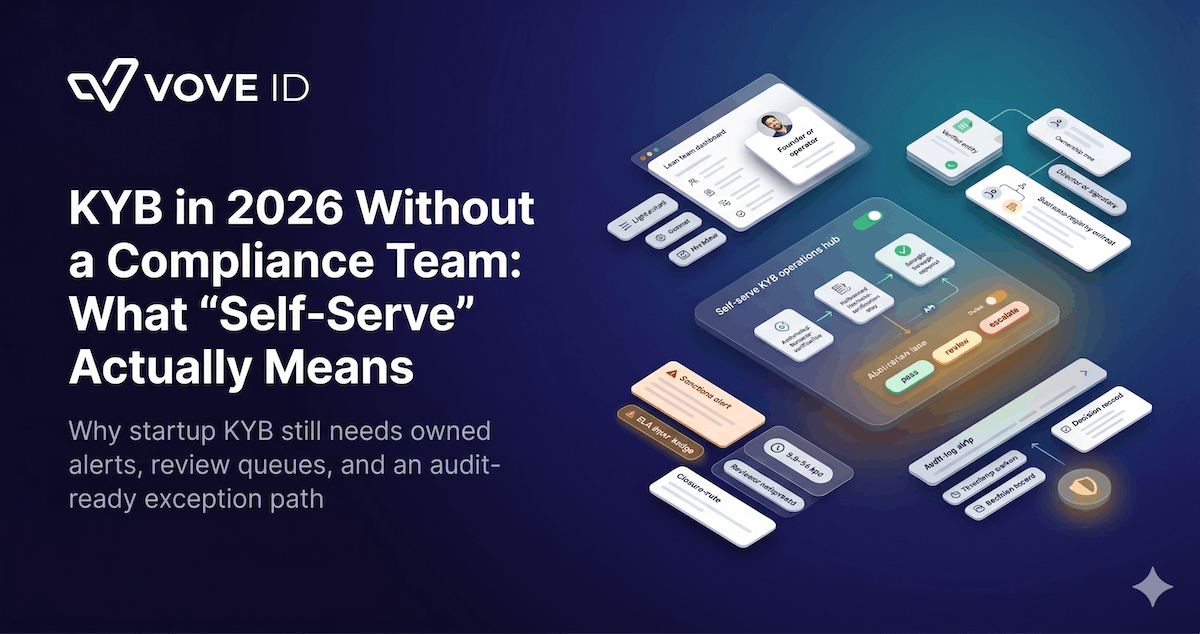
Self-serve KYB does not mean no one is accountable. It means the startup has designed a workflow where structured automation does most of the work and human review appears at the right moments — not at every moment. In 2026, the teams that get this wrong do not usually fail because they lacked software. They fail because no one owned the alerts.
VOVE ID helps fintech startups run KYB without a compliance team in markets where the absence of a CCO does not remove the obligation. This guide covers what self-serve KYB actually requires operationally and where the model breaks. For the underlying KYB framework, see our KYB Requirements Explained 2026.
What does self-serve KYB actually mean for a startup without a compliance team? It means the startup can run most business-verification steps through a structured workflow without hiring a full in-house compliance function, while still making sure edge cases, sanctions hits, ownership anomalies, and unresolved alerts reach a real reviewer within a defined process. Self-serve KYB is real. Unsupervised KYB is not.
On paper self-serve looks complete. In practice the audit asks who reviewed the edge cases. That is the question many startup stacks still cannot answer.
What self-serve KYB really means
Founders often use the phrase in two very different ways.
Sometimes they mean a workflow where the startup can onboard low-risk businesses without hiring a large internal review team. That is reasonable.
Other times they mean a workflow where the tool runs, the cases move, and nobody is clearly responsible for the exceptions. That is where the model breaks.
Self-serve KYB should mean:
- the startup can collect and verify core business information in a structured way
- clean cases can move without heavy manual intervention
- the system records what was checked, what matched, and what remains unresolved
- alerts and edge cases route to a real review path with clear ownership
It should not mean:
- no one reads alerts
- ownership questions stay open indefinitely
- case notes exist only in email or chat threads
- the startup assumes the vendor has "handled compliance" because the portal returned a pass status
The self-serve part belongs to the workflow. The accountability part still belongs to the startup.
Why startups want self-serve KYB in the first place
The reason is straightforward. Early-stage teams do not want a compliance bottleneck before they have product traction. They need to onboard business customers, sellers, merchants, or counterparties without building a large operations layer too early.
For many startups, the right first operating model is not a fully staffed internal compliance function. It is a narrow review lane around a largely automated onboarding path.
The problem appears when teams confuse low-headcount KYB with no-review KYB. That is when the gaps start compounding.
Edge cases a startup cannot afford to ignore
Most KYB cases are not dramatic. They become dangerous because they look almost normal.
The classic startup misses are familiar:
- the entity exists, but the authority of the person acting is unclear
- the ownership structure is incomplete or inconsistent
- a sanctions or screening hit appears, gets deferred, and never closes
- the operating business does not line up cleanly with the legal record
- the file is approved, but no one can later explain why
A startup does not need a large team to handle those cases. It does need a system that distinguishes them from the clean cases and puts them in front of a real decision-maker. Without that, the edge case does not disappear. It sits inside a tool that looks operational from the outside.
The audit question that exposes weak self-serve models
The hardest compliance question is often very short: who looked at this?
If the answer is unclear, the startup usually has a control problem even if the onboarding portal looked modern and automated.
A solid self-serve setup should let the team answer:
- what the system verified automatically
- what the system flagged
- whether the flag was closed, escalated, or overridden
- who made the decision
- when the file should be revisited
If those answers are missing, the startup is not running self-serve KYB. It is running unowned KYB.
A realistic self-serve failure: when no one read the alert
A two-person startup launches a B2B payments product. The founders use a vendor portal for KYB because hiring an internal compliance team is out of scope. The first month feels efficient. Cases are moving. Businesses are activating. The dashboard shows status labels that look reassuring.
Then the gaps appear:
- one sanctions-related alert sits in the queue for 30 days
- several businesses were approved with incomplete ownership data
- one escalated file has no closure note
- no one can say whether the founders, the vendor, or an external reviewer owned the unresolved cases
The startup still believes it is "covered" because the workflow was digital. But the audit trail says otherwise. This is not a tooling failure. It is an operating-model failure.
The difference between automation and unattended compliance
Automation is useful because it keeps clean cases moving. Unattended compliance is dangerous because it assumes a clean pass state equals a clean resolution.
The right model for startups usually looks like this.
Automate the repeatable checks. Entity verification, basic ownership collection, screening, and document gathering should not depend on handcrafted case work when the facts are clear.
Separate clean cases from real exceptions. Not every mismatch deserves a deep investigation. But the ones that do should be visible immediately, not buried in a generic status label.
Assign alert ownership clearly. A startup may use internal founders, part-time compliance help, managed reviewer support, or an outsourced specialist lane. The exact structure can vary. What cannot vary is that unresolved alerts have a named owner.
Preserve one decision trail. The reason a case passed, failed, or escalated should live inside the case file — not in someone's memory or a Slack thread from three months ago. That is what turns low-headcount KYB into a defensible model.
How VOVE ID supports self-serve KYB without leaving alerts unattended
VOVE ID helps startups keep the clean cases self-serve while making the exception lane visible.
Structured onboarding for standard cases. The startup gets a repeatable KYB path that avoids turning every business application into a manual project.
Alert routing with clear queue logic. Screening issues, ownership gaps, and authority mismatches move into a visible review path instead of disappearing inside a generic status label.
SLA-aware case handling. Exceptions should not sit indefinitely because the startup is busy with product work that week.
Reviewer evidence in one place. If a human touches the file, the decision and rationale stay attached to that case for later audit, partner review, or file refresh.
That is the practical meaning of self-serve KYB in 2026. The startup keeps the operating model lean without pretending that alerts close themselves.
Practical KYB checklist
Self-serve
- Automate entity checks and standard collection for low-risk business cases.
- Define which case types can pass without human intervention.
Alerts
- Route sanctions, ownership, and authority alerts into a named review path.
- Set a response SLA for unresolved KYB cases.
Reviewer time
- Record who reviewed the case and why the decision was made.
- Keep exception notes inside the case file, not in external chat or email threads.
Q&A
Can a startup really run KYB without an internal compliance team?
Yes, for many early-stage use cases it can. But it still needs a defined review model for alerts, edge cases, and unresolved ownership or screening questions.
What is the biggest mistake in self-serve KYB?
Assuming the vendor owns the exceptions because the workflow is automated. If no one on the startup side owns the alerts, the control is weak even if the tooling is strong.
Does self-serve mean no manual review?
No. It means manual review is narrower, more structured, and used only where it adds real value. The point is not to eliminate human judgment. It is to stop applying it to every clean case.
What should an audit trail show in a self-serve model?
It should show what the system checked, what it flagged, who reviewed any exceptions, how the case closed, and when the file should be revisited.
Conclusion
Self-serve KYB is not a shortcut around accountability. It is a way to keep business onboarding lean without letting exceptions drift unattended.
Startups can run KYB without a large compliance team when the workflow automates the repeatable work, isolates the real edge cases, and makes ownership of those edge cases unmistakable. Automation, alert handling, and reviewer evidence are one workflow.
Running KYB without a compliance team and not sure who owns the alerts? VOVE ID gives early-stage fintech teams a structured KYB path — clean cases move automatically, exceptions route to a named review lane, and the audit trail stays in one place.
This article is intended for general informational purposes only and does not constitute legal, financial, or regulatory advice. KYC/KYB/AML requirements may vary depending on jurisdiction, industry, and specific business circumstances. For up-to-date and binding compliance obligations, readers should refer to the relevant regulatory authorities or consult qualified professionals.