
Stablecoin Issuers and the AML Authority: What 2026 Looks Like
AMLA's direct supervision starts in 2028. But the evidence standard is already tightening in 2026 — and stablecoin teams that still run fragmented onboarding, monitoring, and travel-rule records will feel it before the authority arrives.
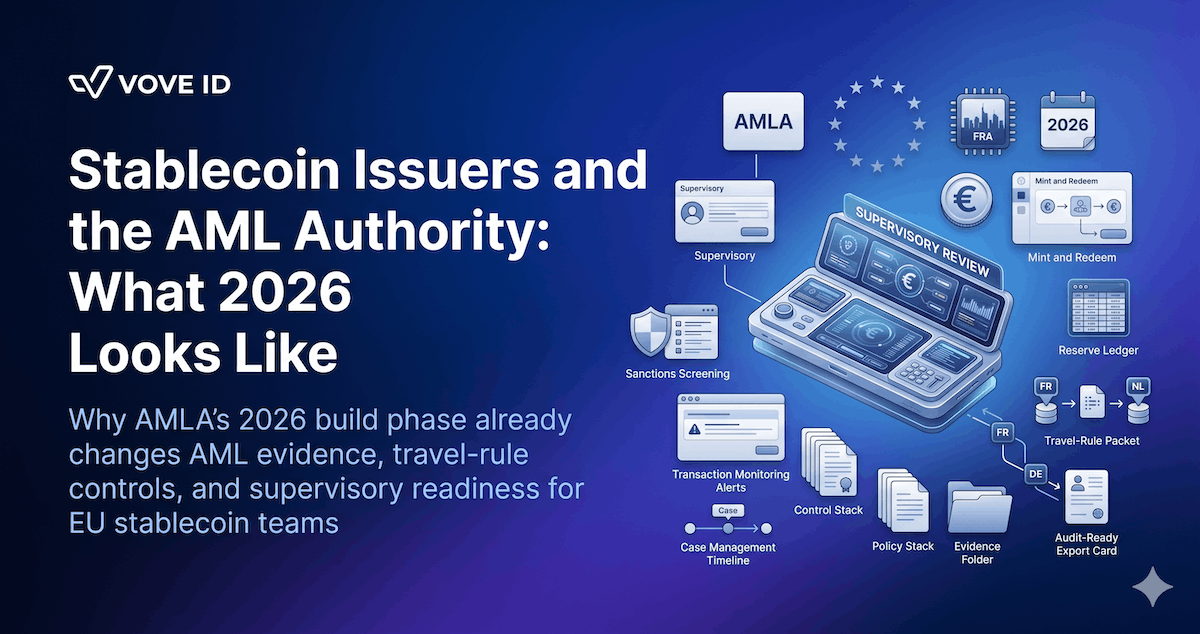
AMLA is already changing the supervision environment for European stablecoin teams in 2026, even though its direct supervision of selected institutions starts in 2028. The operating question now is not whether AMLA exists. It is whether a stablecoin issuer can produce one coherent AML evidence trail across onboarding, monitoring, travel-rule controls, and supervisory reporting.
What does 2026 look like for stablecoin issuers under AMLA? In 2026, AMLA is in build mode, not full direct-supervision mode. The authority is operating from Frankfurt, taking over EU-level AML/CFT coordination work, testing risk models, and preparing the 2027 selection process for direct supervision that starts in 2028. For stablecoin issuers, this means one thing: home-supervisor files, monitoring outputs, travel-rule records, and governance evidence already need to look like they belong to a more harmonised EU system.
VOVE ID helps stablecoin and crypto payments teams run AML operations in markets where the legal framework is now clearer than the operating model. On paper, many issuers assume AMLA is still a future institution and that 2026 remains a home-regulator year.
In practice, 2026 is the year the evidence standard starts tightening.
Timeline: what 2026 actually is
Many teams still talk about AMLA as if it is an announced project.
That is outdated.
The AMLA Regulation was published in the Official Journal on 19 June 2024. AMLA says it was legally established on 26 June 2024, its Chair took office on 16 February 2025, and the authority started operations in summer 2025.
The more important 2026 dates are operational.
AMLA launched its testing and calibration exercise in March 2026. On 17 April 2026, it said the first selection exercise will take place in 2027, with direct supervision starting in 2028. On 12 May 2026, it published the next reporting package for identifying provisionally eligible entities and said national supervisors will collect data by 15 August 2026.
This means one thing: 2026 is the build year for AMLA's supervisory model.
Direct supervision: what AMLA does not do yet
Teams can misread AMLA in two different ways.
The first mistake is assuming AMLA is still too early to matter. The second is assuming AMLA is already directly supervising every cross-border crypto or stablecoin business in Europe. Both are wrong.
AMLA's own explainer says direct supervision starts in 2028. The first selection happens in 2027. AMLA's public materials also say the first cycle will cover up to 40 high-risk financial institutions or groups operating across borders.
So a stablecoin issuer in 2026 should not assume that AMLA will show up as the immediate frontline supervisor tomorrow.
It should assume something narrower and more important: the data model, risk methodology, and cooperation logic are being built now, and those standards will shape what national supervisors ask for before 2028 arrives.
Stablecoin reality: why issuers still feel AMLA now
Stablecoin teams do not operate inside an AML-only box.
They sit at the intersection of MiCA, transfer-information rules, sanctions controls, onboarding, monitoring, and incident reporting. The EU's Regulation (EU) 2023/1113 has applied since 30 December 2024 and already requires payer and payee information to accompany transfers of funds, while extending similar traceability logic to certain crypto-asset transfers.
On paper, that looks like a transfer rule.
In practice, it is a recordkeeping and control-discipline rule. A stablecoin issuer cannot answer a supervisory question about monitoring quality if its originator data, beneficiary data, wallet records, and case notes sit in different systems and reconcile only after an alert.
This is where AMLA matters in 2026.
Even before direct supervision begins, the direction is clear: the EU expects a more comparable, more inspectable AML operating model across borders. Stablecoin teams that still run fragmented tooling will feel that pressure first through home supervisors, counterparties, auditors, and licensing reviews.
Governance: the new weakness is not the policy deck
Most stablecoin issuers already have policy language.
The weak point is whether the policy survives operational questions such as:
- which alerts were generated for a corridor last month
- how sanctions matches were dispositioned
- which travel-rule records were incomplete
- who approved escalations and why
- whether the reserve, redemption, and AML records describe the same customer activity
This is why AMLA should be read as a governance signal in 2026.
The old model allowed teams to separate market-regulation work from AML operations work. The newer EU direction makes that split harder to defend. If a stablecoin product has cross-border activity, the AML record is now part of the product record.
A realistic supervisory failure: when the reserve page is clean and the AML file is not
A euro stablecoin issuer operates from one EU member state and serves customers in six more.
The team has:
- a clean MiCA reserve disclosure page
- onboarding records in one vendor
- sanctions screening in another
- transaction monitoring in an internal tool
- travel-rule handling through a corridor partner
Then a supervisor asks for a narrow file.
Show the onboarding record, travel-rule payload, alert history, sanctions review, and case outcome for one institutional customer that minted, redeemed, and transferred across two jurisdictions in the same quarter.
That is where the inconsistencies appear.
The reserve page is correct. The monitoring alert exists. The travel-rule payload was sent. But the alert ID does not map neatly to the customer case. The sanctions reviewer used a different counterparty record than the one attached to the transfer. The redemption file lives in treasury operations and never made it into the AML case history.
This is not a disclosure failure.
It is an evidence-layer failure.
How VOVE ID approaches this: one evidence surface, not four
VOVE ID helps stablecoin teams build one operational AML layer across onboarding, screening, monitoring, and case handling.
That matters because supervisors do not review products the way teams build them. Teams build in components. Supervisors review in narratives. They ask whether the customer, the transfer, the alert, and the decision all describe the same event.
VOVE ID closes that gap by keeping:
- customer and counterparty identity records tied to monitoring outcomes
- sanctions and watchlist reviews attached to the case trail
- cross-border transfer context visible inside the same workflow
- escalation, notes, and review decisions stored as audit evidence
The result is not only faster review work.
It is a supervisory file that holds together when the question stops being general and becomes specific.
Practical AMLA-readiness checklist
Governance
- Map which legal entity owns each stablecoin activity in the EU.
- Assign clear ownership for onboarding, monitoring, sanctions, and reporting evidence.
- Review whether board reporting reflects operational AML metrics, not only policy status.
Monitoring
- Tie wallet and transfer monitoring to the same customer record used at onboarding.
- Track incomplete or rejected travel-rule data as a control issue, not an ops annoyance.
- Re-screen counterparties and high-risk business users on an ongoing basis.
Records
- Keep one case trail for alert creation, review, escalation, and closure.
- Store the exact transfer payload reviewed by compliance, not a reconstructed version.
- Make sure reserve, redemption, and AML records can be reconciled at customer level.
Supervisory cooperation
- Prepare for 2026 and 2027 data requests through the home supervisor.
- Test whether a single file can answer a corridor-specific supervisory question end to end.
- Remove workflows that rely on exports, screenshots, and inbox searches to explain a case.
FAQ
What does AMLA do in 2026?
In 2026, AMLA is building its EU-level supervisory model, testing risk and selection methods, and preparing the 2027 process that leads to direct supervision starting in 2028.
Is AMLA already directly supervising stablecoin issuers?
No. AMLA's direct supervision of selected financial institutions starts in 2028. But the authority is already shaping the data, governance, and cooperation standards that national supervisors will use before then.
Why does AMLA matter for stablecoin teams before 2028?
Because stablecoin issuers already have to prove that onboarding, transfer data, monitoring, sanctions reviews, and case handling form one coherent AML record. AMLA increases pressure for that record to be comparable and inspectable across borders.
What should a stablecoin issuer fix first?
The first fix is the evidence layer. Teams should connect customer identity, transfer context, alert history, sanctions decisions, and review notes into one file that can survive a corridor-specific supervisory question.
Conclusion
AMLA in 2026 is not a distant institutional story. It is the year the EU's AML operating model becomes more concrete, more comparable, and more difficult to fake with clean summaries.
Stablecoin issuers do not need to wait for 2028 to feel that shift. They need to treat 2026 as the year to unify their evidence layer before supervisors, auditors, or partners ask for a file that crosses onboarding, transfers, and monitoring at once.
AML readiness is no longer a policy question. It is a records question.
Want to see how VOVE ID gives stablecoin teams one audit-ready AML evidence layer across onboarding, screening, and monitoring?