The Hidden Cost of False Positives in Crypto AML Monitoring
False positives in crypto AML are not just inefficiency. They distort risk detection, delay legitimate activity, and overload investigation queues. This guide explains why alert noise happens and how to fix it with better design, context, and prioritization.
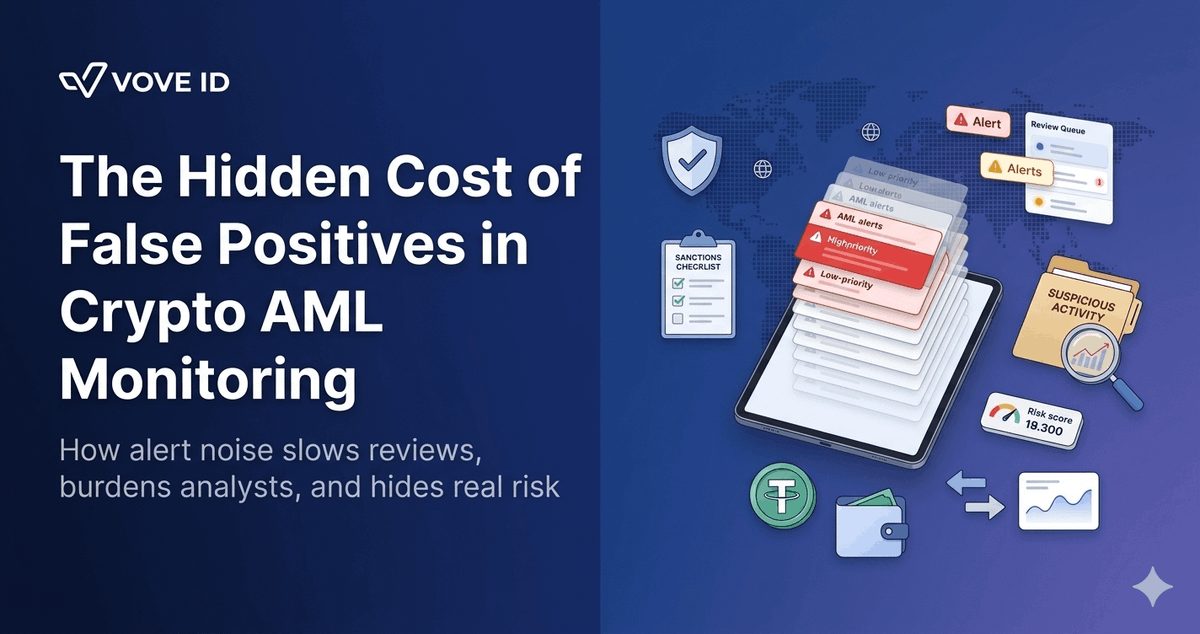
False positives in crypto AML do more than waste analyst time. They slow legitimate payments, bury real risk signals in review queues, and turn compliance teams into manual alert-processing operations instead of risk decision-makers.
Why are false positives so costly in crypto AML monitoring?
Because they create operational drag at every stage of the workflow. Too many low-quality alerts increase investigation backlog, delay customer decisions, weaken escalation discipline, and make it harder for teams to spot the cases that actually deserve scrutiny.
Crypto compliance teams are under pressure from both sides. Transaction volumes keep growing, while regulators still expect monitoring programs to be risk-based, documented, and effective.
That sounds reasonable in theory. In practice, many teams end up with monitoring stacks that generate far too much noise.
The problem is not only that analysts spend time clearing harmless alerts. The deeper issue is that excessive noise changes how the entire AML operation behaves. Reviews get rushed. Queues are triaged by convenience instead of risk. Product teams start seeing compliance as friction. Legitimate customers wait longer. Truly suspicious patterns become easier to miss.
For exchanges, stablecoin platforms, wallets, and cross-border crypto products, false positives are not a minor efficiency issue. They are a control-quality issue.
What a false positive actually is in crypto AML
A false positive is an alert that appears suspicious to the monitoring system but does not represent reportable or escalatable risk after review.
That can happen for ordinary reasons:
- a sanctions name match that clearly does not correspond to the customer
- a velocity rule that captures legitimate high-frequency activity
- a wallet interaction that looks unusual in isolation but fits the expected business model
- a structuring-style scenario applied too broadly
- a threshold that triggers without sufficient customer or transaction context
Crypto products are especially vulnerable because transaction behavior is faster, more fragmented, and more cross-border than in traditional financial systems. If rule design is weak, the system starts treating normal crypto behavior as suspicious simply because it is complex.
Why alert noise gets worse in crypto and stablecoin flows
Crypto AML stacks tend to generate high noise for four recurring reasons.
1. Rules are copied from traditional finance without adaptation
Some firms deploy scenarios designed for bank transfers, card flows, or retail account activity and apply them directly to wallets, stablecoin settlement, treasury activity, or on-chain movement.
That usually fails because the underlying behavior is different. A pattern that looks abnormal in a consumer bank account may be entirely normal for a liquidity desk, a payment orchestrator, or a stablecoin corridor product.
2. Customer context is disconnected from transaction monitoring
Monitoring works best when the system understands what type of customer is behind the activity.
If onboarding risk, jurisdiction, customer type, KYB data, and expected transaction profiles do not feed into the monitoring layer, the engine treats too many cases as generic risk. That inflates alert volumes quickly.
3. Thresholds are tuned for coverage instead of usefulness
A common mistake is setting low thresholds to avoid missing anything. That feels safer, but often produces the opposite outcome.
Once a queue becomes too large, investigators cannot give sufficient attention to the cases that matter. Coverage increases on paper while detection quality declines in practice.
4. Teams treat every alert equally
Not every alert deserves the same workflow. A probable sanctions hit, a sudden shift in counterparty profile, and a minor behavioral anomaly should not all enter the same queue with the same review standard.
When prioritization is missing, teams spend too much time on weak signals and too little on credible ones.
The real cost of false positives
The obvious cost is analyst time. But that is only the first layer.
Investigation backlog
The more low-quality alerts a system generates, the more investigators spend their time closing cases that should not have existed. Backlog becomes normal. Queue age increases. Escalations arrive later than they should.
This weakens the institution’s ability to perform ongoing monitoring in a meaningful way.
Slower customer operations
False positives do not stay within the compliance team. They spill into product and operations.
Payments may pause. Treasury actions may be delayed. Account activity may be held longer than necessary. Legitimate customers experience compliance not as risk management, but as unexplained latency.
That matters in crypto, where users expect near real-time movement.
Missed true positives
This is the most critical effect.
When analysts spend too much time on noise, real risk receives less attention. Even if a true positive enters the queue, it may arrive later, receive a more superficial review, or compete with hundreds of weak alerts for the same capacity.
In other words, poor alert quality increases the likelihood that important cases are treated like routine tasks.
Weaker SAR quality
A noisy system also affects reporting quality. When teams are overloaded, narratives become thinner, evidence is assembled less carefully, and escalation decisions become inconsistent.
This is a hidden cost. The program still appears active: alerts are generated, cases are reviewed, reports are filed. But the quality of judgment deteriorates.
Why “more alerts” is not the same as better AML
This is a common trap.
More alerts do not mean more effective monitoring. Regulators expect a risk-based system that identifies relevant suspicious activity and supports defensible investigation decisions.
An alerting program should help teams focus on behavior that is inconsistent with the customer’s profile, business model, jurisdictional exposure, or known risk factors.
If the system cannot differentiate effectively, it is not more conservative. It is simply less precise.
What better crypto AML monitoring looks like
Reducing false positives does not mean weakening controls. It means designing them properly.
Connect onboarding risk to monitoring
Monitoring decisions should use context collected earlier in the lifecycle:
- customer segment
- geography
- product type
- KYB and beneficial ownership data
- expected transaction behavior
- sanctions and screening history
When the system understands who the customer is and what is expected, alerts become more relevant.
Tune scenarios against actual typologies
Rules should reflect real typologies: mule activity, layering, sanctions exposure, unusual corridor usage, merchant abuse, or high-risk counterparty behavior.
That is very different from deploying generic scenarios and expecting analysts to resolve the mismatch.
Create tiered alert severity
A serious sanctions-adjacent pattern should not compete with a low-confidence velocity alert.
A strong operating model separates:
- immediate escalations
- high-priority analyst review
- standard queue review
- low-confidence alerts requiring additional automation
This protects capacity for high-impact cases.
Close the feedback loop
False positives persist when investigation outcomes are not fed back into tuning.
Every AML function should track:
- which scenarios generate the most noise
- which scenarios lead to meaningful escalations
- average review time by scenario
- queue age by severity
- alert-to-case and case-to-SAR conversion rates
These metrics show whether the system is actually improving.
Metrics crypto teams should watch
If you want to assess whether your monitoring stack is useful, start here:
| Metric | What it shows |
|---|---|
| Alert volume by scenario | Which rules generate the most noise |
| Alert-to-case ratio | How often alerts justify deeper review |
| Case-to-SAR ratio | Whether escalations produce meaningful outcomes |
| Median investigation time | Operational drag created by the queue |
| Queue age by severity | Whether high-risk cases are handled fast enough |
| Reopen rate | Whether initial decisions lack quality |
No single metric is sufficient. Together, they show whether the program is both active and usable.
How VOVE ID helps reduce false positives
VOVE ID helps crypto and fintech teams make AML monitoring more operationally effective by connecting onboarding, screening, and monitoring into a single workflow.
This can include:
- customer and business risk context from KYC and KYB
- sanctions, PEP, and adverse media screening
- transaction monitoring aligned to the actual product model
- configurable thresholds and risk scoring
- alert routing and workflow automation
- audit-ready case management
The goal is not to eliminate human review, but to ensure investigators work with a queue that reflects risk rather than raw system noise.
Practical questions for compliance teams
If your team is dealing with alert overload, ask:
- Which scenarios generate the most alerts today?
- Which of those rarely produce meaningful cases?
- Are alerts prioritized by severity and context, or only by timestamp?
- Does the monitoring engine use onboarding and customer data?
- How long do high-priority alerts wait before review?
- Can the team justify current threshold settings?
If these answers are unclear, the issue is likely in alert design, not just staffing.
Conclusion
False positives in crypto AML monitoring are costly because they distort the entire control environment. They slow legitimate activity, overload investigators, and reduce attention available for genuinely risky cases.
The solution is not fewer controls, but better ones: risk-based rules, stronger context, clearer prioritization, and tighter feedback loops.
That is how crypto teams improve signal quality without sacrificing coverage.
Need a monitoring workflow that reduces alert noise without weakening AML coverage?
FAQ
1. What causes false positives in crypto AML monitoring?
Typically a mix of weak scenario design, missing customer context, overly broad thresholds, and rules that do not reflect actual product behavior.
2. Are false positives just an efficiency problem?
No. They also degrade control quality by creating backlogs, slowing reviews, and obscuring real risk signals.
3. Does reducing false positives lower compliance standards?
No. A properly risk-based system improves precision and strengthens monitoring effectiveness.
4. Which metric should teams track first?
Start with alert volume by scenario and queue age by severity. These usually reveal where noise overwhelms capacity.
Sources
- FATF, Risk-Based Approach Guidance for the Banking Sector
- FinCEN, CDD Final Rule and related guidance on ongoing monitoring
- FinCEN, suspicious activity reporting guidance and enforcement materials