Usage-based KYC pricing: Pay only for actual verifications
Usage-based KYC pricing from VOVE ID: pay only for actual verifications, not fixed monthly fees. Perfect for early-stage fintechs — no platform costs, no overpaying on low volume.
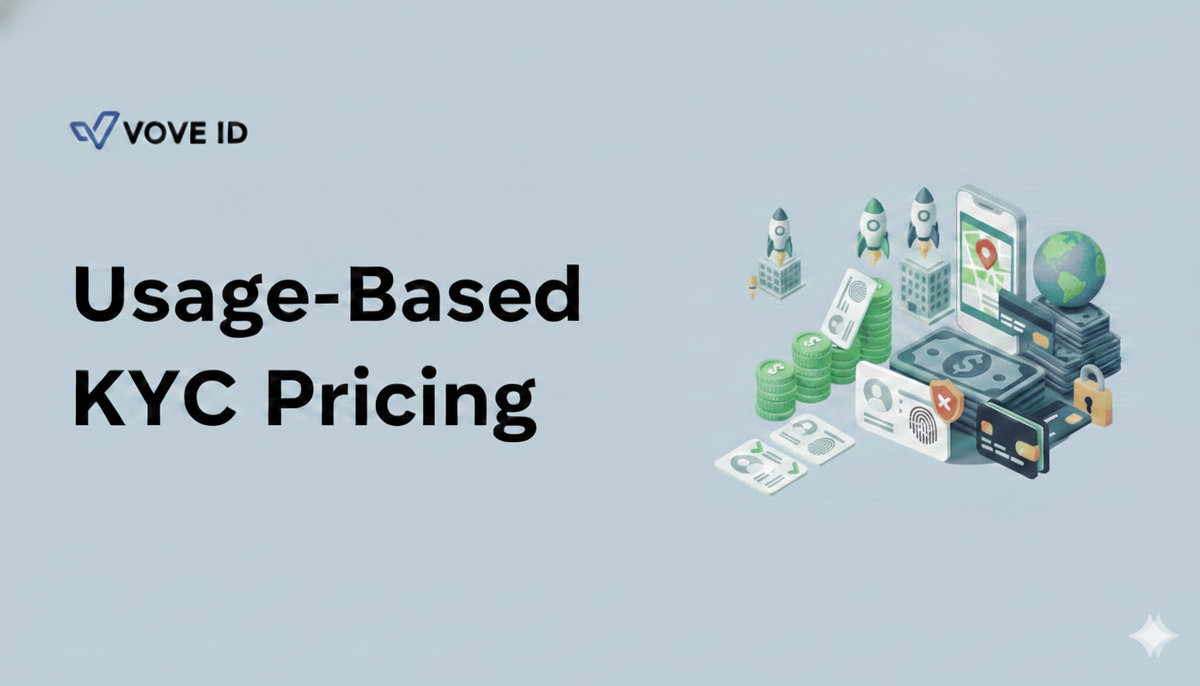
Most KYC vendors charge a flat monthly fee whether your team runs 10 verifications or 10,000. Usage-based KYC pricing means teams pay only when a verification actually happens.
What is usage-based KYC pricing?
Usage-based KYC pricing is a model where fintech teams pay per completed verification instead of paying a fixed monthly platform fee. This lets early-stage teams match compliance spend to actual onboarding volume instead of buying unused capacity.
VOVE ID helps fintech founders evaluate and implement KYC infrastructure without locking into a platform fee before they have real volume. Most teams do not have a stable onboarding curve in the first year. Their growth is usually messy and unpredictable.
On paper, flat-fee pricing looks predictable and safe. In practice, it forces teams to guess future verification volume long before they have enough data to make an accurate forecast. This is exactly where KYC pricing most often breaks down.
KYC pricing models: what teams are really buying
Most KYC vendors sell access, not activity. Teams buy a monthly platform fee, a seat bundle, or a verification tier that assumes a certain level of usage.
That model works when volume is stable and predictable. It does not work when volume moves sharply from one month to the next.
An early-stage fintech can run 80 verifications in one month, 400 in the next, and 2,000 after a product launch or distribution deal. The contract stays fixed while the business changes underneath it.
This means teams stop paying for what actually happened and start paying for an estimate.
Flat-fee pricing: why early-stage fintechs overpay first and scramble later
Flat-fee pricing creates two problems simultaneously. Teams overpay during low-volume months, then run into caps, overages, or contract renegotiation when growth suddenly arrives.
The first problem is waste. If a team buys a 1,000-verification package and only uses 120, they still pay for the full package.
The second problem is timing. When onboarding spikes, the pricing model becomes an operational bottleneck instead of a tool that supports growth.
This is not just a procurement detail. It directly affects how quickly compliance can support product and business growth without reopening the vendor conversation.
A realistic pricing failure: what this looks like in practice
A payments startup signs with a KYC vendor three months before launch. The contract includes a flat monthly fee built around 1,000 verifications.
Month one:
- 140 verifications completed
- One product line live
- Most of the package unused
Month three:
- 1,900 verifications completed
- A new partner channel goes live
- Operations volume doubles in just two weeks
Then the pricing problem appears. The team already overpaid in the low-volume months. Now they hit the top of the contracted tier and get pushed into expensive overage pricing or a mid-cycle renegotiation.
Compliance didn’t fail. Onboarding didn’t fail. The pricing model failed first.
Pay-per-verification: how usage-based KYC pricing actually works
Usage-based pricing removes the fixed platform charge and bills only for completed verification activity. If a team runs 50 verifications, it pays for 50. If it runs 5,000, it pays for 5,000.
Costs move with growth instead of fighting against it.
VOVE ID uses this model because most fintech teams do not need a pricing structure designed for mature enterprise volume on day one. They need a model that holds up when usage is uneven, launch timing shifts, and new markets open faster than expected.
There are no seat fees. There is no monthly platform cost. Teams pay when verification work actually happens.
Pricing comparison: flat fee vs usage-based at different volumes
| Monthly verifications | Flat-fee package | Usage-based (VOVE ID) |
|---|---|---|
| 100 | $300 | $30 |
| 500 | $300 | $150 |
| 1,000 | $300 | $300 |
| 2,500 | $450 | $750 |
| 5,000 | $600 | $1,500 |
At lower volumes, usage-based pricing avoids wasted spend. At higher volumes, costs rise because actual activity rises. That is the point — compliance spend should track real onboarding and revenue, not a bundle negotiated for a different month.
How VOVE ID approaches pricing: activity, not access
VOVE ID prices KYC the same way many fintech teams think about infrastructure costs. The charge follows usage.
This gives teams a much cleaner way to plan. Product, compliance, and finance can all look at the same operating number: completed verifications.
It also reduces vendor risk. Teams don’t need to delay integration because the contract assumes enterprise volume too early. They can start with live onboarding, see what real demand looks like, and scale from there.
This matters most for founders who are still testing channel fit, country expansion, or customer acquisition motion. Their KYC vendor should not be the least flexible part of the stack.
Practical KYC pricing checklist
Evaluation
- Ask whether pricing is based on platform access or completed verifications.
- Model verification volume for months 1, 3, and 12 before signing.
- Check where overage charges begin and how they are calculated.
Finance
- Compare contract spend against realistic low-volume months, not only optimistic target months.
- Forecast verification cost as a variable operating expense, not a fixed SaaS line item.
- Review whether sandbox or test traffic is billed.
Operations
- Confirm how quickly pricing adapts if volume doubles after a launch.
- Verify whether new markets or document types change the unit cost.
- Make sure compliance teams can see verification counts in real time.
Conclusion
KYC pricing is not just a vendor packaging question. It is a volume-matching question.
Flat-fee pricing works when onboarding is stable and predictable. Early-stage fintech growth is rarely either of those things.
Teams need a pricing model that scales with actual verification activity and stays aligned when volume changes quickly. Pay-per-verification does that by tying spend to real work, not reserved capacity.
Want to see how VOVE ID handles KYC without platform fees or seat-based pricing?