
MiCA KYC Compliance: What EU Fintechs Must Have Before July 2026
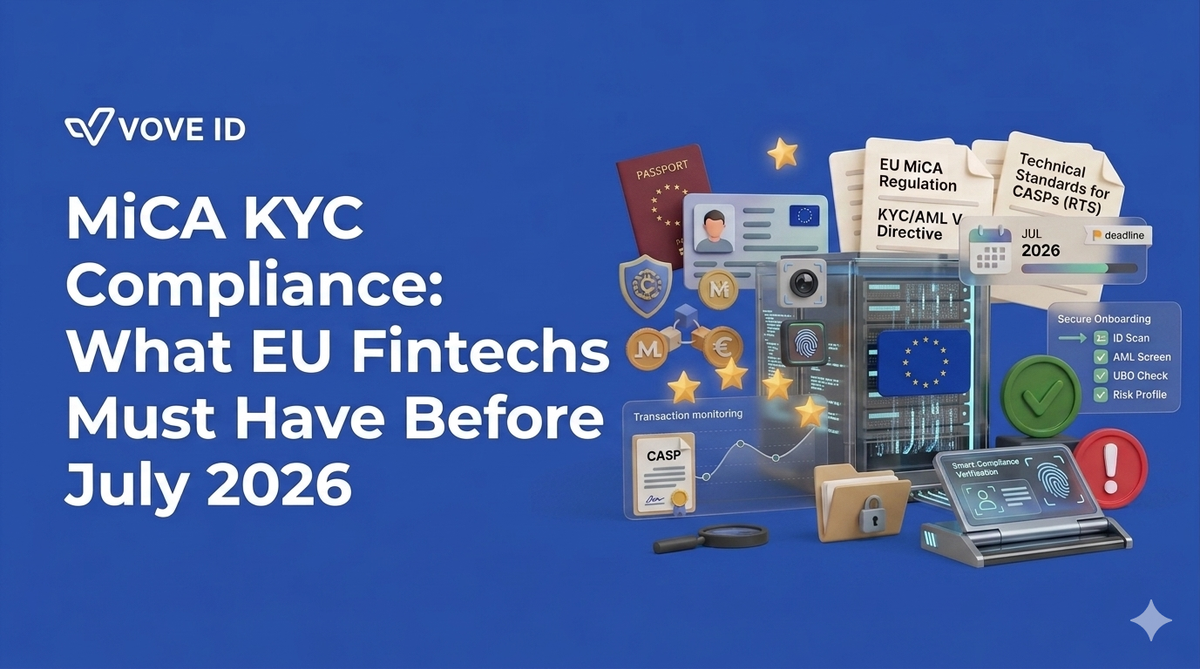
If your crypto or fintech product serves EU users, the right question is not whether MiCA starts in July 2026. It does not. The right question is whether your onboarding, screening, monitoring, governance, and evidence trail will hold up before transitional relief ends in the markets where you operate.
What KYC does MiCA require and when?
MiCA does not create a standalone KYC checklist that begins in July 2026. The core MiCA regime already applies, while many pre-existing crypto firms can only rely on transitional relief until 1 July 2026 at the latest, or earlier if their Member State shortens the period. In practice, EU fintechs and CASPs need customer identification, sanctions and PEP screening, risk-based due diligence, transaction monitoring, Travel Rule handling where applicable, and a documented control framework now.
Many teams still talk about MiCA as if the real deadline sits in mid-2026. That is too loose.
Two dates matter more:
- 30 June 2024: MiCA rules for asset-referenced tokens (ARTs) and e-money tokens (EMTs) started to apply.
- 30 December 2024: the broader MiCA framework started to apply for crypto-asset service providers (CASPs).
What sits in July 2026 is not the start of MiCA. It is the outside edge of the transitional window in parts of the EU for firms that were already operating legally before 30 December 2024.
That distinction matters because founders often delay the hard part: turning policy language into an operational KYC and AML workflow that regulators can actually inspect.
Why July 2026 still matters
MiCA created a harmonised EU framework, but it did not force every Member State to use the same transitional runway. ESMA has already warned that national approaches differ because Member States can shorten the transition or not apply it at all.
So the practical question is simple:
If your firm, exchange, broker, wallet product, token platform, or embedded crypto service is still leaning on transitional treatment, will your control stack be ready before that window closes in the jurisdiction that supervises you?
For most teams, that means having more than a vendor contract. It means having a working onboarding and monitoring system in production.
What MiCA changes operationally
MiCA is often described as a licensing or disclosure framework. That is true, but it is incomplete.
For operating teams, MiCA changes the standard of evidence. A CASP has to show that it can run an orderly business with proper governance, client protection, complaint handling, outsourcing controls, and supervisory cooperation. That does not replace AML/CFT obligations. It makes weak AML operations harder to defend.
In practice, that means your KYC flow needs to connect with:
- authorisation and governance requirements
- AML/CFT obligations already applying to CASPs under the EU framework
- Transfer of Funds / Travel Rule obligations for crypto transfers
- audit trails that can survive regulator review
This is where many firms discover that "we have identity verification" is not the same as "we have a defendable compliance workflow."
The MiCA-ready KYC stack EU fintechs should have now
Customer identification at onboarding
Before a customer can trade, hold, transfer, invest, or access crypto-linked financial services, the platform needs to establish who that customer is.
That usually means:
- collecting core identity information
- verifying a government-issued document
- confirming liveness or equivalent anti-impersonation controls
- checking whether the customer is an individual or a legal entity
- storing the evidence in a retrievable format
For legal entities, the requirement quickly expands into KYB: registry checks, director data, beneficial ownership, and sanctions screening on relevant controllers.
Sanctions, PEP, and adverse media screening
A MiCA-era onboarding flow cannot stop at document verification.
Crypto businesses operating in the EU still need risk controls that screen customers and businesses against sanctions lists, politically exposed person exposure, and other risk indicators. The point is not to create a false-positive factory. The point is to show that high-risk relationships are identified and escalated before activity begins.
Risk-based due diligence
Not every customer should move through the same path.
A low-risk EU resident using a retail product is different from:
- a customer with cross-border exposure into higher-risk jurisdictions
- a legal entity with layered ownership
- a high-value trader
- a wallet flow with unusual counterparties
- a politically exposed person or sanctions-adjacent match
Your workflow should support:
- baseline onboarding for standard users
- enhanced review triggers
- step-up collection for higher-risk cases
- clear decision logging for approvals, rejects, and escalations
Transaction monitoring after onboarding
This is where teams underinvest.
MiCA readiness is not just about who you onboard. It is also about what happens after they are live. A crypto or fintech platform should be able to detect unusual flow patterns, wallet behavior, structuring, sanctions-adjacent transfers, velocity spikes, or transaction activity inconsistent with the customer profile.
Without monitoring, onboarding controls decay quickly.
Travel Rule and transfer data handling
From 30 December 2024, the recast EU Transfer of Funds regime for crypto-assets applies alongside MiCA-era operations. If your product handles in-scope crypto transfers, originator and beneficiary information handling is no longer optional operational detail. It is part of the compliance baseline.
That means a MiCA-ready stack often needs:
- wallet and transfer risk checks
- originator and beneficiary data capture
- routing of transfer data to counterparties where required
- exception handling for missing or suspicious information
Ongoing review and evidence retention
The regulator does not review your controls at the moment you wrote the policy. It reviews what you actually did.
Your team should be able to show:
- what information was collected
- what checks ran
- what alerts were triggered
- who reviewed the case
- what decision was made
- when re-screening or re-verification occurred
If that evidence sits across disconnected tools and analyst inboxes, the control framework is weaker than it looks.
A practical MiCA compliance timeline
As of 15 April 2026, the working timeline looks like this:
| Date | What it means |
|---|---|
| 30 June 2024 | MiCA rules for asset-referenced tokens and e-money tokens started applying |
| 30 December 2024 | Most of MiCA started applying, including the main CASP framework |
| Up to 1 July 2026 | Transitional regime may let some pre-existing CASPs continue temporarily, depending on Member State |
| Before your local transition ends | Your authorisation path, KYC workflow, AML controls, and operational evidence need to be ready |
The key point is that July 2026 is not the start line. It is a hard backstop for some firms and not even available in every Member State.
What a MiCA-ready onboarding flow should look like
Below is the workflow most teams should expect to defend:
| Stage | Control | Why it matters |
|---|---|---|
| Account creation | Identity capture and consent | Establishes the customer relationship |
| Verification | Document check, liveness, fraud signals | Confirms the person behind the account |
| Risk screening | Sanctions, PEP, adverse media, geography | Flags higher-risk relationships early |
| Entity onboarding | Company registry, UBO, director verification | Supports KYB for business customers |
| Activation decision | Risk-based approval or escalation | Creates a documented decision trail |
| Live activity | Transaction and wallet monitoring | Detects risk after onboarding |
| Transfer handling | Travel Rule and counterparty data checks | Supports in-scope crypto transfers |
| Ongoing review | Re-screening, refresh, alert handling | Keeps the customer file current |
This is the difference between a compliant-looking signup form and a real operating model.
Where firms usually fail before MiCA deadlines
The most common failure points are operational, not theoretical:
- identity verification is live, but sanctions and PEP screening are manual
- KYB exists on paper, but UBO checks are inconsistent
- transaction monitoring is weak or delayed
- Travel Rule handling is bolted on after launch
- reviews happen in Slack or email with poor evidence retention
- no one can explain how high-risk customers are escalated
- the team assumes a Member State gives the full transition when it may not
These are exactly the kinds of gaps that become visible when authorisation or supervisory review gets serious.
How VOVE ID helps EU fintechs close the gap
VOVE ID helps fintech and crypto teams connect onboarding, screening, and monitoring into one workflow that is easier to defend.
That includes:
- identity verification and liveness checks
- sanctions, PEP, and adverse media screening
- KYB and UBO verification for business customers
- transaction monitoring and alerting
- audit-friendly evidence trails
For teams trying to get MiCA-ready before local transition windows close, the value is not only automation. It is operational clarity. The compliance stack becomes something the business can run, not just something legal drafted.
Practical checklist before July 2026
Before relying on any remaining transitional runway, confirm these points:
- Which Member State supervises the activity, and what transition period actually applies there?
- Does the onboarding flow verify both individuals and legal entities where needed?
- Are sanctions, PEP, and adverse media checks automated and recorded?
- What triggers enhanced due diligence?
- How are crypto transfers and Travel Rule requirements handled?
- What monitoring runs after onboarding?
- Where are analyst decisions and supporting evidence stored?
- Can the team produce a clean audit trail for a sample customer or business account?
If any of those answers are fuzzy, the problem is probably operational rather than legal.
Conclusion
MiCA compliance is not waiting for July 2026 to begin. It is already here.
What July 2026 represents is the end of the road for firms still relying on transitional treatment in the Member States that allow it. The teams that will be ready are the ones that already treat KYC, KYB, screening, monitoring, and evidence retention as core product infrastructure.
That is the standard EU fintechs should be building to now.
Need a MiCA-ready KYC, KYB, and AML workflow before transitional relief runs out?
FAQ
Does MiCA itself create a brand-new KYC rulebook?
Not as a standalone checklist. MiCA sets the crypto regulatory framework, while KYC and AML/CFT obligations still need to be met through the wider EU compliance regime and the firm's operating model.
Is 1 July 2026 the date MiCA starts?
No. The main MiCA framework has applied since 30 December 2024. 1 July 2026 is the latest end date for a transitional regime that some Member States may allow for certain pre-existing CASPs.
Do all Member States give firms until July 2026?
No. MiCA lets Member States shorten the transition or choose not to apply it. Firms need to confirm the local position with the relevant competent authority.
What controls should a MiCA-ready fintech prioritise first?
Customer identification, sanctions and PEP screening, risk-based due diligence, transaction monitoring, Travel Rule handling where applicable, and a clear evidence trail.
Does MiCA matter only for crypto exchanges?
No. It matters across the range of in-scope crypto-asset services and products. Any fintech touching regulated crypto services in the EU should assess whether MiCA authorisation and related compliance controls apply.
Sources
- European Commission - Markets in Crypto-Assets Regulation (MiCA)
- ESMA - Statement on MiCA Transitional Measures, 17 December 2024 (and later updates)
- EBA - Explainer on preventing money laundering and terrorist financing in the EU crypto-assets sector
- Regulation (EU) 2023/1113 on information accompanying transfers of funds and certain crypto-assets