KYC Verification: How to Implement KYC for a Digital Lending App
A practical guide to building KYC for digital lending apps as a full lifecycle workflow across onboarding, approval, disbursement, repeat borrowing, and ongoing AML monitoring.
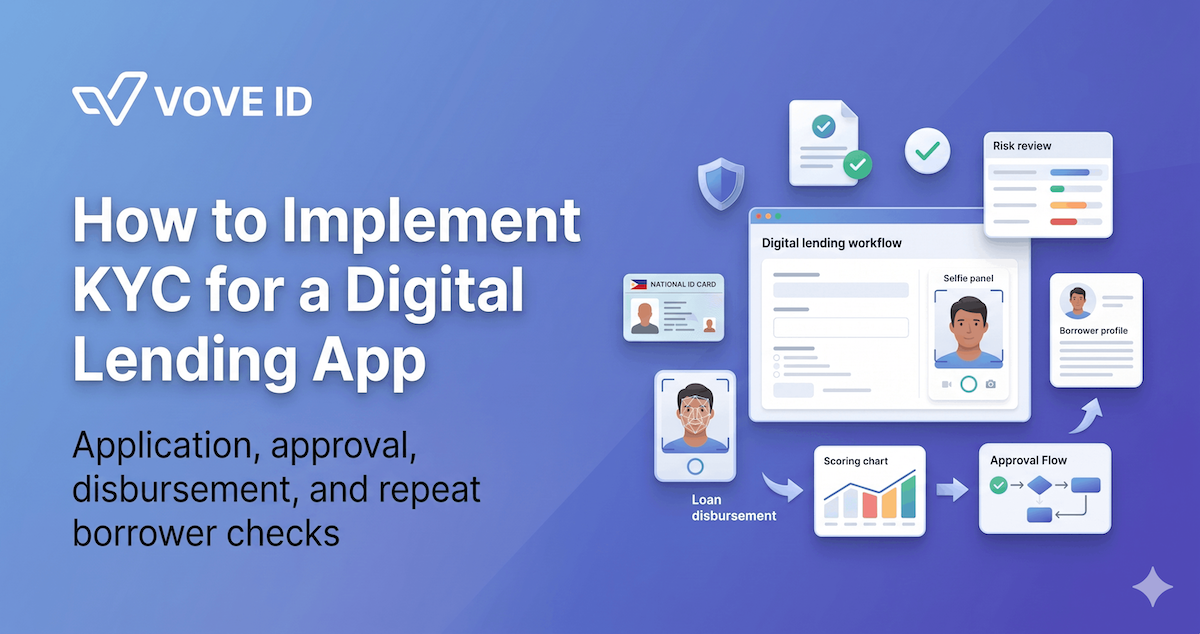
The right KYC flow for a digital lending app is not a single API call at signup. It is a lending-specific workflow that verifies identity before approval, reuses data carefully for repeat borrowers, escalates edge cases before disbursement, and feeds risk signals into AML monitoring after the loan goes live. Platforms like VOVE ID help lending teams operationalize these steps into a consistent workflow, but the underlying design must follow the full lending lifecycle.
How do you implement KYC for a digital lending app?
Start by mapping every lending event that creates compliance risk: application, approval, disbursement, top-up, and repeat borrowing. Then build a flow that captures identity data, verifies documents and liveness, checks sanctions and PEP exposure, applies risk scoring, routes failed cases into review, and keeps monitoring active after origination.
Digital lending teams usually think about KYC too narrowly.
They focus on account creation, maybe add a selfie check, and move on to underwriting. But lending products create risk at multiple points: when the user applies, when credit is approved, when funds are disbursed, when the borrower returns, and when suspicious behavior starts showing up in repayment or account activity.
That is why a lending app needs a KYC system designed for the lending lifecycle, not just a generic onboarding form.
For broader context on identity frameworks across markets, see the KYB compliance guide.
Step 1: Map the KYC events in your lending flow
Before picking any vendor or endpoint, define where identity and AML controls need to fire.
For a typical digital lending app, the core events are:
- Application: first capture of customer identity and onboarding data
- Approval: final decision point before credit is granted
- Disbursement: control point before money leaves the platform
- Top-up or limit increase: re-assessment when exposure grows
- Repeat borrowing: refresh or re-verification for returning users
This matters because many teams only run KYC at signup, even though the real regulatory and fraud risk often sits at disbursement or credit expansion.
If your flow treats all five moments as the same event, you will either over-friction good users or under-control high-risk ones.
Step 2: Define the identity data you need
A lending app should collect enough data to answer three questions:
- Who is this borrower?
- Can we verify that independently?
- Does the expected borrowing behavior fit the profile?
That usually means collecting:
- legal name
- date of birth
- phone and email
- residential address or location evidence where required
- official ID data
- jurisdiction-specific identifiers where relevant, such as BVN or NIN in Nigeria
For business lending or merchant cash advance products, the scope expands into KYB: company registration, directors, beneficial owners, and authorized representatives.
A better approach is to define:
- minimum data needed to start the application
- additional data required before approval
- extra evidence needed for higher-risk cases
Step 3: Build the verification sequence
A good lending KYC flow usually follows this order:
- identity data capture
- document verification
- liveness or anti-spoofing check
- database or identifier validation
- sanctions and PEP screening
- fraud and risk scoring
- approval, rejection, or manual review
The sequence matters because the output of one step should shape the next.
Step 4: Design for failed KYC before it happens
You need explicit rules for:
- unreadable documents
- selfie mismatch
- low-confidence liveness
- duplicate identity attempts
- database mismatch on key fields
- sanctions or PEP hits
- repeated application attempts
Each outcome should map to an action:
- retry automatically
- request another document
- escalate to manual review
- reject the application
- freeze the case until more evidence is collected
Step 5: Connect KYC to the credit decision
KYC results must feed the credit and fraud decision layer.
A lending decision usually combines:
- identity confidence
- fraud risk signals
- sanctions and PEP outcome
- device and session signals
- document integrity
- affordability or underwriting data
KYC alone does not determine approval — it conditions the risk input into underwriting.
Step 6: Treat disbursement as a separate control point
Before funds are released, confirm:
- the approved identity still matches the payout destination
- no new AML or sanctions alerts appeared after approval
- disbursement details have not changed unexpectedly
- the transaction fits expected borrower behavior
Disbursement is often the most under-controlled step in lending systems.
Step 7: Handle returning borrowers correctly
Repeat borrowers should be treated as partially trusted, not fully exempt.
A proper model includes:
- reuse of previously verified identity data
- periodic re-screening for sanctions and PEP exposure
- step-up verification for material changes
- refresh triggers based on time, risk, or behavior changes
Step 8: Add AML monitoring after origination
Post-origination monitoring should cover:
- repayment anomalies
- duplicate or structured repayments
- linked-account behavior
- unusual disbursement or repayment patterns
- third-party payment signals
AML does not end at approval — it shifts into behavioral monitoring.
Step 9: Keep audit-ready logs
You should be able to reconstruct:
- what data was collected
- what checks ran
- what results were returned
- how the decision was made
- who reviewed exceptions
- when re-screening occurred
Without this, the system is not defensible in audits or partner reviews.
What a working lending KYC architecture looks like
| Stage | What happens | Why it matters |
|---|---|---|
| Application start | Collect identity data | Establish borrower profile |
| Verification | Document + liveness checks | Confirm identity validity |
| Screening | Sanctions, PEP, fraud checks | Identify risk early |
| Decisioning | Combine KYC + credit rules | Prevent weak approvals |
| Disbursement control | Re-check payout integrity | Reduce fraud exposure |
| Post-loan monitoring | Track repayment behavior | Detect emerging risk |
| Repeat borrowing | Refresh verification | Prevent stale identity risk |
How VOVE ID helps digital lending teams
VOVE ID helps lending platforms connect identity verification, liveness checks, AML screening, and ongoing monitoring into a single operational workflow.
That includes:
- onboarding and document verification
- biometric and liveness validation
- sanctions, PEP, and adverse media screening
- risk scoring and decision routing
- manual review workflows
- repeat borrower re-verification
- ongoing monitoring and case tracking
Practical checklist before you ship
- At which events do KYC checks run?
- What data is required at each stage?
- What triggers manual review?
- How are failed verifications handled?
- How is disbursement linked to verified identity?
- When do returning users require re-checks?
- What post-loan behaviors trigger AML review?
- Can every decision be reconstructed later?
Conclusion
Implementing KYC for a digital lending app is about designing a full lifecycle control system across application, approval, disbursement, repeat borrowing, and ongoing monitoring.
The teams that get this right reduce fraud and improve approval speed without weakening risk controls.
If you're building or scaling a digital lending product and need to align KYC, AML, and disbursement controls into a single workflow, explore how VOVE ID structures identity and risk decisions across the full lending lifecycle.
What KYC verification means in digital lending
KYC means "Know Your Customer." In a lending product, KYC verification is the process of collecting customer information, checking it against reliable identity evidence, screening for relevant financial-crime risk, and recording the decision before credit is released.
Identity verification is one part of that process. It establishes whether the applicant is who they claim to be through data, document, database, and biometric checks. A complete KYC process also covers sanctions and PEP screening, risk-based escalation, record keeping, and later refreshes when the borrower or relationship changes.
A passed identity check should support the lending decision, but it should not replace the wider customer-risk controls around approval, disbursement, and ongoing monitoring.
What does KYC mean?
KYC means "Know Your Customer." It is the process a regulated or risk-sensitive business uses to identify a customer, verify the customer’s identity, assess relevant risk, and retain evidence of the decision.