VOVE ID vs Trulioo for Cross-Border KYC: A Buyer’s Evaluation Framework
Coverage is a starting point, not proof a cross-border KYC flow works. Here's how to actually test a provider before you launch.

Cross-border KYC is not a coverage claim. It is a controlled decision made from the documents, signals, policy, and review process that a team can prove in its launch markets.
VOVE ID helps fintech and regulated-platform teams verify people across varied document types and markets. The difficult part is not collecting a passport image. It is proving that the document, decision rule, exception path, and audit record work together in the markets a team is opening.
Trulioo's public developer materials describe a GlobalGateway workflow with identity-verification requests, document-image capture, and configurable verification rules. That makes it a legitimate option to assess. A buyer should still validate the exact market, data source, document, and configuration that its own policy requires.
This is exactly where cross-border onboarding loses control.
Cross-border KYC: coverage is only the starting point
An international launch turns one generic identity question into many operating questions. Which document types are acceptable in each market? Which fields must match? When does a result enter manual review? What does the product show while that review is open?
On paper, provider coverage answers the first question. In practice, it does not answer the rest. A team needs evidence from its own document pack, its own risk policy, and its own customer journey.
Trulioo's documentation describes country-specific configurations and verification responses that include a configured rule and underlying match signals. That is useful buyer evidence because it points teams toward the rule design they must inspect. It is not proof that every intended onboarding decision is suitable for every product, jurisdiction, or customer segment.
For the underlying framework, see our KYC requirements explained.
The buyer's test: evaluate the operating evidence
A comparison should not turn a vendor brochure into a scorecard. It should turn a launch plan into a test plan.
Start with exact documents and capture conditions. Then test the policy that decides whether an outcome passes, requests more evidence, or moves to a reviewer. Finally, make sure the product, operations team, and audit process receive the same decision state.
| Evaluation area | Evidence to request in a pilot | Decision the team needs to make |
|---|---|---|
| Market and document fit | Results for the actual passports, IDs, residence documents, and scripts in scope | Which evidence is accepted by policy? |
| Verification logic | Configured rule, result fields, and exception handling for the launch flow | What is automated, and what needs review? |
| Customer journey | Test completion, pending, and further-evidence states in the application | What does a customer see at each state? |
| Review operations | A completed reviewer disposition with its supporting evidence | Who owns the exception and escalation? |
| Audit record | A retrievable case record tied to the final decision | Can the team explain the decision later? |
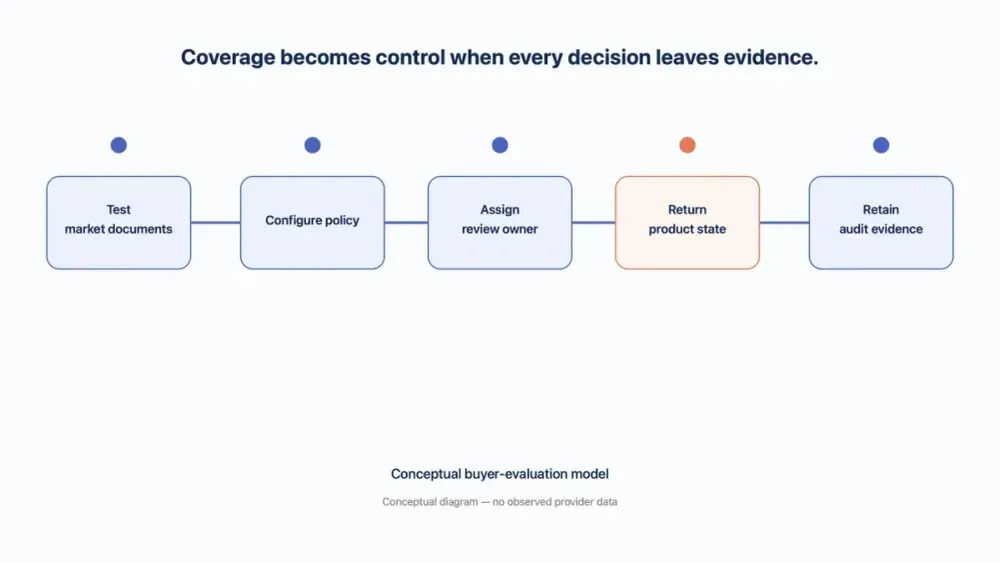
Cross-border coverage becomes operational control only when a team can test each decision and its record.
The framework is deliberately vendor-neutral. It asks a team to prove its intended workflow rather than assume a provider's public product description settles the policy question.
A realistic scenario: the marketplace adding two payout corridors
A marketplace opens onboarding for sellers in two new payout corridors. Product wants one sign-up journey. Compliance needs different evidence depending on the seller's market and risk profile.
The team receives:
- A passport from a seller living outside the payout market
- A national ID with a local script
- A low-light document image from a mobile device
- A result that needs supporting evidence before approval
- A reviewer decision that must reach the product team
Then the inconsistencies appear.
The first question is not whether a provider's website lists the market. The question is whether the submitted document works in the team's configured flow, whether the decision rule fits the policy, and whether a reviewer can close an exception with a clear rationale.
This is not a coverage failure. It is an operating-evidence failure.
How VOVE ID fits: connect checks to a reviewable decision
VOVE ID covers identity verification, biometric liveness detection, face matching, sanctions screening, KYB workflows, and audit-ready logging in one operating flow, with document verification across 190+ countries (exact figure to confirm with the team).
That is a starting point for a pilot, not a substitute for one. Teams should test their exact launch documents, languages, capture conditions, policy thresholds, and review paths before making a coverage or compliance decision.
VOVE ID supports Arabic-language and Portuguese-language OCR. For a launch involving those document languages, the practical question remains the same: can the team collect sufficient evidence, apply its policy, and retain the decision record when an exception appears?
Practical cross-border KYC checklist
Documents and policy
- Build a test pack from each launch market's expected identity evidence.
- Define acceptable alternatives before the first customer reaches an exception.
- Map each evidence request to a documented risk reason.
Integration and product
- Test completed, pending, failed, and further-review states in the product flow.
- Confirm which result fields the application and reviewer workflow consume.
- Keep customer messages separate from the internal decision rationale.
Review and audit
- Assign ownership for inconclusive results and escalations.
- Record the evidence and rationale behind every manual disposition.
- Rehearse retrieval of a closed case before production launch.
FAQ
Does global coverage prove a cross-border KYC flow will work?
No. Coverage is a useful starting point, but a team still needs to test the exact documents, decision rules, and exceptions that its launch policy uses.
What should a Trulioo evaluation include?
Use the provider's public documentation to identify available integration and rule concepts, then require a pilot that demonstrates the team's own markets, documents, and review process.
When is VOVE ID a relevant option?
It's worth piloting when a team's launch markets need multi-language document support, sanctions screening, and an audit trail that a reviewer can retrieve after the case closes — not just broad geographic coverage on paper.
Conclusion
VOVE ID versus Trulioo is not a question of who sounds more global. It is a question of which implementation a team can evidence in the markets it is about to serve.
Teams should treat document coverage, decision logic, review ownership, product states, and audit records as one controlled system. That is how an identity check becomes a defensible onboarding decision.
Want to test VOVE ID against your launch documents and review process?
This article is intended for general informational purposes only and does not constitute legal, financial, or regulatory advice. KYC/KYB/AML requirements may vary depending on jurisdiction, industry, and specific business circumstances. For up-to-date and binding compliance obligations, readers should refer to the relevant regulatory authorities or consult qualified professionals.