Webhooks vs Polling: How to Architect Real-Time KYC Status Updates
Displaying a KYC result is easy. Getting the backend to reliably record it is the real problem. Here's when to use webhooks vs polling, and why.
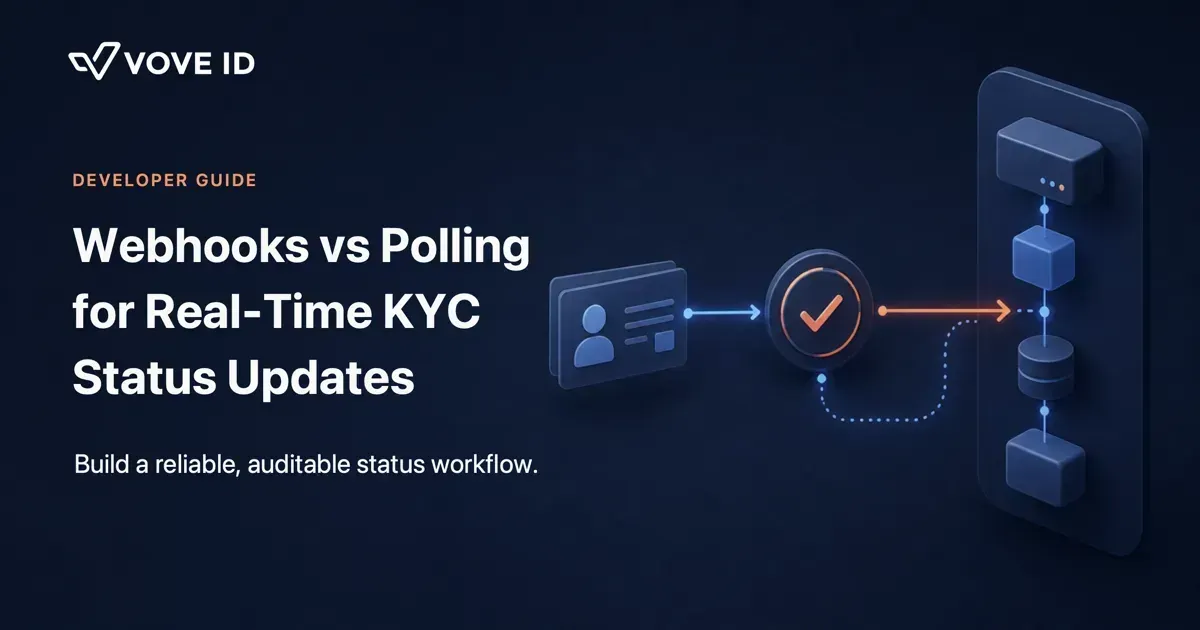
A KYC decision becomes operational only when the right system receives, verifies, and records the status change.
VOVE ID helps product, engineering, and compliance teams move KYC decisions into their own workflow after a verification changes state. The hard part is rarely displaying a status in the SDK. It is making sure the backend receives the change, handles it safely, and leaves an audit trail.
This is exactly where onboarding flows drift out of sync.
The short answer
Use webhooks as the primary signal for KYC status changes when your backend needs to react quickly. Use polling as a controlled reconciliation path for a known verification or when a webhook delivery needs investigation.
The right architecture is not a forced choice. It is a webhook-led workflow with a narrow polling fallback, a durable status record, and clear ownership of the final decision.
The event is not the decision: what the backend needs to own
On paper, KYC status is a front-end concern: a user finishes a flow and the application shows a result. In practice, the status controls account access, manual review queues, notifications, and evidence retained for a later review.
The backend therefore needs a stable internal reference for every verification. VOVE's documentation uses refId to connect a verification with the customer record in the client system, and recommends it over the older userId field in webhook payloads. That reference gives a team one key for matching an event to the correct case.
This means one thing: do not let a browser callback become the only source of truth. A user can close a tab, lose a connection, or leave the app before the customer record changes.
For the underlying identity-control framework, see our KYC requirements explained.
Webhooks: push the change to the system that needs it
A webhook is an HTTPS POST sent to an endpoint that your team configures. VOVE's webhook documentation describes events such as in_progress, pending, successful, and suspected, and states that failed deliveries are retried with exponential backoff. The receiving endpoint should acknowledge a successfully processed delivery with a 2xx response.
That pattern fits KYC because it removes the need for an application to repeatedly ask whether a verification has changed. When an event reaches the backend, the service can validate it, record it, fetch any required case detail, and route the case to the next owner.
Do not do expensive work before acknowledging the delivery. First validate and persist the event. Then hand downstream actions — such as fetching session detail, updating an internal case, or notifying a reviewer — to a durable worker.
VOVE's documentation also describes a webhook secret generated when a webhook URL is configured. Verify the signature before trusting a payload, and keep the secret in server-side configuration rather than application code.
Polling: useful for reconciliation, costly as a default
Polling means your service calls a status endpoint at intervals to ask whether a specific verification has changed. It is useful when an internal case needs confirmation after an operational exception, when a deployment team is diagnosing an integration, or when a webhook event needs reconciliation.
It becomes weak as the primary architecture because it creates a race between your interval and the user journey. A customer may finish a verification just after a poll. Your product then holds a stale state until the next request.
Polling also turns every active verification into repeated API traffic. That is not a reason to avoid it entirely. It is a reason to target it: query a known refId when there is a real case to reconcile, not as a broad substitute for event delivery.
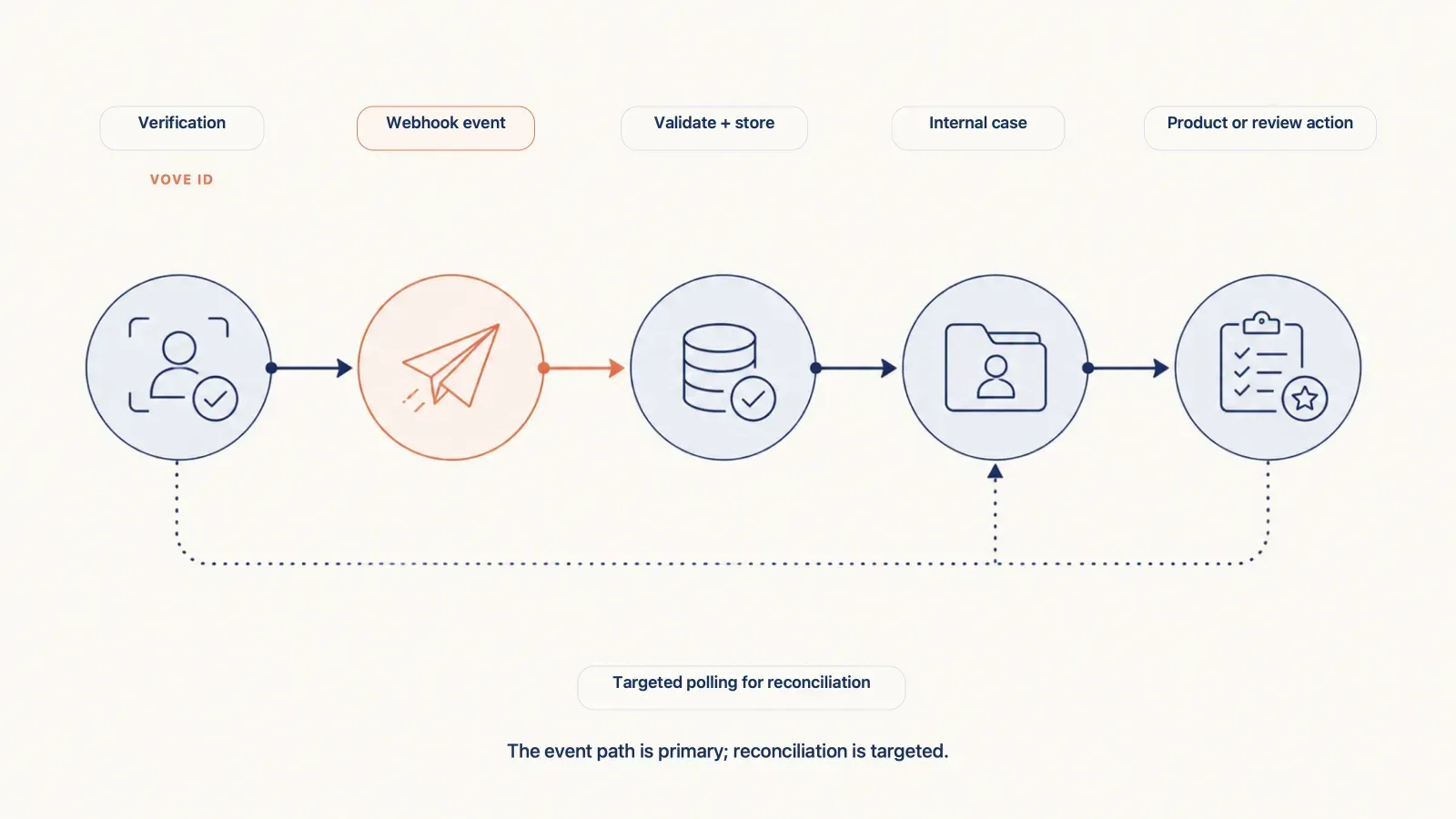
Webhooks carry the status change; polling confirms an exception without becoming the main workflow.
A realistic failure: a finished KYC flow that never unlocks the account
A digital lender receives a completed verification from a borrower on a mobile connection.
The team has built only a client-side callback.
The borrower closes the screen before the application sends its final update. The backend still shows "verification started," while the lender's reviewer sees no case and the borrower cannot continue.
Then the inconsistency appears. The verification system has a completed status, the app has a local result, and the lender's customer record remains incomplete. Support asks engineering to repair it manually.
This is not a KYC failure. It is a status-orchestration failure.
How VOVE ID fits into a reliable status workflow
Start by creating a verification with an internal reference that your own systems can resolve. Configure the webhook endpoint in the VOVE dashboard, protect its secret, and allow the endpoint to receive HTTPS POST requests.
When the event arrives, verify its signature, capture the provider event and refId, and store the raw payload with a processing state. A 2xx acknowledgement should only mean the event was accepted safely; it does not need to mean every downstream customer action has already finished.
Next, let a backend worker apply your own business rules. A successful verification can move a customer to the next onboarding step. A pending verification can create a review task. A suspected outcome can restrict the appropriate action until the compliance team has assessed the case. The control belongs to the team's workflow, not to a front-end message.
Finally, use a targeted session lookup when an event needs reconciliation. VOVE's documentation describes retrieving user-verification details by refId after the backend receives a webhook. Keep the lookup limited to the affected case and record the result alongside the event history.
Practical KYC status-update checklist
Event design
- Create and retain one internal reference for every verification.
- Configure an HTTPS webhook endpoint in the VOVE dashboard.
- Map each received status to an explicit internal case state.
Security
- Verify the webhook signature before processing the payload.
- Keep API keys and webhook secrets in server-side secret storage.
- Restrict logs so sensitive verification data is not copied into client telemetry.
Operations
- Persist the event before acknowledging it with a 2xx response.
- Route pending and suspected outcomes into an owned review workflow.
- Poll a known verification only for reconciliation or an operational exception.
FAQ
Should a KYC integration use webhooks or polling?
Use webhooks for the normal status-change path. Add targeted polling to reconcile a known case when an event is missing or a workflow needs confirmation.
What should a webhook endpoint do first?
Verify the signature and save the event with its internal reference. Move slower work into a backend worker after the delivery is safely accepted.
Can the front-end callback be the source of truth?
No. It can improve the user experience, but it cannot guarantee that the backend has recorded the outcome or taken the required operational action.
What should teams keep for auditability?
Keep the event receipt, the internal case transition, the associated refId, and the reviewer action where manual review applies.
Conclusion
Webhooks and polling are not competing KYC products. Webhooks are the event path; polling is a narrow reconciliation tool.
What actually keeps a case auditable is a backend that verifies each event, persists it before acting, and routes it to an owner — not which delivery mechanism carried it.
Want to see how VOVE ID fits into an identity and compliance workflow that your backend can operate?
This article is intended for general informational purposes only and does not constitute legal, financial, or regulatory advice. KYC/KYB/AML requirements may vary depending on jurisdiction, industry, and specific business circumstances. For up-to-date and binding compliance obligations, readers should refer to the relevant regulatory authorities or consult qualified professionals.
Sources
- VOVE ID Webhooks documentation (accessed August 13, 2026)
- VOVE ID Get User Verification documentation (accessed August 13, 2026)
- VOVE ID Authorization documentation (accessed August 13, 2026)