Western EU vs. Eastern EU: Why the Same Stack Doesn't Work in Both
A fintech can be EU-licensed and still break east of Germany. The rulebook is shared. The data inputs — registry quality, address logic, transliteration — are not.
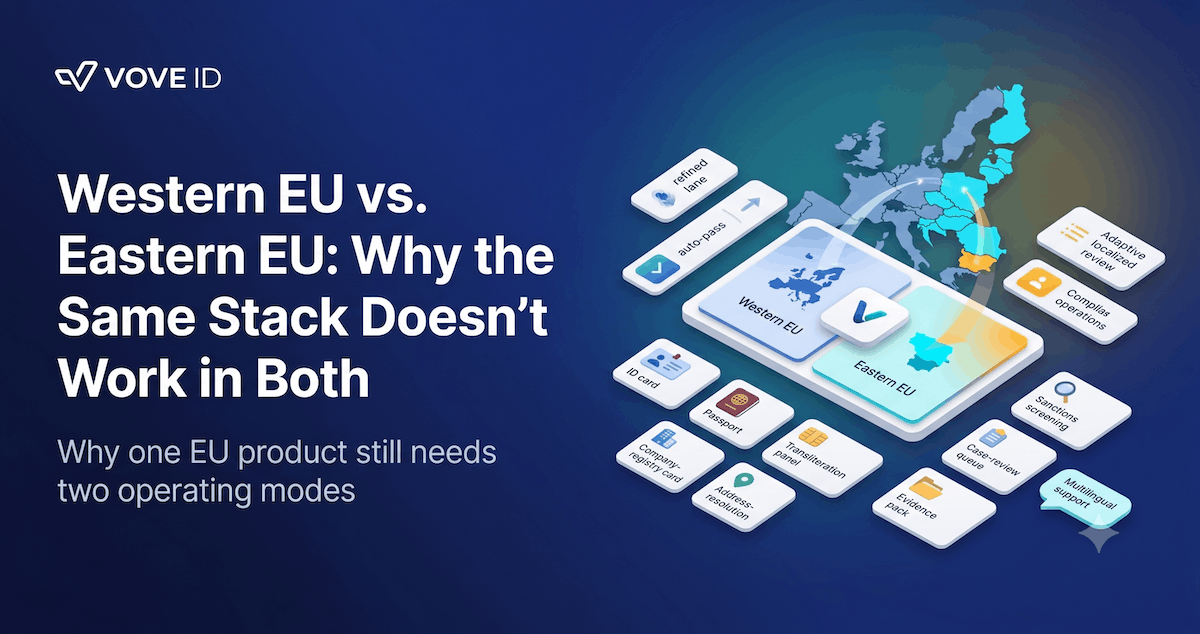
EU expansion looks straightforward on paper — get the license, file the notification, add the market. The harder part starts after entry, when the same onboarding and monitoring stack has to interpret very different customer records across countries that share a legal framework but not an operating reality.
VOVE ID helps fintech teams running cross-EU corridors maintain one compliance engine that stays commercially fast in Western Europe while handling Eastern European document coverage, registry variance, and language-aware review logic where those corridors need it.
This guide covers where the gap between Western and Eastern EU compliance operations actually sits, what breaks first, and how to encode regional differences without forking the product. For the underlying CDD and KYB framework, see our KYB Requirements Explained 2026: Complete Fintech Compliance Framework Used by Regulated Institutions.
What works in Western EU and breaks in Eastern EU
The classic Western-European fintech compliance stack is built around a few assumptions that hold well enough in markets like France, the Netherlands, or Germany:
- registry data is retrievable and normalises cleanly
- address formats resolve with high confidence
- name matching behaves predictably
- document coverage is mature
- manual review volumes stay manageable
Then the same stack moves east.
The team hits a different operating reality: identity documents the original parser was never trained on, naming and transliteration edge cases, company records with different field completeness, director and representative data that is present but not presented the same way, and entity types that do not map neatly to the original journey logic.
None of that means Eastern Europe is harder because it is weaker. It means many Western-origin stacks were optimised around Western-origin data assumptions.
That becomes visible fast in payments, e-money, BaaS, and marketplace products. The front-end flow looks unified, but the back-end truth is not. One country has strong legal-entity data and weaker operating-brand visibility. Another has acceptable registry access but lower automated address confidence. Another produces more false positives because the name-matching logic was tuned around a different linguistic pattern.
The stack then does one of two bad things: it over-automates and approves weak files, or it over-escalates and turns manual review into the product.
EU compliance coverage is not one problem — it is six
A lot of teams talk about "EU coverage" as a single vendor checkbox. It is not.
Coverage inside the EU breaks into at least six separate layers: identity document coverage, business-registry coverage, beneficial-ownership visibility, director and representative matching, address normalisation, and sanctions or PEP name disambiguation.
That distinction matters because a stack can look complete in a demo and fail in operations.
Under the EU AML framework, CDD still requires more than surface identification. Article 13 of Directive (EU) 2015/849 requires identifying the customer, identifying and taking reasonable measures to verify the beneficial owner, understanding the purpose and intended nature of the relationship, and conducting ongoing monitoring. The job is not to collect one acceptable document and move on. The job is to build a record that holds up when the relationship grows, changes, or gets reviewed later.
For a full breakdown of AML/CFT requirements that apply across EU markets, including CDD obligations, transaction monitoring, and ongoing monitoring standards, see our AML Requirements Explained 2026: Compliance Operating System for Regulated Financial Institutions.
A Western-EU stack may perform well when business customers arrive with familiar entity types, documents are already in the vendor library, representative checks are supported by stable domestic sources, and address validation returns high-confidence results. The same stack weakens in Eastern EU markets when SME entity structures differ from what the flow expects, registry retrieval is possible but less normalised, address confidence drops and humans start compensating, transliteration variance widens sanctions noise, or beneficial-ownership evidence needs additional source layering.
This is why coverage is not just a product feature. It is the difference between a stack that scales commercially and a stack that exports its uncertainty into operations.
When a Western-EU stack hits Poland and Bulgaria
Consider a payment fintech that launched in Germany with healthy onboarding metrics — high auto-approval rates, predictable false-positive volume, low manual review, stable complaint volumes. It expands into Poland and Bulgaria, assuming the existing stack is EU-native enough to transfer.
At first, nothing looks broken. Applications come in. The forms render. The dashboard shows green.
Then the real signs appear: document completion falls, address validation confidence drops, manual review climbs, support tickets rise because customers do not understand why they were asked for another record, and entity review stretches because the same SME arrives as different records across the registry, the director profile, and the payment account.
The company does not have a regulatory crisis. It has an operating-model mismatch. The German stack was tuned for one data environment and pushed into two others without adjusting its decision logic.
The operations team starts patching around it: translation by queue note, reviewer-side address interpretation, manual director verification, ad hoc registry lookups, case-by-case overrides for name mismatches. The stack is still one product, but it now runs two operating modes — the one the software was designed for, and the one the humans quietly built to compensate.
The Eastern EU challenge is evidence quality, not just regulation
Founders usually expect the Eastern-EU challenge to be about extra regulatory requirements. Often it is not.
Often it is about whether the file can be reconstructed cleanly after the decision. Can the team show which document was used, how the name was normalised, which registry source informed the entity result, which UBO checks were performed, why a case was escalated or cleared, and what changed in ongoing monitoring?
If that evidence is weak, the stack is fragile even when approval rates look fine. Eastern-EU expansion tends to surface that fragility faster because it introduces more source diversity and more judgment-heavy edge cases than a narrow Western launch footprint.
How to run one stack across both operating environments
The answer is not a separate platform for Eastern Europe. It is one core compliance engine with explicit regional overlays.
VOVE ID is built for exactly that model. The product does not assume every EU market behaves the same at the data layer — it gives teams one stack that handles Western-European flows while adding Eastern-European document coverage, source-aware record resolution, and language-aware review logic where the corridor needs it.
In practice that means the journey understands more than the original launch market's preferred inputs; the system preserves which source said what and how confidently records were matched rather than treating every registry as equally shaped; transliteration and local-language handling is treated as a control feature rather than a support extra; only the right cases route to human review with enough context to finish them quickly; and the Western-EU flow and the Eastern-EU overlay both land in one reconstructible audit trail.
Without that last piece, the business gains coverage and loses defensibility.
Practical checklist for West-to-East EU expansion
Coverage
Test actual document, address, and registry performance by market before launch — not just availability. Measure false positives and manual-review depth separately for each new country rather than aggregating them into one EU-wide metric.
Language and transliteration
Treat transliteration and local-language support as control features that affect sanctions review quality and audit defensibility. Preserve the exact evidence used in each decision — customer-facing and reviewer-side.
Operations
Add Eastern-European overlays inside the core workflow before launch instead of relying on reviewer improvisation after. One audit trail across all market flows is not optional if the compliance record has to hold up later.
Why this matters now
The EU is moving toward a tighter common compliance baseline, not a looser one. AMLR, the new AML Authority, and the evolving supervisory convergence agenda all push in the same direction.
That makes operating quality more important than it was two years ago. The stacks that will hold up are not the ones that treat Europe as uniform. They are the ones that understand where the framework is shared, where the operating reality is not, and how to encode that difference without fragmenting the product or offloading the gap onto manual review.
FAQ
Why does a fintech stack that works in Western Europe often struggle in Eastern Europe?
The legal framework may be shared, but the operating inputs are not. Teams run into differences in document coverage, registry normalisation, address resolution, transliteration, and language handling that the original Western-European stack was never tuned for.
Is this mainly a regulatory problem or a data-quality problem?
Usually a data and workflow problem first. The stack may still be legally in scope for the market, but if it cannot interpret local records cleanly or preserve defensible evidence, the operations team absorbs the gap manually.
What breaks first when a Western-EU stack expands east?
Falling auto-approval rates, rising manual review, weaker address confidence, more support tickets, and higher sanctions or entity-resolution noise. Those are signs the product has entered a different operating environment without the right overlays.
What should a fintech build before expanding from Western to Eastern EU?
Broader document and entity coverage, source-aware record resolution, transliteration and language support built into the control layer, risk-based routing for edge cases, and one audit trail that preserves how each decision was made across country flows.
Scaling into Eastern Europe with a stack tuned for Germany or France is not a licensing gap — it is a data-model gap. VOVE ID gives teams one compliance engine that handles both operating environments without forking the product or pushing the difference into manual review.
This article is intended for general informational purposes only and does not constitute legal, financial, or regulatory advice. KYC/KYB/AML requirements may vary depending on jurisdiction, industry, and specific business circumstances. For up-to-date and binding compliance obligations, readers should refer to the relevant regulatory authorities or consult qualified professionals.