AML for Agent-Banking Networks: The Africa-Specific Operational Challenge
A distributed cash-agent network needs one operating model, not scattered checks. Here is how principals keep control after agents go live.
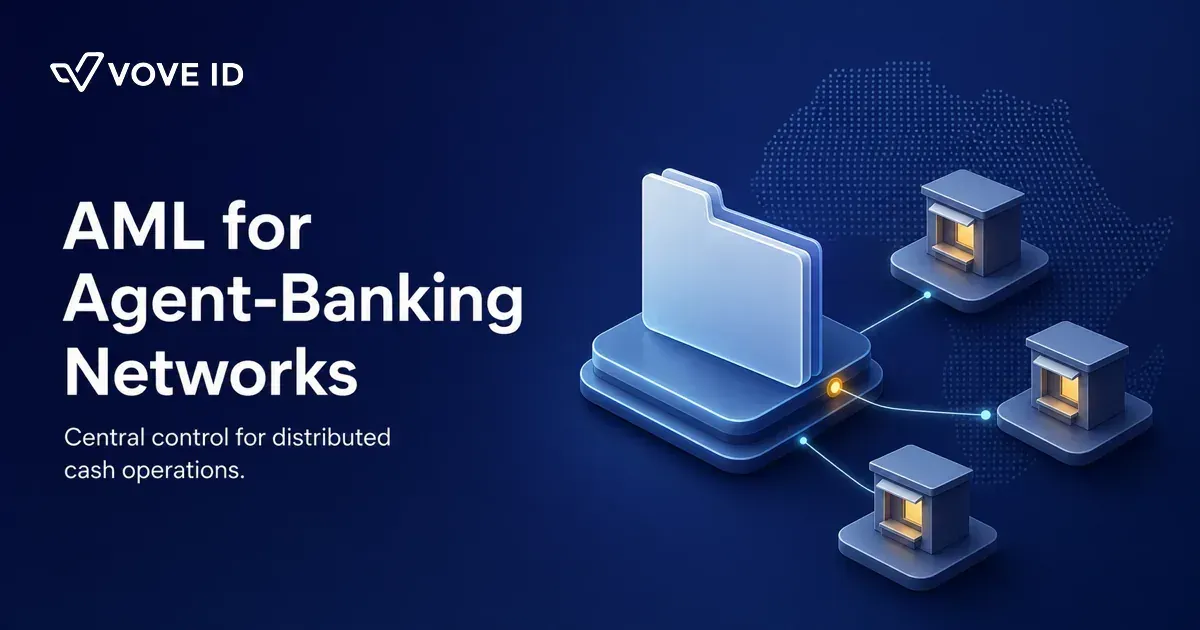
A distributed cash network needs a single operating model for agent approval, activity monitoring, escalation, and evidence.
Direct answer
AML for an agent-banking network works when the principal institution treats agents as part of its control environment, not as independent outlets that only need onboarding. That requires risk-based agent selection, clear cash and transaction controls, continuous monitoring, a route for escalation, and an audit trail that connects network activity to accountable decisions.
VOVE ID helps payment and BaaS teams connect identity verification, AML screening, KYB, transaction monitoring, and case evidence. In an agent network, the operating question isn't only whether an agent can be approved — it's whether the team can keep control after the agent starts handling customers and cash.
This is exactly where network compliance stalls.
The principal's responsibility: a network is not an outsourcing loophole
Across African markets, agent-banking arrangements differ by license type, supervisor, permitted services, and local cash conditions. Teams must start with the rules for the country where the institution operates.
The baseline is clear. FATF's 2025 guidance on financial inclusion describes agents in branchless banking as extensions of the principal financial institution and stresses that effective oversight includes agent screening, training, and monitoring. It also emphasizes that national authorities set the binding rules.
A distributed network still needs central accountability. An institution can give an agent a local customer interface. It cannot give away responsibility for the controls assigned to it. The agent channel needs a central risk view that compliance teams can investigate and explain.
For the underlying entity- and beneficial-ownership model behind agent files, see our KYB requirements framework.
Agent onboarding: approve the business and the operating reality
An agent file is more than a business name and a signed agreement. It should capture the operator, ownership, and control where relevant, location, service model, expected activity, and authorized people.
That is why agent onboarding often needs both KYB and individual identity controls. A franchisee, kiosk operator, or merchant outlet may have a formal entity record but still require a clear view of its owners, directors, staff access, and local operating setup.
The assessment should be risk-based. A platform should not treat every new or rural outlet as high risk, nor assume that a familiar location removes risk. The FATF recommendations call for proportionate mitigation; local rules determine how that standard is applied.
A realistic network failure: cash moves faster than the case file
A payment institution adds a new cluster of cash agents before a holiday period. One outlet operates through a registered business, but several staff members share access to the same agent credentials. The outlet begins processing a higher volume of cash-in and cash-out activity than expected.
The institution has received business registration and operating address, owner identity evidence, an agent agreement, staff access records, and an expected-activity profile.
Then the inconsistency appears. The central team cannot quickly tell whether the pattern reflects seasonal demand, credential sharing, an operating change, or a case that requires escalation. Local support knows the outlet. Compliance sees fragmented records.
This is not only a monitoring failure. It is a network-control failure.
Monitoring the network: combine outlet context with transaction context
Agent monitoring needs more than a generic alert threshold. Connect the outlet identity and location with the expected activity. Define review scenarios around material profile changes, unusual cash patterns, repeated reversals, shared credentials, or changed account details. These triggers are not proof of wrongdoing.
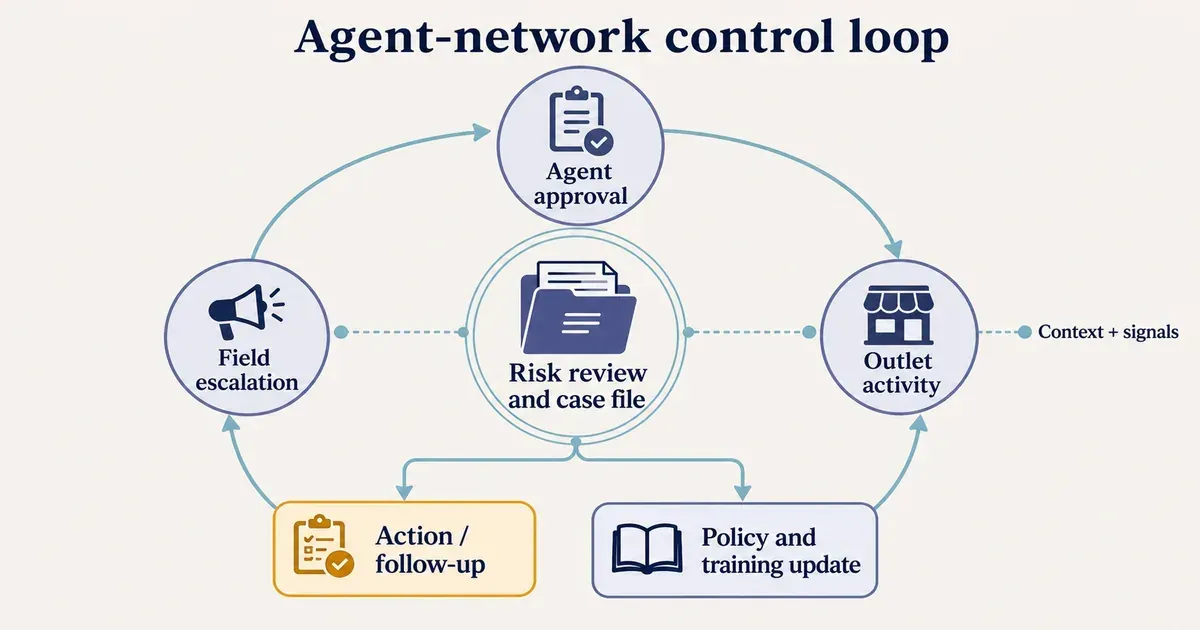
A reviewed case should update the agent's risk view, improve staff guidance, or trigger a control change. Otherwise, the team resolves alerts without learning whether the network model is drifting.
For the broader screening, case-management, and escalation model, see our AML requirements framework.
Cash risk: operational controls need named owners
Cash creates a physical control problem as well as a monitoring problem. Teams need a policy on who may handle cash, access the account, and approve outlet or ownership changes.
The exact limits and reporting rules are local. Don't import a threshold from another country or assume that a payment partner's control replaces the institution's own responsibility. Instead, map local obligations into the network's procedures and make sure field teams know what must be escalated.
Training should explain how to report concerns without asking agents to make AML judgments they aren't authorized to make.
How VOVE ID fits: connected evidence, not a loose collection of checks
VOVE ID supports identity verification, biometric liveness, face matching, AML screening, KYB, and transaction monitoring, and can help identify document-template inconsistencies, invalid MRZ checksums, barcode or QR inconsistencies, and image manipulation across a wide range of document types and countries. These capabilities support a control decision; they don't guarantee that an agent or transaction is legitimate.
The institution still sets the agent-risk policy, approval authority, and reporting process. The operational benefit is a connected case: who the agent is, how the outlet was approved, what activity changed, what the reviewer decided, and what follow-up occurred.
Practical agent-banking AML checklist
Agent selection
- Define agent eligibility and required business, owner, and authorized-user evidence.
- Record the outlet's expected activity, service model, and accountable contacts.
- Apply enhanced checks when the risk assessment or local rule requires them.
Network controls
- Restrict and review credential access for each outlet.
- Set a documented process for location, ownership, staff, and account-detail changes.
- Train field and agent teams on escalation, not informal case resolution.
Monitoring
- Review activity against the approved outlet profile and current risk assessment.
- Investigate material changes using both transaction evidence and outlet context.
- Feed confirmed control gaps back into agent policy, training, and supervision.
Audit and reporting
- Maintain a case file for approval, monitoring, review, and action.
- Follow local record-keeping and suspicious-reporting requirements.
- Test whether the central team can reconstruct a decision without relying on informal messages.
FAQ
Are agents responsible for the institution's AML obligations?
Agents have duties under their contract and local rules, but the principal institution cannot treat the channel as an outsourcing loophole. The precise allocation of responsibility depends on the jurisdiction, license model, and agreement.
Does every agent need the same level of review?
No. A risk-based approach should distinguish cases using the institution's documented assessment and local requirements. Lower-risk treatment still needs evidence and oversight; it isn't an absence of controls.
What should trigger an agent review?
Triggers should be tied to the approved risk model, such as material changes in ownership, location, access, expected activity, or transaction patterns. A trigger starts an investigation; it isn't a conclusion.
Conclusion
AML for agent banking is not a collection of outlet checks. It is a network operating model that keeps agent identity, cash activity, review, and escalation connected.
Teams should centralize accountability without losing the local context that makes an agent channel work. Agent approval, monitoring, and case management are one workflow.
This article is intended for general informational purposes only and does not constitute legal, financial, or regulatory advice. KYC/KYB/AML requirements may vary depending on jurisdiction, industry, and specific business circumstances. For up-to-date and binding compliance obligations, readers should refer to the relevant regulatory authorities or consult qualified professionals.