Biometric Verification: How Liveness Detection and Face Matching Work
A copied or replayed selfie can pass a simple face match. Here is how liveness and face matching close that gap.
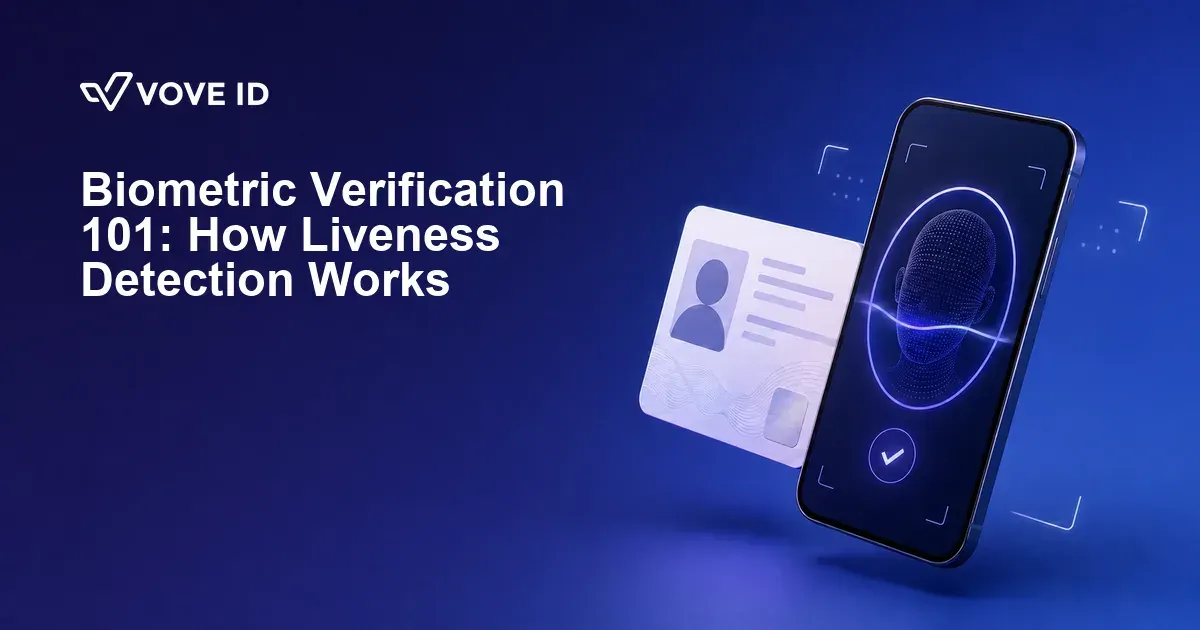
Liveness detection establishes that a facial capture comes from a person present at capture time; face matching establishes whether that person matches the document portrait. A reliable remote flow needs both controls, plus a clear route for exceptions.
VOVE ID helps fintech teams verify people in remote onboarding flows where a document image and a selfie alone do not establish who is actually present.
An uploaded portrait can be copied, replayed, or paired with a document that belongs to someone else. This is exactly where a simple image comparison stops being enough.
What is biometric identification?
Biometric identification uses a physical or behavioral characteristic—such as a face, fingerprint, or voice pattern—to determine which identity in a known set may belong to a person. It is commonly described as a one-to-many comparison.
Biometric verification answers a narrower question: does this biometric sample match the identity the person has claimed? Remote KYC normally uses this one-to-one verification model by comparing a live facial capture with the portrait on a validated identity document. Liveness detection adds a separate check that the capture comes from a person who is present rather than from a photo, replay, mask, or other presentation attack.
Liveness and face matching: two different questions
Liveness detection asks whether the capture is from a live person at the point of capture. It is a presentation-attack control, not an identity decision by itself.
Face matching asks whether the captured face resembles the portrait on a validated identity document. It links the person in the session to the document holder.
The distinction matters. A live person can present another person's document, and a document holder's photo can be replayed without a live person present. NIST's identity-proofing guidance treats live facial capture and liveness controls as part of remote proofing because presentation and spoofing attacks remain a material risk.
For the underlying identity-verification framework, see our KYC requirements explained.
What liveness detection checks: presence, not perfection
A liveness check looks for signals that a submitted capture is happening now and is not a static image, replay, mask, or other presentation attack.
Liveness is not a guarantee; NIST notes that biometric comparison is probabilistic. Teams need evidence handling and escalation around it.
This means one thing: teams should not treat a selfie check as decisive. Use it with document evidence, facial comparison, decision rules, and human review where needed.

Liveness proves that a person is present; face matching connects that live capture to the document, while the decision record keeps the evidence together.
A realistic replay attempt: where the workflow breaks
A lending app receives a passport image and a short selfie video during a new application.
Received:
- A clear passport photo page
- A selfie video replayed from another screen
- Matching biographic fields entered by the applicant
Then the inconsistency appears. The document may be readable and the fields may look complete, but the capture does not provide sufficient evidence that the applicant is present.
Without a liveness control, an automated workflow can compare a replayed face with the document portrait and create a false sense of completion. Without face matching, a live person can still hold up another person's document.
This is not a selfie failure. It is a control-design failure.
How VOVE ID approaches this: one evidence record
VOVE ID supports document verification, biometric liveness detection, and face matching as parts of an identity-verification workflow. It can also help teams detect document-template inconsistencies, invalid MRZ checksums, barcode or QR inconsistencies, and image manipulation.
The operational value comes from keeping the controls in one case record. A reviewer can see the submitted document evidence, the biometric outcome, the decision path, and the reason an exception needs attention.
That record matters when a team needs to explain why it accepted, rejected, or escalated a case. It also keeps the product, risk, and operations teams working from the same decision rather than from disconnected screenshots.
Practical biometric-verification checklist
Onboarding
- Explain the capture step in plain language before the camera opens.
- Capture document evidence and live facial evidence as separate inputs.
- Provide a retry route when capture conditions prevent a usable submission.
Identity
- Distinguish liveness outcomes from face-matching outcomes in case rules.
- Apply the required identity-assurance level to the product and customer segment.
- Record the evidence used for each identity decision.
Risk
- Define which signals trigger review instead of an automatic decision.
- Test controls against relevant presentation-attack risks before deployment.
- Monitor exception reasons for recurring capture or document problems.
Audit
- Retain a decision trail in line with applicable obligations.
- Restrict access to biometric evidence to the roles that need it.
- Review escalation outcomes to improve the workflow without weakening controls.
Q&A
What is the difference between biometric identification and biometric verification?
Biometric identification compares a sample against many enrolled identities to determine who the person may be. Biometric verification compares the sample with one claimed identity to confirm whether they match.
Is liveness detection the same as face matching?
No. Liveness checks whether a person is present during capture. Face matching checks whether that captured person resembles the document portrait.
Can a face match stop a replay attack?
Not on its own. A replayed image or video can resemble the document holder, which is why remote flows use liveness controls alongside comparison.
Does every KYC flow need the same liveness method?
No. The required controls depend on the use case, risk, jurisdiction, and assurance level. The workflow should be risk-sensitive and documented.
FAQ
What happens when a liveness check is inconclusive?
The case should follow a defined retry or reviewer path. An inconclusive result is evidence to assess, not a reason to hide the decision logic.
Are biometric checks a replacement for document verification?
No. A biometric check connects a person to a session or document; document evidence and the broader identity workflow remain necessary.
Conclusion
Biometric verification is not one check. It is the combined work of proving that a person is present and linking that person to credible identity evidence.
Teams should design the flow around those separate decisions, then preserve the evidence and escalation path that makes each decision reviewable. Collection, verification, and case management are one workflow.
Want to see how VOVE ID brings document verification, biometric liveness, and face matching into one case flow? Talk to the team.
This article is intended for general informational purposes only and does not constitute legal, financial, or regulatory advice. KYC/KYB/AML requirements may vary depending on jurisdiction, industry, and specific business circumstances. For up-to-date and binding compliance obligations, readers should refer to the relevant regulatory authorities or consult qualified professionals.