iGaming and Online-Gambling KYC: Age Verification Meets AML
Age verification is the first case in an ongoing risk relationship, not a one-time gate. Here is how GB operators should connect the two.
For a Great Britain remote-gambling operator, age and identity checks must happen before a customer gambles. The harder operating task is connecting that start-of-journey control to ongoing AML and customer-risk decisions.
VOVE ID helps regulated teams establish identity evidence and operate a reviewable onboarding workflow. In online gambling, the risk begins when a team treats age verification as a one-time gate and leaves identity, customer risk, and exception handling disconnected.
This draft uses Great Britain's remote-gambling rules as its regulatory example. The UK Gambling Commission states that remote-licence holders must obtain and verify customer identity information before a customer can gamble, including name, address, and date of birth.
This is exactly where a checkbox approach breaks down.
Great Britain's starting point: verify before gambling, not at withdrawal
The first control is early identity and age verification. The Gambling Commission's Licence Condition 17.1.1 requires remote licensees to establish identity before permitting gambling, and says an operator should not delay information requests until withdrawal when it could reasonably have asked earlier.
That protects the customer journey as well as the control environment. A product cannot promise an open account and then discover that its policy needs identity evidence, a review decision, or further information at the point funds leave the platform.
On paper, this is an onboarding task. In practice, it is the first case in an ongoing risk relationship.
For the underlying controls behind an identity-verification program, see our KYC requirements framework.
Age verification and AML: related controls with different decisions
Age and identity checks establish whether the customer can enter the remote-gambling journey under the operator's policy. AML controls address a broader question: whether customer activity, source of funds, or other risk indicators require review or action.
The Gambling Commission's anti-money laundering guidance for casinos uses a risk-based approach and expects operators to maintain policies, procedures, and controls. It treats the customer relationship as extending beyond initial verification to monitoring activity and, where appropriate, considering suspicious activity and recordkeeping.
This means one thing: an operator should design the first identity decision so later risk decisions can refer to evidence rather than rebuild the case from scratch.
For the underlying framework behind ongoing risk monitoring, see our AML requirements explained.
A realistic scenario: a remote casino account with an early exception
A Great Britain remote-casino operator receives a new account application. The customer provides personal details and identity evidence, then attempts to gamble shortly after registration.
The case includes:
- A date of birth and address that need verification
- A document capture that needs an identity decision
- A customer-facing state before access to gambling
- A later activity pattern that needs a risk review
- A reviewer who must explain the final disposition
Then the operating questions appear.
Can the operator establish identity before gambling? Does the product show a clear pending state when the policy needs further evidence? If an AML or safer-gambling control later needs attention, can the reviewer retrieve the original evidence and earlier decision?
This is not just an age-verification failure. It is a customer-lifecycle control failure.
The operating flow: make early evidence available to later review
| Control point | What the operator must decide | Evidence to retain |
|---|---|---|
| Registration | What information is required before the journey continues? | Customer-entered details and policy version |
| Identity and age | Does available evidence meet the entry policy? | Verification outcome and exception reason |
| Product access | What can the customer do while a case remains open? | Customer state and event history |
| Risk review | Does later activity require enhanced inquiry or escalation? | Trigger, reviewed evidence, and rationale |
| Case closure | Can the final decision be explained later? | Disposition, owner, and audit record |
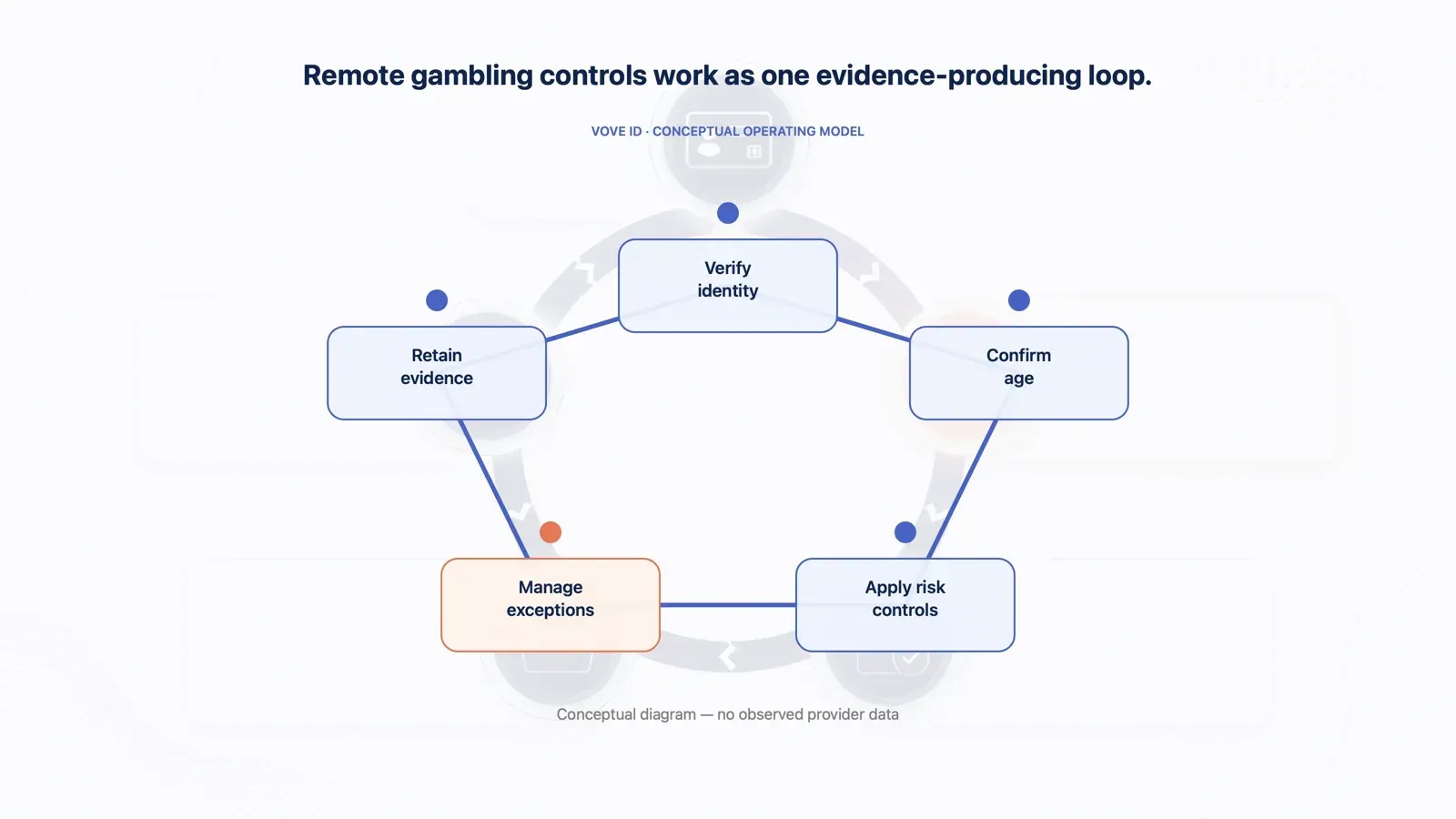
The table is a control model, not legal advice or a claim that any particular vendor satisfies a gambling operator's obligations.
How VOVE ID fits: establish identity evidence without overclaiming the outcome
VOVE ID is relevant where a team needs identity verification, biometric liveness detection, face matching, sanctions screening, KYB workflows, and audit-ready logging in a reviewable process, including document-authenticity checks designed to flag inconsistent or manipulated documents.
An operator should not infer gambling-specific compliance from those capabilities. It needs to validate its licence scope, products, customer-risk policy, document types, customer messaging, and review rules with appropriate legal and compliance advice.
The practical pilot is narrow. Test the policy-approved identity journey, the blocked and pending product states, a further-evidence case, and a later risk-review handoff. Confirm that the outcome of each stage is retained and owned.
Practical iGaming KYC and AML checklist
Identity and age
- Verify the customer identity before allowing gambling in the Great Britain remote journey.
- Define acceptable evidence and the customer message for inconclusive cases.
- Test the journey with the actual web and mobile capture conditions.
Risk controls
- Map AML review triggers and escalation routes to the documented risk assessment.
- Keep age, identity, AML, and safer-gambling decisions distinguishable in the case record.
- Record why a reviewer asks for further evidence and how the customer is informed.
Operations and audit
- Assign ownership for every pending, escalated, and closed case.
- Rehearse retrieval of a completed decision with its supporting evidence.
- Review the workflow when rules, risk assessment, or product scope changes.
FAQ
Do Great Britain remote operators need to verify customers before they gamble?
Yes. The Gambling Commission's Licence Condition 17.1.1 requires remote licensees in scope to obtain and verify customer identity information before permitting the customer to gamble.
Is age verification the same as AML monitoring?
No. Age and identity verification control access to the gambling journey. AML controls assess financial-crime risk throughout the customer relationship and may require different evidence and decisions.
Can an identity-verification vendor make an operator gambling-compliant?
No. A technology capability can support a control, but the operator remains responsible for its licence obligations, risk assessment, policies, and operating decisions.
Conclusion
Online-gambling KYC is not a final document check. It is the first evidence decision in a regulated customer relationship.
Great Britain remote operators need to connect early identity evidence to product states, risk review, and a retrievable audit record — so the second decision never has to start from zero.
Want to see how VOVE ID helps GB operators keep identity evidence connected to the review process?
This article is intended for general informational purposes only and does not constitute legal, financial, or regulatory advice. KYC/KYB/AML requirements may vary depending on jurisdiction, industry, and specific business circumstances. For up-to-date and binding compliance obligations, readers should refer to the relevant regulatory authorities or consult qualified professionals.