VOVE ID and ComplyAdvantage: Choosing AML-Screening and Identity-Verification Layers
A screening hit and an identity check answer different questions. Here is how to design a workflow that connects both without confusing them.

Identity verification and AML screening solve different control questions. The useful design is the one that connects both decisions without treating either layer as a substitute for the other.
VOVE ID helps fintech and regulated-platform teams establish identity evidence and run a reviewable onboarding workflow. The gap appears when a team treats a successful identity check as the same thing as an AML decision.
As of 3 September 2026, ComplyAdvantage publicly describes screening and monitoring products for sanctions, politically exposed persons, adverse media, and transaction activity. That makes it a relevant AML layer to evaluate. It does not make it a substitute for the identity evidence and customer-journey controls a team still needs.
This is exactly where compliance architecture loses control.
Two control questions: who is this customer, and what risk must the team assess?
Identity verification asks whether the evidence collected supports the claimed identity under the team's policy. It includes the document, the capture conditions, consistency checks, and the path for an inconclusive result.
AML screening asks a different question. It tests a customer, business, owner, or payment against risk intelligence and requires the team to decide what a potential match means. A name hit is not the same thing as a confirmed risk event.
On paper, both appear in the same onboarding screen. In practice, they need different evidence, different review decisions, and different escalation routes.
This means one thing: the design should connect the layers without collapsing their purposes.
For the underlying identity-verification framework, see our KYC requirements explained. For the underlying screening framework, see our AML requirements explained.
The layer model: connect decisions, do not force a false comparison
The right buyer question is not "which platform wins?" It is "which control must this workflow prove, and where does each decision belong?"
| Control layer | What the team needs to prove | Evidence to request in a pilot |
|---|---|---|
| Identity evidence | The person submitted acceptable, policy-relevant evidence | Document outcomes, exception reasons, and reviewer record |
| Risk screening | The customer or entity was screened according to the risk policy | Match details, matching settings, disposition workflow |
| Case decision | A reviewer can resolve ambiguity with a clear rationale | Completed low-, medium-, and high-risk cases |
| Product state | The application receives the correct next step | Pending, more-information, approved, and declined paths |
| Audit record | The team can explain the final decision later | Linked identity evidence, screening outcome, and disposition |
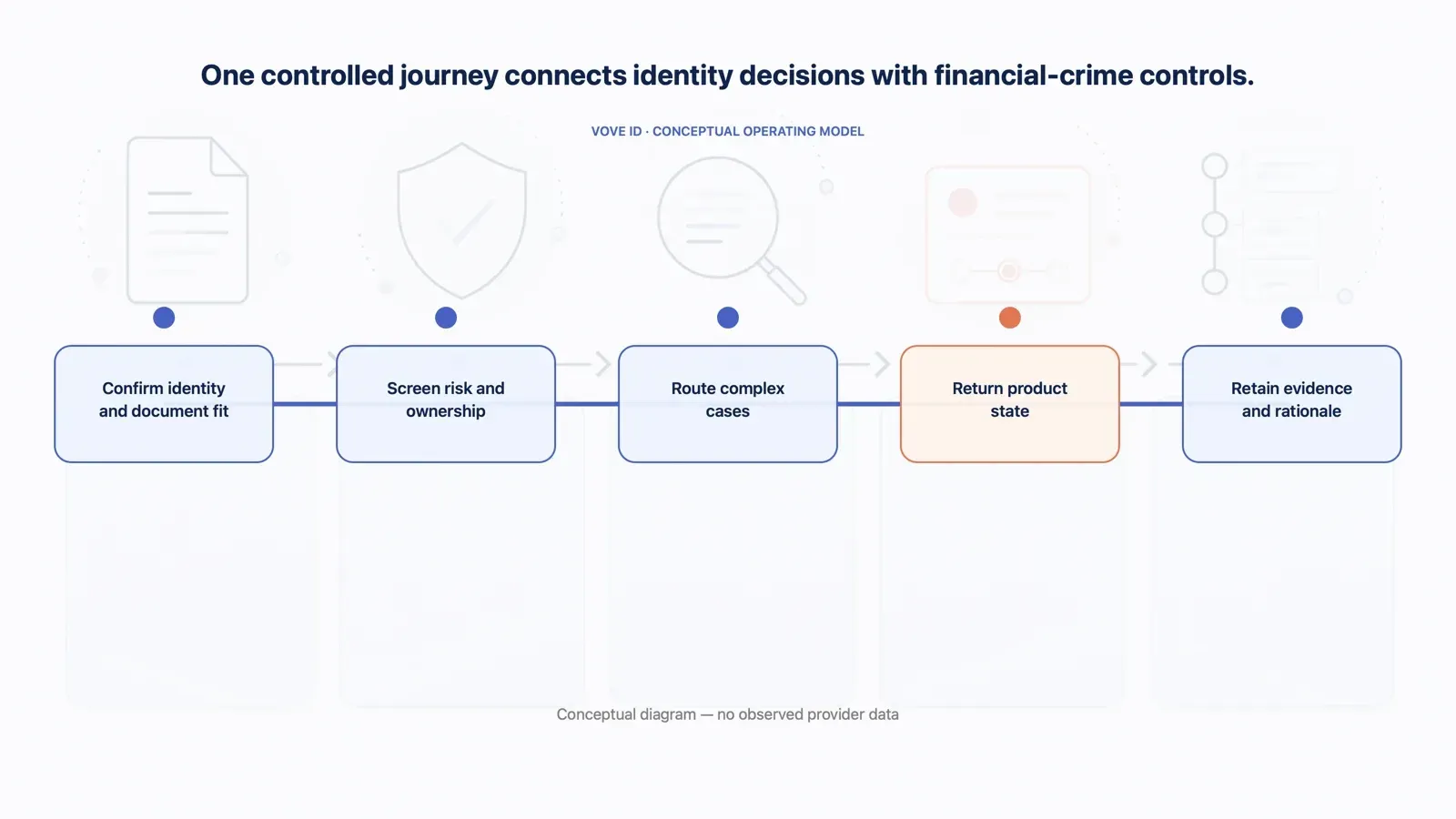
This is not a capability scorecard. It is a test for a connected operating model.
A realistic scenario: the payments app with a clean document and a risk match
A payments app onboards a customer whose document and liveness evidence meet the identity policy. The product team expects the account to move forward.
The case includes:
- A readable government-issued identity document
- A successful document-to-person comparison
- A screening result that needs investigation
- A customer who needs a clear next-step message
- A reviewer who must record the final rationale
Then the control questions split.
The identity layer says the evidence supports the customer's claimed identity. The screening layer may still require a reviewer to distinguish a false positive, a possible match, or a risk that needs further action under the team's policy.
This is not an identity-verification failure. It is a case-orchestration requirement.
How VOVE ID fits: make identity evidence usable by the wider workflow
VOVE ID is relevant where a team needs identity verification, biometric liveness detection, face matching, sanctions screening, KYB workflows, and audit-ready logging in its onboarding process, with document checks built to catch inconsistent or manipulated documents before a case reaches review.
The value is not a claim that one identity result closes every AML question. It is the ability to take an identity decision, its supporting evidence, and its review path into a broader operating workflow.
A team evaluating ComplyAdvantage should separately validate the screening datasets, matching configuration, monitoring approach, workflow, and commercial terms it needs. It should then test how the AML outcome reaches the product and case-management process alongside identity evidence.
Practical identity-and-screening checklist
Identity controls
- Define the acceptable documents and evidence for each customer segment.
- Test inconclusive, damaged-document, and further-evidence cases.
- Keep the customer-facing state distinct from internal reviewer rationale.
AML controls
- Map screening subjects, matching settings, and escalation rules to the written risk policy.
- Require a documented disposition for every material potential match.
- Confirm which changes trigger a new review or monitoring action.
Operating model
- Link the identity result, screening outcome, and final case decision.
- Assign an owner for exceptions at every handoff.
- Rehearse retrieval of one closed case before production launch.
FAQ
Is AML screening the same as identity verification?
No. Identity verification establishes whether the collected evidence supports a claimed identity. AML screening assesses risk information associated with a customer, entity, or activity and often needs a separate disposition.
Is ComplyAdvantage a substitute for VOVE ID?
This is not a substitute comparison. A team should first decide whether it needs an identity-evidence layer, an AML-risk layer, or both, then test how those controls operate together.
What should a combined pilot include?
Run the same policy-approved cases through identity collection, screening, review, product states, and audit retrieval. Include at least one inconclusive identity case and one potential screening match.
Conclusion
Identity verification is not AML screening. It is the evidence layer that makes the customer claim reviewable.
Fintech teams need to connect identity evidence, risk intelligence, human disposition, and product states without pretending that one result answers every compliance question — that connection, not either layer alone, is what a supervisor will actually ask to see.
Want to see how VOVE ID keeps identity evidence usable by your AML screening and case-management workflow?
This article is intended for general informational purposes only and does not constitute legal, financial, or regulatory advice. KYC/KYB/AML requirements may vary depending on jurisdiction, industry, and specific business circumstances. For up-to-date and binding compliance obligations, readers should refer to the relevant regulatory authorities or consult qualified professionals.