Tokenized Assets Under MiCA: The Onboarding Stack You Actually Need
A token that starts as a MiCA crypto-asset can behave like a MiFID II financial instrument six months later. Here is what the onboarding stack needs to handle both.
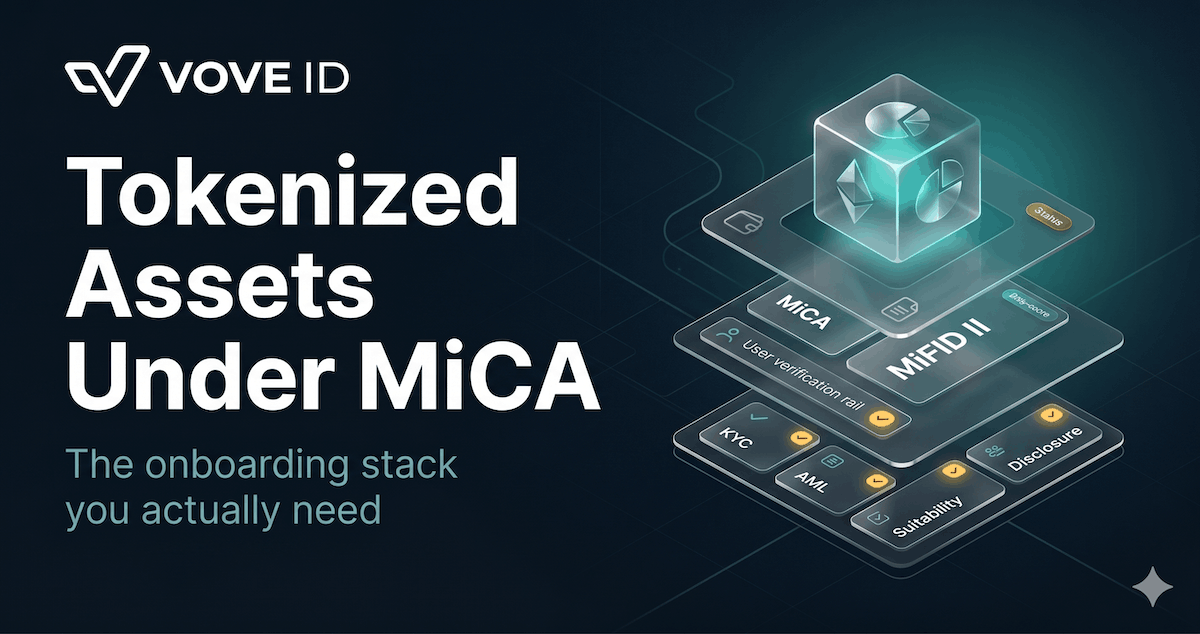
VOVE ID helps tokenization platforms run onboarding in markets where MiCA and MiFID II overlap on the same token. On paper the regime is clear. In practice the platform straddles two.
This guide covers how to build an onboarding stack that handles MiCA and MiFID II requirements without breaking when a token's classification changes. For the underlying AML and KYC compliance framework, see our AML Requirements Explained 2026.
Direct answer: A tokenized asset onboarding stack needs identity verification, sanctions and AML screening, wallet and payment context, token classification records, and suitability checks when the token behaves like a financial instrument. MiCA alone is not enough when the same investor journey can move into MiFID II territory.
Tokenization teams often ask the wrong compliance question first.
They ask whether the asset is covered by MiCA. That matters, but it does not cover the whole onboarding problem. A token can start as a crypto-asset and later behave like a security, a fund interest, or a structured product — any of which can bring MiFID II obligations into the file.
The onboarding stack has to be ready for that shift before growth creates the audit.
Where MiCA Ends and MiFID II Begins
MiCA gives crypto-asset service providers a clearer EU framework for issuance, custody, trading, and service obligations. It does not erase the line between crypto-assets and financial instruments.
That line matters for onboarding.
If a tokenized asset is a MiCA crypto-asset, the platform still needs KYC, AML screening, sanctions checks, transaction monitoring, source-of-funds logic, and evidence retention. If the token is or becomes a financial instrument, the platform may also need MiFID II suitability checks, appropriateness assessments, investor categorisation, disclosures, and product-governance documentation.
The problem is that product teams do not always know which side of the line a token will stay on.
Secondary trading, yield mechanics, profit rights, governance rights, or a change in how the token is marketed can alter the regulatory reading. A static onboarding flow can pass day-one requirements and fail month-six review.
For a full breakdown of KYC requirements applicable to tokenized asset investors, see our KYC Requirements Explained 2026.
Dual-Regime Onboarding in One Journey
The safer model is not to run every user through every MiCA and MiFID II step from the start.
The better approach is modular onboarding.
Every user goes through a core identity and AML layer. Additional modules trigger when the asset type, user profile, geography, or transaction behaviour requires them. That keeps conversion manageable while building a file that can absorb reclassification or regulatory review without gaps.
A practical stack covers:
- identity verification and liveness checks
- sanctions and PEP screening
- wallet, payment, and source-of-funds records
- token classification fields tied to the product record
- investor categorisation where the product requires it
- suitability or appropriateness checks when the token falls into MiFID II logic
- disclosures linked to the specific product sold
- ongoing monitoring when the token or user risk profile changes
The difference between a compliance flow and a compliance architecture is whether the stack can absorb what happens after day one.
When a Token Starts as Utility and Becomes a Security
Consider a tokenized art platform that launches a utility token for access and membership benefits.
The initial legal view treats it as a MiCA crypto-asset. The platform runs identity checks, sanctions screening, and wallet verification. Six months later, secondary trading grows. The token is marketed around expected appreciation. New rights attach to revenue from the underlying art portfolio.
The regulator asks whether the token now functions as a financial instrument.
The platform has identity records and AML screening, but it never captured investor categorisation, suitability evidence, risk disclosures, or product-specific acknowledgements. The user base is already live. Re-onboarding everyone creates churn, support volume, and legal exposure.
That failure does not come from ignoring KYC. It comes from treating KYC as a fixed checklist rather than a stack that can expand when the product moves.
How VOVE ID Adapts Onboarding to Dual-Regime Tokens
VOVE ID helps tokenization platforms keep the core investor journey simple while leaving room for regulatory expansion.
The base layer covers identity, liveness, AML screening, sanctions, and PEP checks. When a token, investor profile, transaction size, or jurisdiction triggers additional requirements, further steps can be introduced without rebuilding the whole flow.
That can include:
- source-of-funds collection for higher-risk or higher-value investors
- investor categorisation for retail, professional, or eligible counterparty logic
- suitability or appropriateness modules when the product enters MiFID II territory
- product-specific disclosure capture
- monitoring triggers when token behaviour or user risk changes
- audit trails that connect the user, the product, the token classification record, and the decision
Token classification is not only a legal memo. It is an operational trigger. When the product changes, the onboarding stack needs to identify which investors require additional evidence, which disclosures apply, and which files remain defensible.
Checklist for Tokenized Asset Onboarding
Before scaling a tokenized asset platform across the EU:
- Token classification: Maintain a live product record that records how the token is classified and which onboarding modules apply.
- KYC: Verify identity, liveness, sanctions, and PEP status before the user can invest or transact.
- Suitability: Add investor categorisation, suitability checks, appropriateness assessments, and disclosure capture when the asset moves into MiFID II scope.
- Source of funds: Collect evidence when investment value, geography, wallet behaviour, or risk score requires it.
- Monitoring: Watch for product, trading, and user-risk changes after onboarding completes.
- Audit: Store the full chain from user verification through product access decision, including token classification at the time of onboarding.
Q&A
Does MiCA replace MiFID II for tokenized assets?
No. MiCA creates a framework for crypto-assets, but tokenized assets can still fall under MiFID II when they qualify as financial instruments or behave like regulated investment products. The two regimes can apply to the same platform and sometimes the same token.
What is the biggest onboarding risk for tokenized asset platforms?
Building only for the day-one token classification. If the token's rights, trading behaviour, or marketing changes, the platform may need evidence it never collected and users who cannot easily provide it retroactively.
Do all tokenized asset investors need suitability checks?
Not always. Suitability and appropriateness requirements depend on the product type, investor category, jurisdiction, and regulatory classification. The onboarding stack should trigger those modules when they are required — not by default for every user.
How should platforms handle token reclassification?
Keep token classification tied to onboarding rules. If the product moves into a different regime, trigger additional evidence collection, disclosure capture, or suitability steps for affected users. The earlier the classification review, the smaller the re-onboarding problem.
Conclusion
Tokenized assets do not fail compliance because teams forget to collect identity documents. They fail because the product moves faster than the onboarding stack.
MiCA gives tokenization platforms a clearer EU foundation, but MiFID II can enter the file when the token behaves like an investment product. The stack has to support both without forcing every investor through maximum friction on day one.
That means modular onboarding, a live token classification record, adaptive suitability logic, and an audit trail that follows the product as it develops.
Building onboarding for a tokenized asset and not sure when MiFID II suitability steps should trigger? VOVE ID can show you how the modular stack handles dual-regime classification in one investor journey.
This article is intended for general informational purposes only and does not constitute legal, financial, or regulatory advice. KYC/KYB/AML requirements may vary depending on jurisdiction, industry, and specific business circumstances. For up-to-date and binding compliance obligations, readers should refer to the relevant regulatory authorities or consult qualified professionals.