Source-of-Funds for Retail Investors: The Step Most Platforms Skip
Retail SoF is no longer optional. Here is how to build a risk-based workflow that triggers on the right signals, collects the right documents, and keeps the audit trail clean.
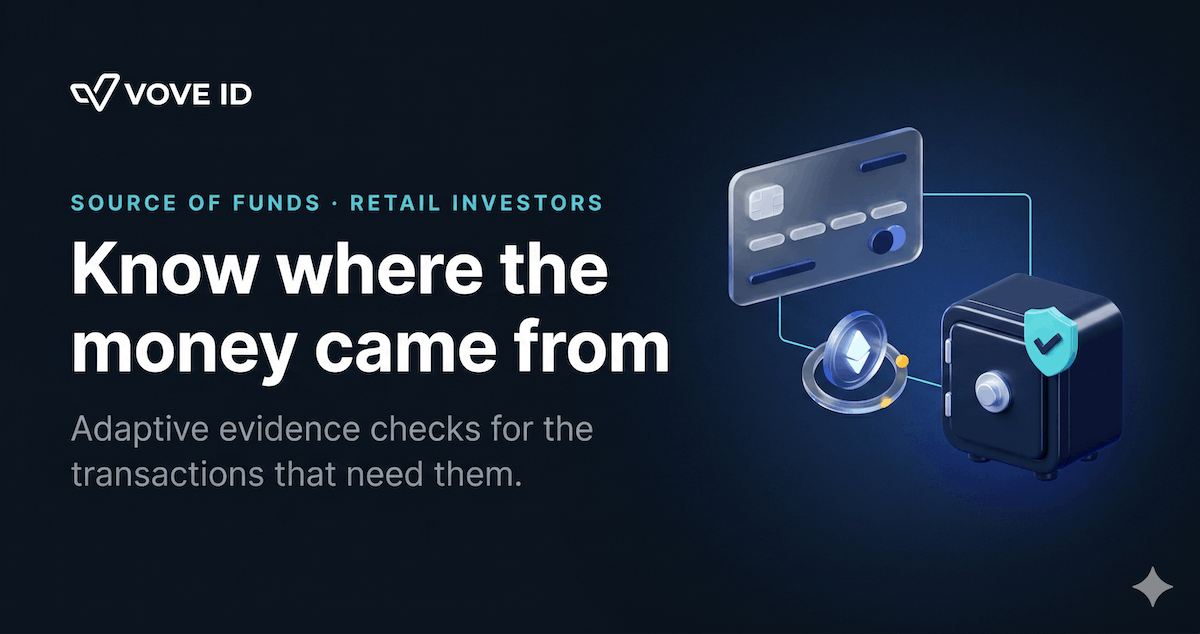
VOVE ID helps retail investment platforms collect source-of-funds evidence in markets where supervisors treat SoF as basic compliance hygiene — not an optional control reserved for high-value clients.
This guide covers how to build a risk-based SoF workflow for a retail context. For the underlying AML framework that governs when and how SoF obligations apply, see our AML Requirements Explained 2026.
Direct answer: Source-of-funds checks help a platform confirm where a specific investment payment came from and whether it fits the investor's profile and risk level. A risk-based SoF workflow should request evidence when a threshold or risk signal is met, record the review decision, and avoid applying the same friction to every investor regardless of risk.
Why Retail SoF Moved from Optional to Expected
Many retail platforms treated source-of-funds as a private banking control or reserved it for customers who looked visibly high-risk. That position is harder to defend in 2026. Retail distribution scales fast, transaction values grow as users gain confidence, and supervisors increasingly expect firms to understand more than identity when money enters the product.
SoF answers a narrower operational question than source of wealth: where did this payment come from, and does the evidence fit this customer, this transaction, and this risk profile?
A proportionate approach starts with defined triggers. The right signal may be a transaction threshold, an unusual payment pattern, a higher-risk geography, a PEP or sanctions screening result, a mismatch between stated occupation and investment behaviour, or a combination of these.
For a full breakdown of KYC requirements and how identity checks connect to SoF obligations, see our KYC Requirements Explained 2026.
The Three Documents That Close Most Cases
Evidence should fit both the claimed source and the transaction size. A retail investor funding a modest recurring subscription should not face the same document request as an investor making a high-value one-off payment from a newly opened account.
In most ordinary cases, one of the following is enough to reach a reasonable, documented view:
- Bank statement or transaction record. Links the funding account to the payment and establishes the immediate source.
- Payslip, employment evidence, or tax documentation. Supports an income-based savings claim where the value and pattern are consistent.
- Sale, inheritance, dividend, or investment documentation. Supports a one-off event such as an asset disposal, dividend receipt, or inheritance.
The objective is not a document archive. It is the minimum evidence that resolves the risk question — and a record of why it was sufficient. If the evidence does not match the stated source, escalate rather than collecting additional uploads indefinitely.
The Failure Mode: Growth Becomes the Audit Trigger
Consider a retail investment app that crosses 50,000 users. Early growth came from low-value repeat subscriptions, so the team never built a consistent SoF process. As balances grow, a significant share of higher-ticket investors has only identity documents on file.
The home regulator opens a review. The platform can show who its users are and when they invested. It cannot explain the origin of funds for a group of higher-value subscriptions, demonstrate the thresholds that should have triggered review, or prove that exceptions were handled consistently.
This is rarely fixed by sending a blanket document request after the fact. That creates customer friction, strains operations, and does not reconstruct the position at the time the decision was made. The better design is adaptive: request evidence when the signal requires it and preserve the result while the transaction is current.
How VOVE ID Collects SoF Without Killing Conversion
VOVE ID lets platforms make source-of-funds a targeted workflow rather than a universal gate. Risk rules trigger a case when a transaction, customer profile, screening result, or behaviour pattern meets the defined criteria. The investor sees a clear request for the evidence that fits their case; the compliance team sees the context, documents, and audit record in one place.
A practical sequence:
- verify identity and screen the investor;
- apply transaction and risk thresholds;
- request proportionate SoF evidence only where the rule requires it;
- route inconsistencies to a reviewer with the relevant context;
- record the decision, rationale, and reviewer action; and
- set a refresh or re-trigger rule for future activity.
The outcome is less friction for straightforward customers and a stronger file for the cases that actually need attention.
Implementation Checklist
- Threshold: Define the value, velocity, geography, screening, and behavioural triggers that require SoF review — and document them.
- Evidence: Map acceptable document types to common funding scenarios and specify what makes evidence sufficient or inconsistent.
- Audit: Store the request, submission, decision, rationale, timestamps, and reviewer actions against the investor and the specific transaction.
- Escalation: Create a clear path for missing, contradictory, or suspicious evidence. Repeated upload requests are not a substitute for a decision.
- Testing: Sample completed cases regularly to confirm that thresholds and reviewer outcomes are applied consistently over time.
Q&A
Is source of funds required for every retail investor?
Not in a well-designed framework. SoF collection should be risk-based, triggered by defined criteria, and documented. The obligation is to have a defensible process — not to apply it uniformly to every account.
What is the difference between source of funds and source of wealth?
Source of funds addresses the origin of a specific payment or investment. Source of wealth is broader — it explains how a person built their overall assets. Higher-risk cases may require both, but they answer different questions and need different evidence.
How can platforms avoid losing conversion during SoF collection?
Keep the request targeted, explain to the investor why the evidence is needed, accept document formats that are realistic for that user's country and bank, and only interrupt the journey where the risk rule requires it.
Conclusion
Retail SoF is not a control platforms can defer until they are larger. The right time to establish it is before growth turns a group of high-value payments into a portfolio-wide evidence gap. Proportionate triggers, focused evidence requests, and an audit-ready decision record are what make the process defensible when supervisors ask.
Hitting a SoF review gap across your retail investor base and not sure where to start? VOVE ID can show you how risk-based triggers and adaptive evidence collection work in practice.
This article is intended for general informational purposes only and does not constitute legal, financial, or regulatory advice. KYC/KYB/AML requirements may vary depending on jurisdiction, industry, and specific business circumstances. For up-to-date and binding compliance obligations, readers should refer to the relevant regulatory authorities or consult qualified professionals.