Document Forgery Detection: What Helps Detect a Fake ID in 2026
A document check is a signal for a reviewer, not a verdict on a person. Here's what forgery-detection signals actually establish, and what they don't.
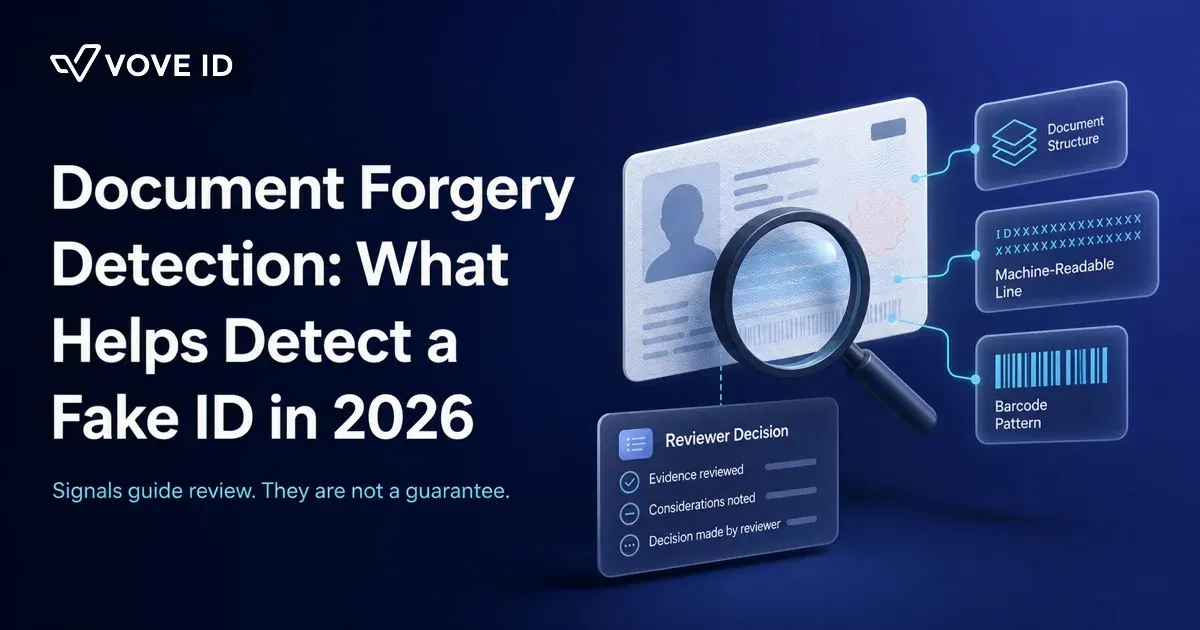
Document-forgery detection helps a KYC team find evidence that deserves review. It does not turn a single image check into a guarantee that an ID is genuine or that an applicant is trustworthy.
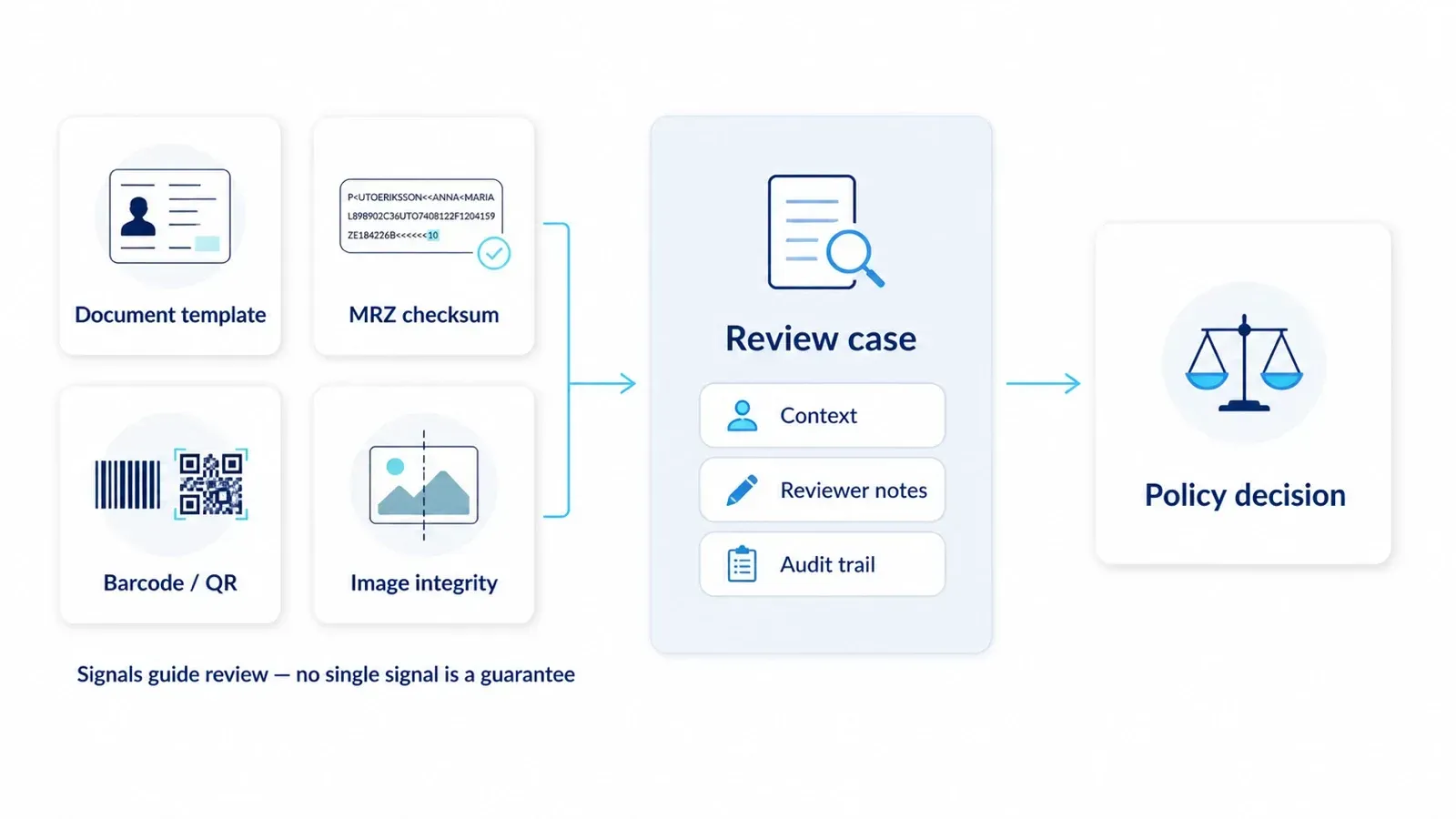
Direct answer: Forgery-detection signals — template consistency, MRZ checksums, barcode/QR consistency, and image-manipulation indicators — flag evidence for a reviewer to investigate. None of them alone proves a document is fake or genuine; the decision belongs to the policy and the reviewer.
VOVE ID helps compliance and risk teams assess identity documents as part of a controlled verification workflow. The challenge is that a document image can contain a mixture of valid-looking fields, altered elements, capture defects, and missing context.
Teams run into the same failure repeatedly: a single check gets treated as a verdict instead of a signal that still needs a reviewer's judgment.
What document checks are actually trying to establish
Identity proofing has distinct steps. The current NIST identity-proofing guidance separates collection of identity evidence, validation of the evidence, and verification that the claimed identity is associated with the person presenting it. That is useful operationally even where a team is not implementing a NIST program.
For a KYC reviewer, a document check asks narrower questions. Does the document type look internally consistent? Do machine-readable fields agree with visible fields? Does the image show signs that matter for review?
The answers help decide whether to continue, request better evidence, route the case to manual review, or reject under a documented policy. They do not replace the policy itself.
The ICAO Doc 9303 series illustrates why travel-document assessment is not one visual test: its specifications cover machine-readable documents, document security, biometrics, and security mechanisms.
For the underlying identity-verification framework, see our KYC requirements explained.
Useful detection signals: consistency, structure, and capture integrity
Some signals help a reviewer focus attention because they test whether pieces of the submitted evidence agree. They are not interchangeable, and their relevance varies by document type and capture quality.
Document-template consistency compares the submission with expected structural features. A mismatch can result from an altered image, an unsupported variant, an outdated template, or a poor capture.
MRZ checksums provide a narrow consistency test for machine-readable travel documents. An invalid checksum can expose an issue in the read data, image, or document fields; it does not prove forgery on its own.
Barcode or QR consistency checks whether encoded information can be read and aligns with visible information when a relevant code is present. Treat the result in context.
Image-manipulation indicators can surface signs that the submitted image has been edited or recaptured. They should be evaluated with capture quality, document format, and the full identity case. A false alarm is possible; so is a sophisticated forgery that does not trigger every signal.
Put together, these signals work best as corroboration across evidence, not as a binary label on a file.
The limits that matter in 2026
Teams should be explicit about what a remote workflow cannot establish. It cannot guarantee that a person is safe, that a document was issued to the applicant without qualification, or that a result satisfies every regulator and use case.
Likewise, a document image is not a government-database check. Do not describe image or template comparison as confirmation from an issuing authority unless the workflow uses an approved source and the claim is documented.
FATF's digital identity guidance supports a risk-based assessment of whether digital identity is appropriate for customer due diligence. In practice, that calls for defined evidence requirements, documented decisions, and escalation paths — not a claim that every applicant can be resolved automatically.
A realistic KYC case: the polished image that does not close the review
A marketplace applicant submits a crisp photo of an identity document and a selfie. The upload passes basic image-quality checks. The document's visual fields look plausible at a glance.
Then the inconsistencies appear:
- The document structure does not match the expected template.
- The machine-readable zone does not produce a valid checksum.
- The encoded data does not align with the visible fields.
- The case requires a reviewer decision under the platform's policy.
The reviewer does not label the document fake merely because one check failed. They review the evidence, request a new capture or additional documentation where policy allows, and record the reasoned decision.
This is not an image-analysis failure. It is an evidence-and-decision workflow.
How VOVE ID approaches this: signals inside an auditable case
VOVE ID supports identity verification, biometric liveness, and face matching as part of an identity workflow. It can help detect document-template inconsistencies, invalid MRZ checksums, barcode or QR inconsistencies, and signs of image manipulation.
These controls help teams identify cases that merit attention. They do not guarantee fraud detection, authenticate every document, or replace a team's approval criteria. VOVE ID does not claim government-database checks for this workflow.
When a case needs judgment, a compliance team can use manual review where it has sufficient evidence to approve a verification. The outcome is an auditable decision: what was supplied, considered, and actioned.
Practical document-forgery detection checklist
Collection
- Request the document types and capture quality required for the relevant use case.
- Keep the original submission and the identity-case context together.
- Explain when an applicant must provide a new capture or additional evidence.
Detection and review
- Use template, MRZ, barcode or QR, and image-integrity signals as review inputs.
- Treat a single failed signal as a reason to investigate, not an automatic fact.
- Record the policy reason and reviewer action for every exception.
Decision and audit
- Link document findings to liveness or face-matching evidence where required.
- Escalate unresolved risk through the team's documented process.
- Retain the evidence and decision record according to applicable obligations and policy.
FAQ
Can software prove that an ID is fake?
No. Detection controls can identify inconsistencies or manipulation indicators that help a team investigate. The final action depends on the available evidence and the platform's documented policy.
What does an invalid MRZ checksum mean?
It means the machine-readable data did not satisfy the checksum calculation. That can arise from an altered field, an extraction issue, a damaged capture, or another inconsistency that needs context.
Is selfie matching the same as document-forgery detection?
No. Face matching helps assess whether the person presenting is associated with the document portrait. Document checks assess the submitted identity evidence; both can inform one case decision.
Should a reviewer automatically reject a document with a failed barcode or QR check?
No. A code can be unavailable or unreadable for legitimate reasons. Apply the platform's policy, use the full case evidence, and record the rationale for the next action.
Conclusion
Document-forgery detection isn't a verdict engine that clears or condemns a person on its own — it's an evidence layer that helps KYC teams find inconsistency, apply policy, and record a reasoned outcome.
Teams should combine relevant document signals with identity context and an accountable review path. Collection, verification, and case management are one workflow.
Want to see how VOVE ID helps teams assess identity evidence in an auditable workflow?
This article is intended for general informational purposes only and does not constitute legal, financial, or regulatory advice. KYC/KYB/AML requirements may vary depending on jurisdiction, industry, and specific business circumstances. For up-to-date and binding compliance obligations, readers should refer to the relevant regulatory authorities or consult qualified professionals.