EBA Guidelines on Outsourcing: What Compliance-as-a-Service Has to Prove
Outsourcing compliance work is allowed under EBA rules. Losing the ability to inspect and govern it is not.
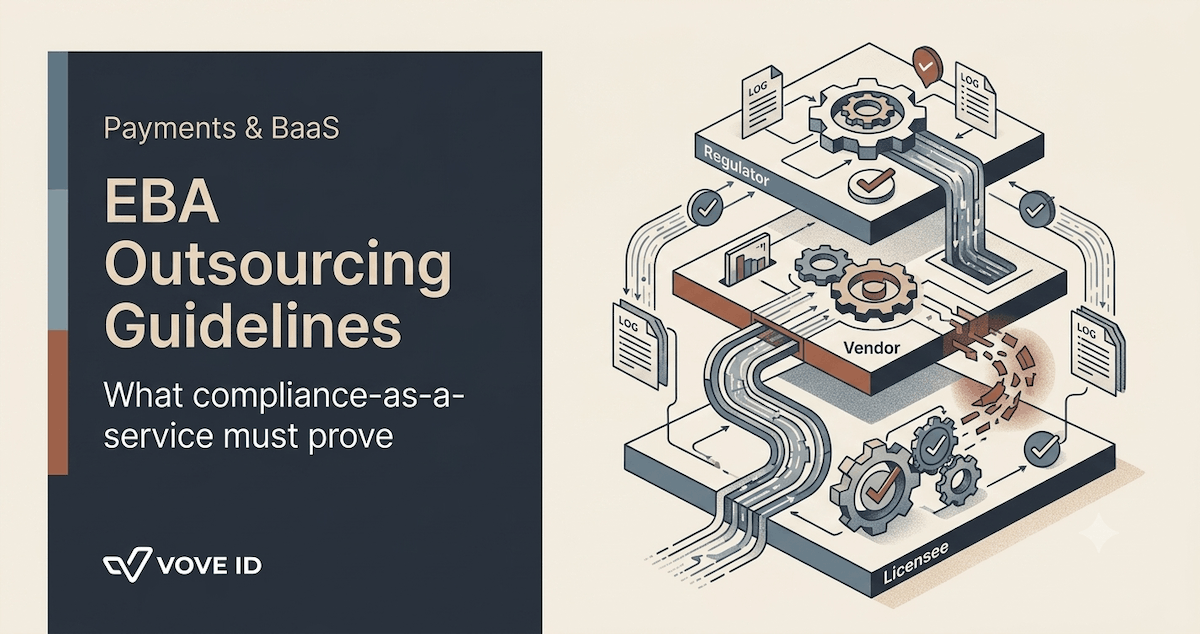
VOVE ID helps payment institutions and EMIs outsource parts of their compliance stack in a way that still leaves the licensee in control. That is the core issue under the EBA Guidelines on Outsourcing. Outsourcing is allowed. Abdicating responsibility is not. The institution remains accountable for the regulated outcome even when a third party performs the operational work.
Direct answer: Under the EBA Guidelines on Outsourcing, compliance-as-a-service has to prove two things above all: that the regulated institution keeps real control over the outsourced function, and that it retains real access to the data, evidence, workflows, and exit path needed to govern that function. If the vendor cannot demonstrate those two pillars on demand, the outsourcing model will fail under scrutiny.
What the EBA outsourcing guidelines require
The EBA approach to outsourcing is often summarized too loosely as "have a contract and monitor the vendor." That is not the real standard. The real standard is operational governance. A payment institution or EMI has to identify whether the outsourced activity is important or critical, assess the risk before signing, maintain a register of outsourcing arrangements, and ensure that the arrangement remains controllable throughout its life.
For compliance-as-a-service, this matters because the outsourced function often touches onboarding, screening, monitoring, case handling, or decision support. Those are not background vendor tasks. They are part of the evidence trail regulators use to judge whether the licensee actually runs its control framework.
That is why outsourcing due diligence has to go beyond product capability. The licensee must understand how the provider operates, how incidents are escalated, what data is retained, which subcontractors are involved, what access rights exist for audit and inspection, and how service continuity would work if the relationship ended badly.
In other words, the EBA is not asking whether the vendor is useful. It is asking whether the licensee can still prove control after the work has moved outside its own walls.
Control and access: the two evidence pillars
Most outsourcing failures reduce to one of two missing pillars: control or access.
Control means the institution can define the rules, govern the service, review outcomes, escalate issues, and intervene when the vendor process is not sufficient. If a compliance service provider makes risk decisions in a black box the institution cannot tune or challenge, the institution does not control the function. It merely consumes it.
Access means the institution can retrieve what it needs when it needs it. That includes data, case records, audit trails, rule logic, incident history, evidence of performance, and documentation about the provider's own controls. If a regulator, internal audit team, or board risk committee asks for proof, the institution cannot wait three weeks for a vendor export and call that governance.
The EBA logic is practical: if you cannot inspect it, you cannot govern it. If you cannot govern it, you cannot outsource it safely.
Those pillars also define what "compliance-as-a-service" must look like in practice. The vendor cannot be just an API plus an SLA. It has to be an inspectable operating model with clear accountability boundaries.
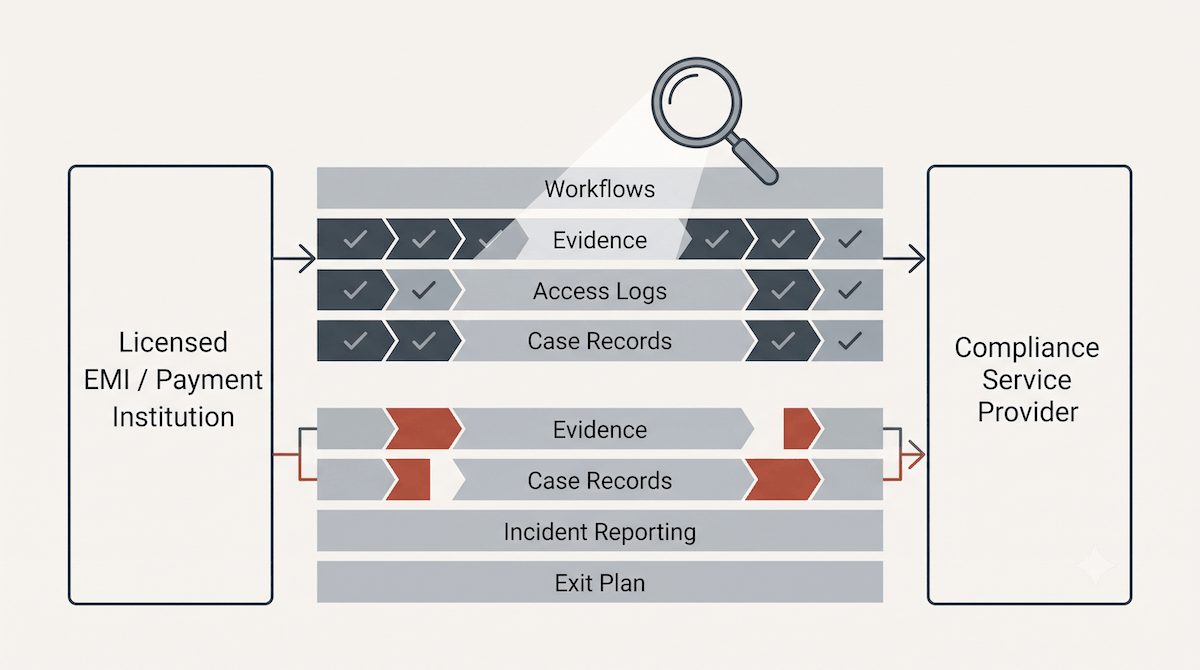
A realistic outsourcing failure: when the vendor cannot produce its own audit
Consider an EMI that outsources transaction monitoring operations to a specialist provider. The service works well in ordinary weeks. Alerts are reviewed on time. Cases are closed. Reporting metrics are shared monthly. The relationship looks healthy.
Then an inspection asks a harder question: show the provider's own control evidence, including access logs, quality review records, incident history, subcontractor visibility, and the most recent independent assurance report. The EMI asks the vendor for the documents. The vendor says the SOC package is under separate NDA, the access logs are not exportable in the expected format, and part of the review workflow is handled by a subcontractor the EMI had not assessed directly.
At that point, the problem is not a missed alert. The problem is that the licensee cannot prove control over an outsourced important function. Even if day-to-day performance was acceptable, the governance file is weak. Under EBA logic, that weakness belongs to the licensee.
This is exactly where many compliance-as-a-service pitches fall apart. They focus on speed, analyst coverage, and operational convenience, but not on inspectability. Regulators do not audit the marketing claim. They audit the evidence trail.
For a full breakdown of transaction monitoring and sanctions screening requirements, see our AML Requirements Explained 2026.
How VOVE ID stays inside EBA-grade outsourcing boundaries
VOVE ID is built for institutions that want outsourced support without losing governance. The operating principle is simple: the licensee should see, inspect, and evidence the same workflow the provider uses.
That means onboarding and monitoring workflows must be visible with auditable actions, not hidden behind managed-service summaries. Rule outcomes need to be explainable. Access and user activity need to be logged. Case decisions need timestamps, actors, notes, and review history. If the institution wants to change escalation thresholds, review queues, or evidence requirements, the workflow should support that without rebuilding the relationship.
It also means the outsourcing file should not be assembled ad hoc during an inspection. Core evidence such as control documentation, access models, incident handling logic, and exit-readiness materials should already exist in a form the institution can review and retain.
This is the real bar for compliance-as-a-service in Europe: not just performing compliance work competently, but performing it in a way the licensee can continuously supervise and defend.
Outsourcing checklist for payment institutions and EMIs
Before treating a compliance provider as EBA-ready, ask the following.
Can we explain which outsourced functions are important or critical, and why?
Can we inspect the workflow, not just the outcome reports?
Can we retrieve access logs, case history, rule logic, incident records, and independent assurance evidence without delay?
Can we see subcontractor involvement clearly and assess the associated risk?
Can we move or unwind the service without losing data, continuity, or regulatory evidence?
If those answers are not already documented, the outsourcing model is weaker than it looks.
Q&A
Do the EBA outsourcing guidelines prohibit compliance-as-a-service?
No. They allow outsourcing, including important functions, provided the institution keeps effective governance, oversight, access, and exit control.
What is the biggest outsourcing risk for a regulated fintech?
The biggest risk is losing operational control while assuming the vendor's competence solves the governance problem. It does not. Accountability stays with the licensee.
What should a fintech ask a compliance vendor before signing?
Ask for evidence of auditability, access rights, subcontractor transparency, incident governance, assurance reporting, and exit readiness, not just service coverage and SLA language.
Conclusion
The EBA Guidelines on Outsourcing do not make compliance-as-a-service impossible. They make lazy outsourcing impossible. A provider can run pieces of the compliance operation, but the regulated institution still has to prove that it controls the function, understands the risk, and can inspect the evidence at any time.
That is why the right outsourcing question is not "Can this vendor do the work?" It is "Can we still defend the work as if a regulator were looking over our shoulder?" If the answer is yes, the model can scale. If the answer is no, the institution has bought convenience at the cost of governability.
Could your outsourced compliance provider produce its own audit trail tomorrow, on demand? Most outsourcing arrangements fail governance review not because the work was done badly, but because the licensee cannot inspect it fast enough when asked. VOVE ID keeps onboarding and monitoring workflows visible and auditable by design, so the evidence file already exists before the inspection does.
This article is intended for general informational purposes only and does not constitute legal, financial, or regulatory advice. KYC/KYB/AML requirements may vary depending on jurisdiction, industry, and specific business circumstances. For up-to-date and binding compliance obligations, readers should refer to the relevant regulatory authorities or consult qualified professionals.