Fractional Real Estate in the EU: KYC When the Investor Is Anywhere
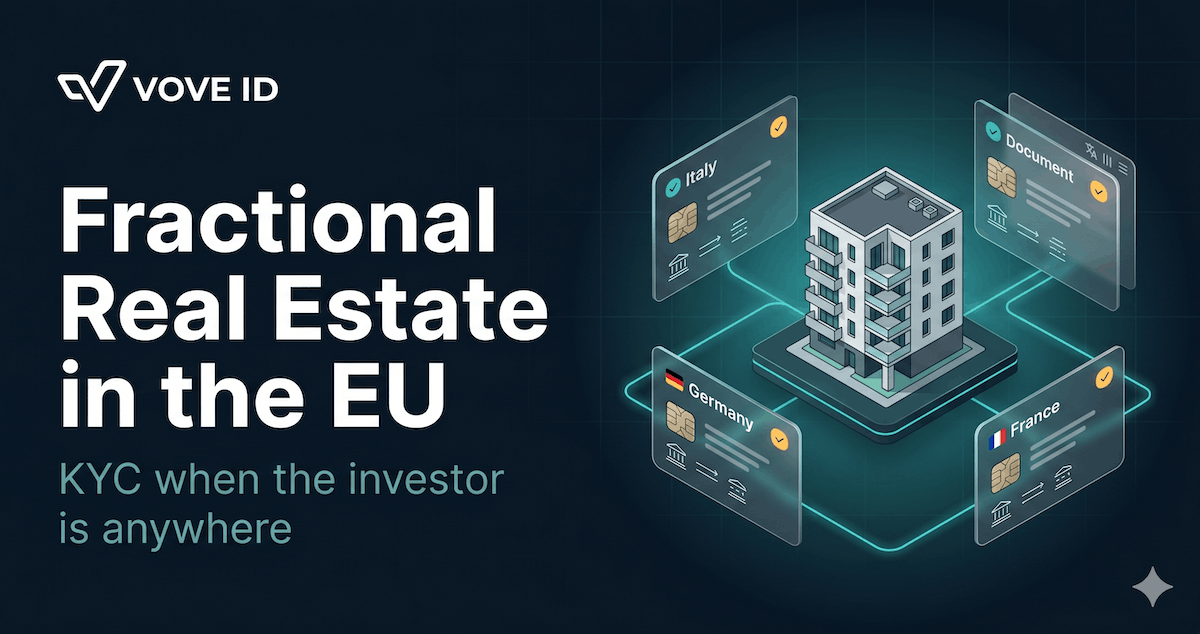
Fractional real estate KYC breaks when the investor is Italian, the asset is German, and the payment comes from France. Here is how to build an onboarding stack that handles the combination.
VOVE ID helps fractional real estate platforms onboard investors in markets where the asset is in one country and the user is in twenty. On paper the asset is local. In practice the investor is everywhere.
This guide covers the cross-border KYC and source-of-funds logic that fractional real estate platforms need to get right. For the underlying identity verification framework, see our KYC Requirements Explained 2026.
Direct answer: Fractional real estate KYC in the EU requires verifying the investor, the source of funds, and the cross-border risk behind each subscription. A platform cannot treat a German property, an Italian investor, and a French bank account as a single-country onboarding file.
Fractional real estate makes property investing accessible to retail participants who could not buy a whole asset. A retail investor can take a position in a Berlin apartment block, a Spanish logistics asset, or a Dutch rental portfolio from a mobile app.
The commercial model is clean. The compliance file is not.
The investor may live in Italy. The asset may sit in Germany. The payment may arrive from France. The platform may be licensed in Lithuania. Each of those facts can change what evidence the platform needs, which language the user sees, and what the audit trail must prove.
Why Fractional Real Estate Is a Multi-Jurisdiction KYC Problem
Traditional real estate onboarding assumed local buyers, local brokers, and local banks. Fractional platforms break that assumption by design.
The investor can come from anywhere in the EU. The property stays in one member state. The payment rail may pass through another. The platform has to decide which country rules apply without turning the signup flow into a legal questionnaire.
That means the KYC stack needs more than a passport scan and a liveness check:
- identity verification appropriate for the investor's country of residence
- address evidence that fits the risk profile
- sanctions and PEP screening
- source-of-funds collection when thresholds or risk signals require it
- language handling for supporting documents
- audit logic that explains why the platform approved, paused, or rejected the user
The problem is not just regulatory coverage. It is operational consistency. If every country combination creates a manual exception, review queues grow and conversion drops. If every user goes through the heaviest possible flow, low-risk investors leave before funding.
For a full breakdown of AML requirements in cross-border retail investment contexts, see our AML Requirements Explained 2026.
Cross-Border Source of Funds
Source of funds is where fractional real estate onboarding gets difficult.
A user can pass identity checks without raising a flag and still create a source-of-funds question because the funding path does not match the user's profile. A French account funding an Italian resident's purchase of a German asset is not suspicious. It is a case that needs the right evidence.
The mistake is asking every investor for the same documents in the same format.
Low-risk subscriptions may only need basic payment-source consistency. Higher-ticket investments may require salary evidence, bank statements, sale proceeds documentation, or inheritance records. Cross-border users may need request templates that explain what is needed in their language and accept the document formats their local bank actually produces.
Source-of-funds collection should be adaptive:
- trigger only when subscription size, geography, payment path, or risk score justifies it
- request documents the investor can realistically provide
- parse multiple languages and document formats
- link the evidence to the specific subscription, not just the user profile
- keep the decision trail reviewable for compliance reviewers and regulators
When an Italian User Buys a German Fraction with French Funds
Consider a Berlin-based fractional platform onboarding an Italian investor.
The investor passes identity verification. The asset is a German rental property. The investor funds the subscription from a French account because they work in Paris and hold their salary account there.
Nothing about that fact pattern is unusual in the EU. But if the platform's onboarding flow supports only one language, one source-of-funds template, and one review queue, the process breaks.
The system asks for source-of-funds evidence in English. The investor uploads a French bank document. The reviewer cannot process it quickly. The file sits for three days. The investor assumes the platform has a technical problem and abandons the subscription.
This is not a fraud problem. It is a compliance design problem.
The platform needed a flow that could identify the country combination, explain the request in the right language, parse the French document format, and keep the review moving without escalating a routine EU investor case to manual exception.
How VOVE ID Handles Cross-Border Source of Funds
VOVE ID lets fractional real estate platforms build onboarding around the investor's actual risk profile rather than a fixed checklist applied to everyone.
The flow starts with identity, liveness, sanctions, and PEP screening. When the investment amount, jurisdiction mix, payment source, or risk score requires more, VOVE ID can trigger source-of-funds collection inside the same journey without routing the user out to a separate process.
For cross-border cases, the stack handles:
- country-specific identity and document requirements
- multi-language document parsing, including French, Italian, and German bank records
- source-of-funds request templates matched to the investor's situation
- risk-based escalation instead of blanket manual review
- case records that connect identity, payment origin, source-of-funds evidence, and the final subscription decision
The investor does not need to understand which jurisdiction created the request. The compliance team can reconstruct the decision without additional investigation. The platform holds one investor file that shows who the person is, where the money came from, and why the subscription was approved.
Checklist for Fractional Real Estate KYC
Before scaling cross-border fractional real estate onboarding:
- Identity: Verify the investor with country-appropriate document checks, liveness, sanctions screening, and PEP checks.
- Source of funds: Trigger evidence requests based on investment amount, payment source, geography, and risk score — not as a universal step.
- Cross-border logic: Capture the relationship between investor country, asset country, payment country, and the licensing entity.
- Language: Support the languages and document formats investors actually submit.
- Audit trail: Store the evidence, reviewer action, and decision rationale in one investor file per subscription.
- Conversion control: Do not send low-risk investors through high-friction steps before a risk signal exists.
Q&A
Does every fractional real estate investor need source-of-funds checks?
No. A risk-based approach triggers deeper checks when the investment amount, payment route, jurisdiction mix, or screening result justifies it. Applying the same requirements to every investor regardless of risk signal creates friction without compliance benefit.
Why is fractional real estate KYC harder than standard property onboarding?
Fractional platforms separate the investor from the asset location. One property can attract investors from many EU countries, which means the onboarding stack has to handle cross-border identity verification, cross-border payments, multiple languages, and source-of-funds evidence — often in a single investor file.
Can source-of-funds collection be automated?
The request, collection, parsing, and routing steps can be automated for most cases. Human review should focus on exceptions, unclear documents, high-risk profiles, and decisions that require judgment calls the system cannot make.
What should the audit file contain?
The file should show the investor's identity, screening results, payment context, source-of-funds evidence where required, reviewer actions, and the final decision for the specific subscription. The link between the user and the specific asset transaction needs to be traceable.
Conclusion
Fractional real estate platforms grow by removing geography from the investor experience. Compliance cannot remove geography from the file.
The answer is not heavier onboarding applied to everyone. It is adaptive onboarding that accounts for investor country, asset country, payment path, source-of-funds risk, and language requirements in one connected flow — so the platform can keep cross-border access open while producing a file a regulator can review.
Running cross-border source-of-funds collection across EU countries and getting inconsistent results? VOVE ID can show you how the onboarding stack handles the investor-asset-payment country combination in one file.
This article is intended for general informational purposes only and does not constitute legal, financial, or regulatory advice. KYC/KYB/AML requirements may vary depending on jurisdiction, industry, and specific business circumstances. For up-to-date and binding compliance obligations, readers should refer to the relevant regulatory authorities or consult qualified professionals.