Hungary, MNB, and the New Wave of Crypto-Adjacent Payment Startups
Why Hungarian payment startups with stablecoin or wallet exposure need one mapped, MNB-ready compliance file in 2026.
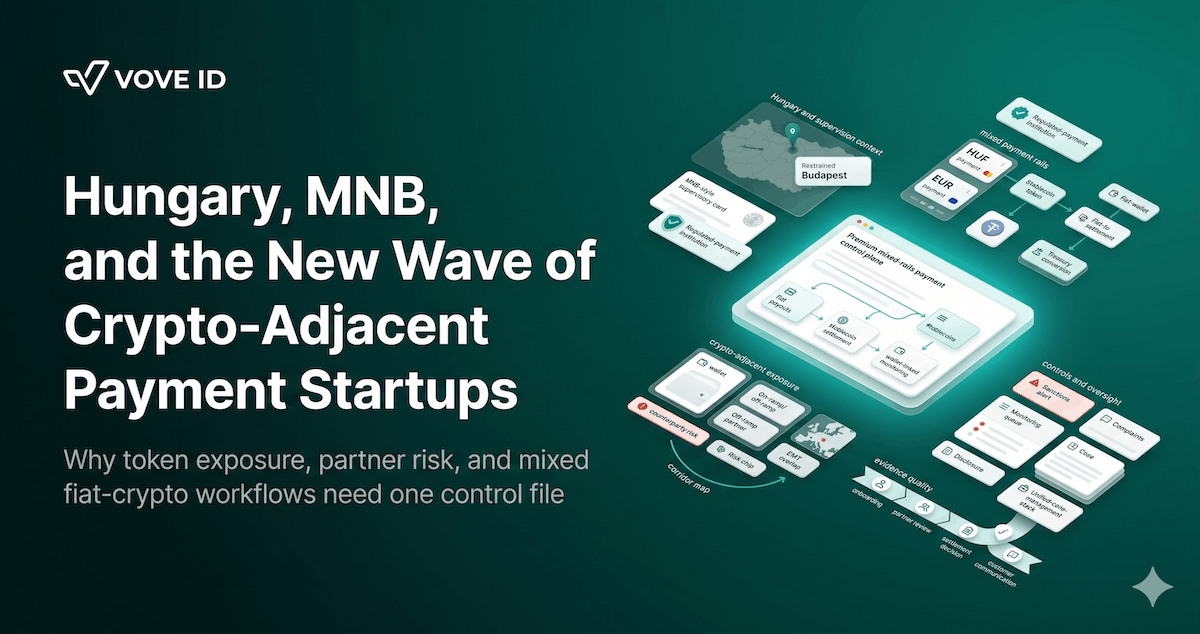
In Hungary, the hard compliance question for crypto-adjacent payment startups in 2026 is not whether the product calls itself crypto. It is whether the startup can explain exactly where token exposure enters a licensed payment flow, what that does to AML and sanctions controls, and how the file still holds together when fiat rails, wallet logic, treasury decisions, and cross-border counterparties start touching the same customer journey.
What should Hungarian crypto-adjacent payment startups expect from MNB scrutiny in 2026? As of 15 June 2026, they should expect scrutiny to land on the token surface area of the business: where stablecoins or other crypto-assets enter or leave the product, how counterparties are classified, whether any e-money-token and payment-services overlap has been mapped properly, and whether AML, sanctions, outsourcing, complaints, and evidence controls still work once fiat and token flows touch the same file. The issue is rarely the marketing label. The issue is whether the operating model can explain the token exposure end to end.
Hungary is a credible base for payment products that want to stay close to regional commerce, FX, treasury, and cross-border flow problems.
That is exactly why the crypto-adjacent wave matters.
The startups arriving now are often not pure exchanges and not pure wallet apps.
They are payment businesses with token exposure at the edges:
- stablecoin treasury
- on-ramp or off-ramp components
- merchant settlement logic
- wallet-linked payouts
- EMT-shaped customer flows
On paper, that can still look like a payment product.
In practice, it creates a mixed supervision problem.
This is where the file gets harder than the pitch.
Why "crypto-adjacent" is the category that actually matters
Many teams still divide the market too simply:
- traditional payments
- crypto
That is not how the operating risk appears anymore.
The more realistic category is crypto-adjacent payments.
That means a business where the core user promise is still payment, treasury, merchant flow, remittance, or settlement, but one or more product layers now touches:
- stablecoins
- crypto-asset service providers
- wallet infrastructure
- token-linked liquidity providers
- EMT-type payment logic
This matters because the licensing perimeter may look straightforward while the risk perimeter does not.
A startup can keep saying it is a payment business.
The supervisor will still want to know where token exposure sits, how it is controlled, and whether the AML record is still readable when crypto and fiat events touch the same case.
The timing is not abstract anymore
For years, teams treated European crypto-adjacent regulation as a future migration problem.
That is no longer credible.
The dates are concrete:
- 30 December 2024: the broader
MiCAframework started applying across the EU - 2 March 2026: the
EBAno-action transition on thePSD2andMiCAinterplay ended - 1 July 2026: the EU-wide end point for MiCA transitional periods arrives
So on 15 June 2026, a Hungarian startup building payment products with token exposure is operating in a live transition environment, not a theory environment.
This matters even for teams that are not describing themselves as full CASPs.
If the business touches EMT-like payment flows, crypto-asset counterparties, stablecoin treasury, or wallet-linked payment events, the file needs to be much more precise than it did a year earlier.
The MNB problem is not whether the startup is innovative
The MNB does not need a startup to look old-fashioned.
It needs the operating model to be understandable.
That is the real issue.
Crypto-adjacent payment startups often have elegant front-end logic and messy control boundaries underneath:
- the payments team owns the user relationship
- a third party owns the on-ramp
- treasury owns the stablecoin conversion
- compliance owns sanctions
- another vendor owns wallet analytics
The user sees one product.
The file becomes four partial records.
That is exactly where supervisory discomfort starts.
A Hungarian payment startup with token exposure should assume the hard question will be:
where exactly does the regulated payment workflow stop, where does token exposure begin, and who owns the control logic across that boundary?
Where crypto-adjacent payment files usually break
The weakness is rarely one dramatic compliance failure.
It is usually one fragmented operating model.
1. The token-exposure map does not exist
This is the most common problem.
The startup can explain the product commercially, but it cannot produce one clean diagram showing:
- where customer funds enter
- where conversion happens
- whether a wallet is involved
- which counterparties touch the flow
- whether the startup or a partner performs the crypto-facing step
- where monitoring, screening, and escalation attach
Without that map, every later control conversation becomes harder.
The institution cannot classify risk cleanly if it cannot map the flow first.
The starting point of that map is always the customer relationship itself — see KYC requirements explained for the identity-verification baseline that any token-exposure map has to build on.
2. Counterparty risk is under-designed
Crypto-adjacent payment products depend on more than customers.
They depend on counterparties:
- exchanges
- OTC desks
- liquidity partners
- wallet infrastructure providers
- payout partners
- treasury counterparties
Teams often perform customer-level KYC and then treat the counterparty layer as a commercial dependency instead of a compliance dependency.
That is too weak.
If a stablecoin treasury partner, on-ramp, or off-ramp sits inside the funds path, the startup needs a repeatable method to classify, review, and re-review that counterparty risk.
Otherwise the product is only half screened.
Counterparties are businesses too, and the same entity-and-ownership rigor applies — see KYB requirements explained for how that verification model works.
3. EMT and payment-services overlap gets described loosely
This is where precision matters in 2026.
The EBA already spent 2025 and early 2026 addressing the overlap between MiCA and payment-services rules where e-money tokens and payment functionality start colliding.
That does not mean every token-linked payment startup is the same.
It does mean sloppy language is now dangerous.
If a team cannot explain whether it is dealing with:
- pure payment flows
- crypto-asset service components
- EMT-related payment logic
- outsourced partner activity
then the supervisory file becomes blurred at exactly the wrong point.
4. Complaints and disclosures still assume a pure payment product
This failure is underrated.
A user who sees stablecoin settlement, wallet-linked payout, or token-conversion language is not dealing with a classic card or bank-transfer experience.
That changes the questions the user may ask:
- what counterparty handled the conversion
- what happened to the wallet address
- why settlement timing changed
- why a transaction was held for review
- whether the user was exposed to token-specific risk or fees
If the complaints process and disclosure logic still read like a normal payment product, the institution creates avoidable conduct risk.
5. Monitoring is split between fiat logic and token logic
This is where the queue starts leaking.
A fiat monitoring tool may see:
- payer
- beneficiary
- amount
- country
- velocity
A token-specific tool may see:
- wallet exposure
- hops
- clustering
- on-chain counterparties
- sanctions adjacency
If those two views do not join inside one decision file, the startup may investigate only half the risk.
That is not a technology problem first.
It is a control-design problem.
This is exactly the kind of cross-checking that sits at the center of how AML requirements work in practice — joining transaction-level signals into one reviewable case.
6. Outsourcing hides the real control perimeter
Crypto-adjacent payment businesses are unusually vendor-heavy.
That is not inherently wrong.
The problem appears when no one can explain:
- what the startup itself controls
- what the partner controls
- how alert ownership works
- what happens if the partner fails
- who can reconstruct the event later
This is especially relevant when the token-facing component is not operated directly by the Hungarian regulated entity.
The customer journey may still rely on it.
That makes it part of the control perimeter whether the startup likes that or not.
A realistic Hungarian failure: when the product looks like payments and the file looks like crypto fragments
Imagine a Budapest-based payment startup serving exporters and digital merchants.
Its product pitch is simple:
- local onboarding
- EUR and HUF collections
- cross-border payout
- optional stablecoin settlement for selected treasury or merchant use cases
The founders do not think of the business as a crypto firm.
That is commercially understandable.
Then the operating gaps appear.
The on-ramp partner owns one part of wallet screening.
The payment platform owns customer onboarding.
Treasury decides when stablecoin liquidity is used.
Compliance reviews sanctions alerts in a separate queue.
The customer complaint workflow still assumes a traditional payout product.
Now one merchant asks why a settlement was delayed after a wallet review.
Another asks which entity actually handled the conversion.
An internal audit asks for one end-to-end record covering:
- onboarding
- disclosures
- counterparty identity
- monitoring
- settlement decision
The team can answer each question in a different system.
It cannot answer them in one file.
That is the real failure mode.
The startup did not become unviable because it touched crypto.
It became hard to supervise because token exposure was added faster than the control model was redesigned.
What a stronger MNB-ready operating file looks like
A stronger crypto-adjacent payments file usually gets five things right.
1. It maps the token surface precisely
The startup can show exactly where token exposure begins and ends for each product flow.
That includes treasury, settlement, conversion, counterparties, and customer touchpoints.
2. It treats counterparties as compliance objects
The business has a repeatable method to classify and review exchanges, OTC desks, wallet-service providers, liquidity partners, and token-linked infrastructure vendors.
3. It separates labels from legal and operational reality
The file does not rely on marketing language like "crypto-enabled" or "just settlement."
It explains what actually happens in the flow and what regulatory or AML consequences follow from that.
4. It joins fiat and token monitoring into one case record
Alerts, sanctions logic, transaction context, wallet data, and manual decisions should live in one reconstructible case file.
Otherwise the business cannot prove how it handled a mixed event.
5. It redesigns complaints and disclosures for mixed flows
If the product lets a user touch token-linked activity, the institution should already know how that will be explained, documented, and defended when something goes wrong.
How VOVE ID helps crypto-adjacent payment startups build a cleaner file
VOVE ID helps startups turn fragmented crypto-adjacent workflows into one controllable operating record.
For Hungarian payment businesses with token exposure, that usually means:
- joining onboarding, sanctions, and monitoring events into one case structure
- preserving counterparty and wallet-linked context next to the customer record
- giving mixed fiat-and-token alerts a clearer escalation path
- helping teams keep KYB, KYC, and AML evidence connected instead of spread across separate vendor views
- making it easier to explain a payment-plus-token flow in one supervisory file
That matters because the real problem is not only detection.
It is readability.
The institution has to be able to re-tell the same event coherently to compliance, audit, partners, and the supervisor.
Practical checklist
Product mapping
- Draw one end-to-end flow for every product where stablecoins, wallets, EMT logic, or token counterparties appear.
- Mark exactly where customer funds, partner activity, and token exposure intersect.
- Separate pure payment flows from token-linked flows before launch volume arrives.
Counterparty control
- Classify exchanges, OTC desks, liquidity partners, wallet providers, and treasury counterparties as compliance-relevant dependencies.
- Set review and re-review triggers for token-facing partners instead of treating them as static vendors.
- Preserve ownership for counterparty onboarding, screening, and escalation.
Monitoring
- Join fiat transaction monitoring and token or wallet risk signals into one case file.
- Define who owns mixed alerts and what evidence must exist before closure.
- Store the final decision, not only the raw alert output.
Conduct and operations
- Rewrite disclosures and complaint handling for wallet-linked or token-conversion events.
- Document which entity performs each step the customer experiences.
- Build one reconstructible audit trail covering onboarding, partner use, settlement, restrictions, and customer communication.
Q&A
Does a Hungarian payment startup become a CASP just because it touches stablecoins?
Not automatically.
The answer depends on the exact service model. The key point is that token exposure still has to be mapped precisely, because payment rules, crypto rules, AML controls, and outsourcing logic can all be affected by the same flow.
Why does EMT and payment-services overlap matter so much in 2026?
Because the European supervisory framework has already spent 2025 and early 2026 clarifying that some token-linked payment activity cannot be described loosely anymore.
If the flow touches EMT-like payment logic, the operating model has to be much more precise.
What usually breaks first in a crypto-adjacent payment file?
The first break is usually the missing token-exposure map.
Once the startup cannot explain where conversion, wallet logic, counterparty risk, and customer ownership meet, every later control becomes harder to defend.
Can one AML stack cover both fiat and token-linked payments?
Yes, but only if the case model joins both sides of the event.
If fiat monitoring, wallet risk, counterparty review, and complaints all sit in separate systems, the institution will only ever see part of the file at once.
Conclusion
The MNB problem for crypto-adjacent payment startups is not that innovation moved too fast.
It is that many teams added token exposure without rebuilding the control perimeter around it.
The startups that survive 2026 cleanly will be the ones that can map the token surface, control the counterparties, and explain one mixed payment file from first onboarding to final settlement.
Want to see how VOVE ID helps crypto-adjacent payment startups turn fragmented token exposure into one defensible compliance workflow?
This article is provided for general informational purposes and does not constitute legal, regulatory, or compliance advice. Businesses should consult qualified professionals regarding their specific obligations.