KYC Compliance in the UAE (2026): Identity Verification Requirements for Fintechs and Regulated Businesses
Discover KYC compliance in the UAE with our 2025 guide. Learn about UAE KYC laws, verification processes, and digital solutions like VOVE ID to ensure compliance and prevent financial crime.
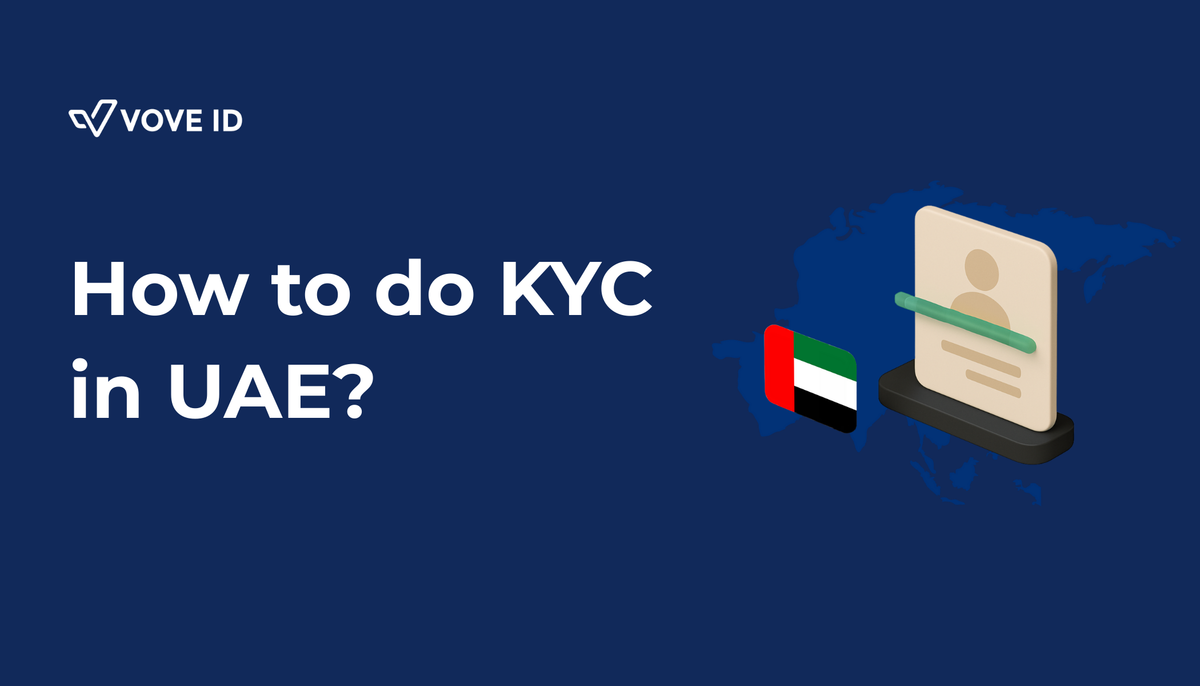
The UAE has built one of the most developed KYC infrastructures in the MENA region — combining federal legislation, free zone regulatory frameworks, and national digital identity systems into a layered compliance environment. For fintechs and regulated businesses, this means KYC is not a single standard but a set of requirements that vary depending on which regulator supervises your activity and where you operate.
This guide covers the UAE-specific KYC layer: legal framework, accepted documents, digital verification infrastructure, free zone distinctions, and where onboarding breaks in practice. For the underlying KYC system architecture and verification logic, see our KYC Requirements guide.
The Legal Framework
UAE KYC obligations are anchored in Federal Decree-Law No. 20 of 2018 on Anti-Money Laundering and Combating the Financing of Terrorism, and operationalised through Cabinet Decision No. 10 of 2019, which details customer identification procedures and risk assessment requirements.
The Central Bank of the UAE (CBUAE) issues guidelines that set the KYC standard for mainland-supervised entities — banks, payment institutions, exchange houses, fintechs, and e-money providers. CBUAE guidelines mandate enhanced due diligence for high-risk clients and set the baseline for what "adequate" identity verification looks like under UAE law.
Free zones operate under separate but aligned frameworks:
- DIFC is regulated by the DFSA, with its own AML Rulebook setting KYC expectations for financial services firms in the Dubai International Financial Centre
- ADGM is regulated by the FSRA, with a separate AML/CFT rulebook for Abu Dhabi Global Market entities
Both free zone frameworks align with federal law but add their own procedural requirements — particularly relevant for firms that operate across mainland and free zone jurisdictions simultaneously.
Who Must Comply
KYC obligations apply to:
- Banks, finance companies, and exchange houses
- Payment service providers, e-money institutions, and licensed fintechs
- Insurance companies
- Investment firms and fund managers
- Virtual asset service providers (VASPs) — regulated by VARA (Dubai) and SCA (federal)
- Real estate agents — subject to enhanced AML/KYC oversight given sector risk profile
- DNFBPs: lawyers, accountants, auditors, dealers in precious metals and stones
Non-compliance carries penalties of up to AED 5 million per violation under CBUAE enforcement powers. In 2023, total fines across the UAE exceeded AED 339 million for AML and KYC breaches.
Accepted Identity Documents
UAE residents: The Emirates ID is the primary identity document. It is machine-readable, biometrically linked, and connected to the UAE's national identity infrastructure (ICP). Expired Emirates IDs are a frequent compliance issue — banks have been known to freeze accounts where IDs have not been renewed, and regulators have specifically flagged this as a gap.
Non-residents and foreign nationals: Passport is the standard document. For higher-risk relationships or longer-term engagements, additional documentation — residency permits, proof of address, source of funds — may be required depending on the risk classification.
Businesses: Trade licence, certificate of incorporation, and Emirates ID registration are the baseline for corporate client onboarding.
UAE's Digital Identity Infrastructure
The UAE has invested significantly in digital identity infrastructure, which directly shapes how KYC can be conducted:
UAE Pass is the government's national digital identity platform. It allows residents to authenticate their identity across government and private sector services using a single verified credential. For KYC purposes, UAE Pass provides a high-assurance identity layer that regulated entities can leverage to reduce document handling friction while meeting CBUAE verification standards.
National KYC Platform — launched in 2023, this platform centralises KYC data across financial institutions, government entities, and free zones. Its goal is to reduce duplication in customer onboarding across institutions, improve data accuracy, and enable collaborative AML/CFT intelligence. It uses blockchain-based architecture for data integrity. This is one of the most operationally significant developments in UAE KYC infrastructure in recent years — firms that integrate with it gain meaningful efficiency in re-verification and ongoing monitoring.
eKYC and biometric verification are accepted by CBUAE, DFSA, and FSRA as equivalent to in-person verification, provided the process meets the same evidentiary standard. This means document capture, liveness detection, and face matching must all be logged for audit purposes.
This is where platforms like VOVE ID close the gap — OCR, biometric liveness, and face matching in one API, with audit-ready logging aligned with CBUAE and DFSA standards. With UAE Pass and the National KYC Platform reducing friction on the identity layer, the operational challenge shifts to risk classification and ongoing monitoring — where automation matters most.
Risk Classification in the UAE
UAE KYC operates on a risk-based approach mandated by both federal law and free zone rulebooks. Entities must classify customers by risk and calibrate verification depth accordingly:
Standard CDD applies to typical relationships with identifiable, low-to-medium risk clients.
Enhanced Due Diligence (EDD) is mandatory for:
- Politically exposed persons (PEPs) and their close associates and family members
- Clients from jurisdictions on the UAE's high-risk country list or FATF watchlists
- Non-face-to-face onboarding with additional risk indicators
- Relationships involving virtual assets or high-value cash transactions
- Complex ownership structures or offshore entities
Simplified due diligence is permitted for clearly low-risk entities — listed companies, regulated financial institutions — but must be documented.
Risk classification must be reviewed and updated throughout the relationship, not just at onboarding.
Ongoing Monitoring and Re-verification
UAE KYC does not end at account opening. CBUAE and free zone regulators explicitly require:
- Transaction monitoring for patterns inconsistent with the declared purpose of the relationship
- Periodic re-verification of customer data — especially for higher-risk clients
- Immediate re-verification triggered by changes in customer circumstances or risk profile
- Emirates ID renewal tracking — expired IDs must be flagged and updated
Suspicious transactions must be reported to the FIU via the goAML platform. Record-keeping obligations require identity and transaction documentation to be retained for 5 years, available to the FIU within 30 days upon request.
Free Zone vs Mainland: What Changes
For most KYC purposes, free zone frameworks (DFSA, FSRA) align closely with federal CBUAE requirements. The practical differences:
- DIFC (DFSA): maintains a public beneficial ownership register — transparency expectations for corporate clients are higher than on the mainland
- ADGM (FSRA): similar alignment with federal standards, with FSRA-specific guidance on EDD triggers and high-risk client categories
- Multi-jurisdiction operations: firms operating across mainland and free zones must meet the more stringent requirement where standards differ — a DIFC-regulated firm serving mainland clients cannot apply a lower verification standard to those relationships
Where KYC Breaks in Practice
Expired Emirates IDs. This is the most common operational failure in UAE KYC. Emirates IDs have expiry dates, and many platforms do not have automated re-verification triggers. CBUAE has flagged this explicitly, and account freezes for outdated IDs are a real operational risk.
Non-resident onboarding complexity. The UAE's international business environment means a high proportion of corporate and individual clients are non-residents. Passport diversity, varying address documentation standards, and source-of-funds verification for cross-border clients add significant friction to onboarding flows. VOVE ID supports verification across 190+ countries, which matters in a market as internationally diverse as the UAE.
Free zone arbitrage. Some businesses use free zone structures specifically to benefit from lighter oversight — particularly in ADGM and offshore-linked structures. KYC workflows need to account for this and apply risk-based scrutiny to free zone entities rather than treating them as automatically lower risk.
VASP onboarding. Virtual asset service providers and their clients require additional layers of verification — VARA and SCA have specific KYC expectations for crypto businesses that go beyond standard CDD. For VASP-specific KYC and KYB requirements, see our KYB Compliance in UAE guide.
PEP density. The UAE's position as a regional financial hub means a disproportionate concentration of PEPs and PEP-adjacent individuals among its client base. Proximity screening — not just name matching — is essential.
Getting KYC Right in the UAE
The UAE's digital identity infrastructure — UAE Pass, the National KYC Platform, biometric-ready eKYC acceptance — makes it one of the more automation-friendly KYC environments in the region. The challenge is not technology availability; it's building workflows that connect identity verification to risk classification, ongoing monitoring, and re-verification in a way that holds up under CBUAE and free zone scrutiny.
VOVE ID is used by fintechs and regulated businesses in the UAE to build exactly this — identity verification, biometric checks, PEP and sanctions screening, and audit-ready documentation aligned with CBUAE, DFSA, and FSRA standards. If you're building or reviewing KYC operations in the UAE, talk to our team.
This article is intended for general informational purposes only and does not constitute legal, financial, or regulatory advice. KYC requirements may vary depending on jurisdiction, industry, and specific business circumstances. For up-to-date and binding compliance obligations, readers should refer to the relevant regulatory authorities or consult qualified professionals.