KYB for Trade-Finance Fintechs: Verifying Import/Export Counterparties
A clean registration document is where a trade-finance case starts, not where it ends. Here is how to keep entity, ownership, and trade context connected.
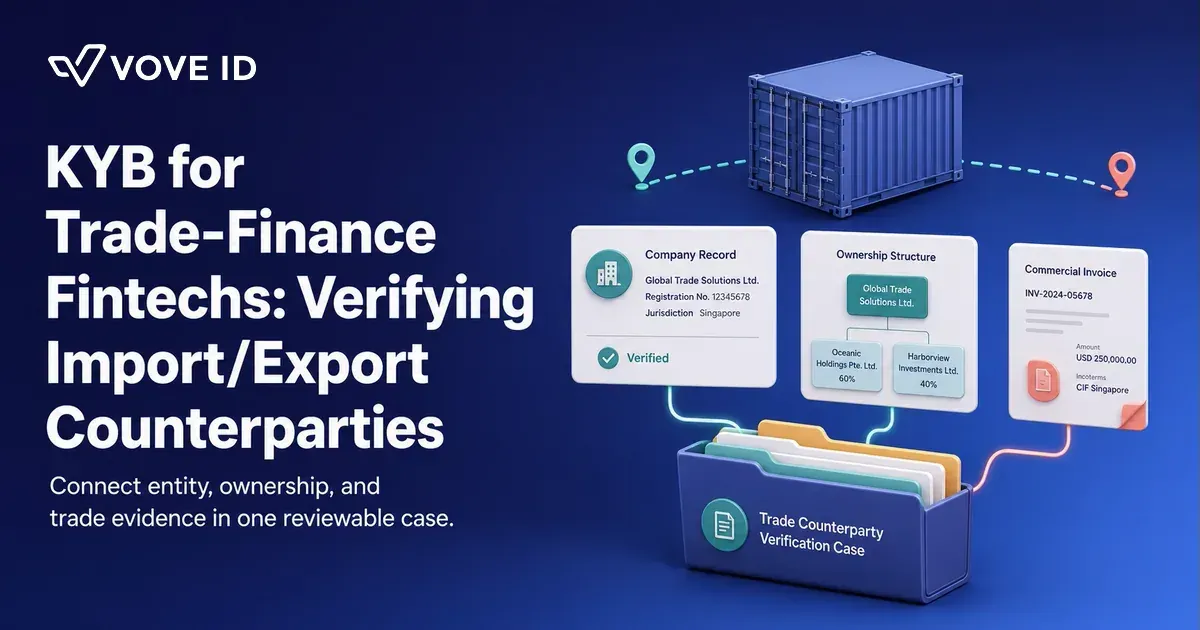
How a trade-finance team can connect business identity, ownership, transaction context, and escalation without treating any single document as the whole case.
Direct answer
KYB for trade-finance fintechs should verify the legal entity and relevant owners, then test whether the trade relationship, documents, payment route, and risk profile make sense together. Entity formation documents alone do not establish that a counterparty, transaction, or ownership structure is appropriate for the facility.
VOVE ID helps trade-finance and B2B payment teams organize identity and business verification around a reviewable case. In trade finance, the failure usually begins when a team sees a valid registration document and stops asking operational questions.
This is exactly where teams lose control over counterparty risk.
For the underlying entity- and beneficial-ownership model, see our KYB requirements framework.
Trade-finance KYB: the entity is the beginning of the case
An importer or exporter can be legally incorporated and still present a case the team does not understand. The firm may have a complex ownership chain, a recently changed director, a payment route that does not match the invoice, or documents that do not align with the stated goods and trading history.
FATF and the Egmont Group describe trade-based money laundering as the misuse of trade transactions and networks to disguise and move criminal value. Their risk-indicator report groups indicators across business structure, trade activity, trade documents and commodities, and account and transaction activity.
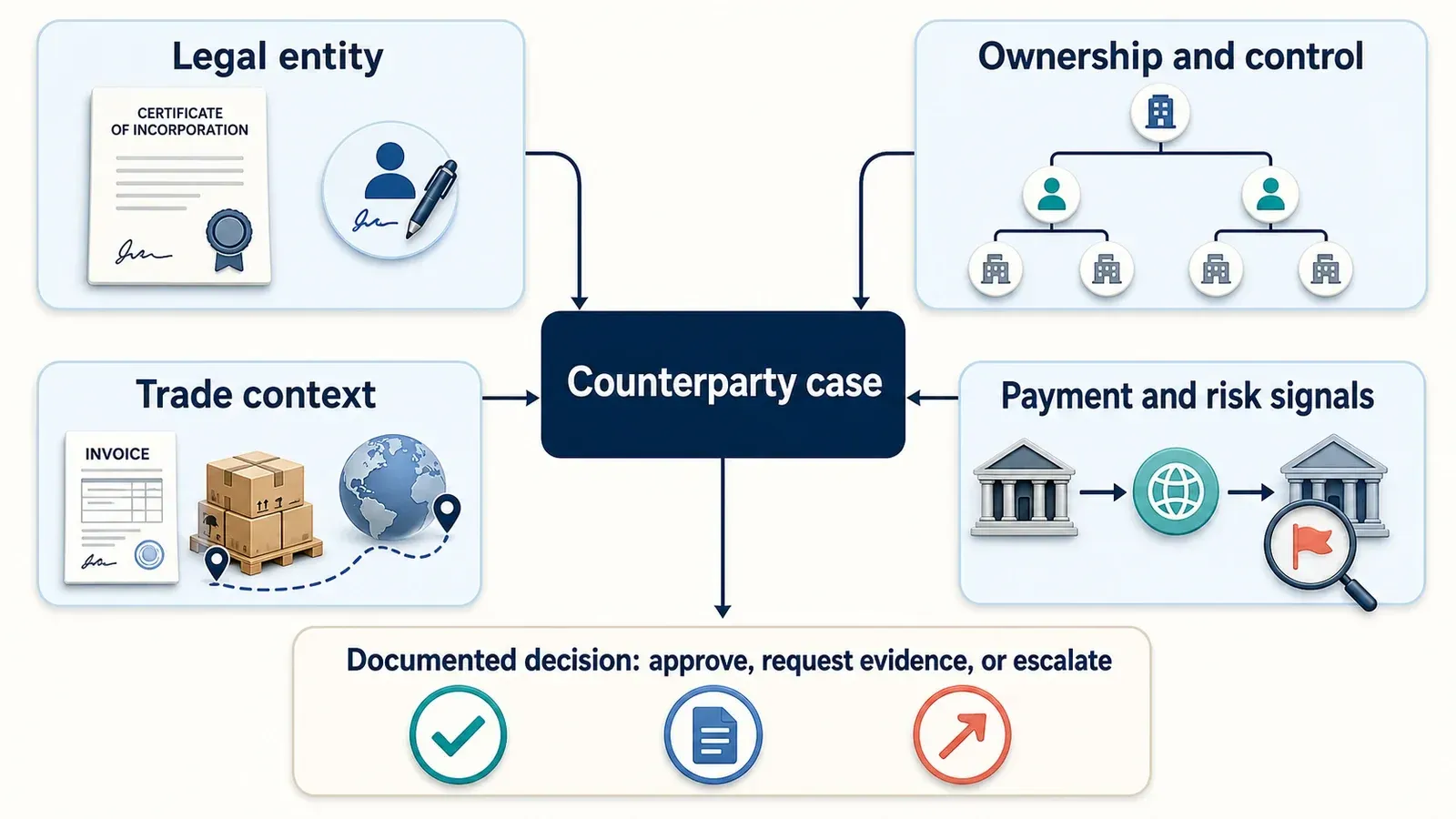
A trade-finance KYB program needs a joined-up case file, not a collection of isolated checks.
The counterparty file: four questions before a facility decision
The exact legal requirements depend on the institution's jurisdiction, license, product, and customer risk. The following is an operating framework, not a substitute for those obligations.
First, establish the entity that is applying. Capture the legal name, registration evidence, operating address, directors or authorized signatories, and the jurisdictional identifiers required by the program.
Second, understand ownership and control. Identify the people and entities that ultimately own or control the business using the applicable legal threshold and record how the conclusion was reached. A register extract can be important evidence, but it may not resolve a layered or cross-border structure by itself.
Third, place the requested facility in context. Compare the claimed goods, counterparties, countries, shipping terms, payment terms, and expected volumes with the customer's stated activity. The aim is not to reconstruct every shipment; it is to make a defensible risk decision and identify when the case does not cohere.
Fourth, define escalation. A mismatch should create a visible question, an owner, and a documented resolution — not disappear into an unstructured notes field.
A realistic KYB failure: the documents agree just enough
A trade-finance fintech receives an application from a newly onboarded exporter seeking invoice financing. The case contains a certificate of incorporation, an invoice, a bill of lading, and a director's identity document.
Then the inconsistencies appear. The invoice beneficiary is not the named exporter, the payment instructions point to a third party, and the company's declared activity does not explain the commodity or shipment pattern. Each document can look plausible on its own.
If the team reviews them in separate queues, the pattern stays hidden. If it connects entity, ownership, and trade evidence in one case, the mismatch becomes a decision point for escalation or enhanced review.
This is not a document-check failure. It is a case-orchestration failure.
Risk indicators: use them to ask better questions
FATF's trade-based money-laundering indicators are not a checklist that proves wrongdoing. They are prompts for further assessment. A single indicator can have an ordinary explanation; several indicators can justify additional questions, documentation, or escalation under the firm's policy.
Teams should avoid turning red flags into blanket exclusions. The more useful approach is to make the trigger specific: which field conflicts, what evidence would resolve it, who can clear it, and what record must remain after the decision.
For trade-finance controls, a useful source of practical framing is the FATF/Egmont trade-based money-laundering report, together with the firm's local AML/CFT rules and sanctions obligations.
For the broader screening, case-management, and escalation model, see our AML requirements framework.
How VOVE ID approaches this: evidence that stays connected
VOVE ID can support a trade-finance workflow with KYB, identity verification for relevant individuals, biometric liveness, face matching, and configurable AML screening. It also helps teams detect document-template inconsistencies, invalid MRZ checksums, barcode or QR inconsistencies, and image-manipulation signals in identity-document evidence.
Those checks do not validate a trade transaction or replace a team's underwriting and compliance judgment. They make the identity and evidence layer easier to inspect, while the customer's team defines the ownership rules, trade-risk policy, screening scope, and escalation threshold.
Where the customer's compliance team has sufficient evidence to approve a verification, manual review can form part of the workflow. AML screening is customer-configurable and its data is refreshed daily.
Practical trade-finance KYB checklist
Entity and control
- Collect the legal entity evidence required for each operating jurisdiction.
- Identify directors, authorized signatories, and relevant beneficial owners.
- Record the source and date of each ownership conclusion.
Trade context
- Compare the stated business activity with goods, counterparties, countries, and payment terms.
- Keep invoice, shipment, and payment evidence in one reviewable case.
- Define when third-party payments or material document mismatches require escalation.
Decision and audit
- Assign an owner and resolution path for each material inconsistency.
- Preserve the evidence, risk rationale, reviewer action, and decision date.
- Reassess the counterparty when ownership, activity, or transaction context changes.
Q&A
Is company registration enough for trade-finance KYB?
No. It is important evidence, but the team still needs to understand ownership, control, and whether the requested trade activity is coherent with the counterparty profile.
What is trade-based money laundering?
It is the movement or disguise of criminal value through trade transactions. FATF notes that risk indicators can arise in the business structure, trade activity, documents and commodities, or account and transaction activity.
Should every document inconsistency stop onboarding?
Not automatically. The team should investigate according to its risk policy, collect a documented explanation where appropriate, and escalate cases that cannot be resolved to the required standard.
Conclusion
KYB for trade-finance fintechs is not a registry search. It is a structured understanding of the business, its controllers, and the commercial activity behind the facility.
Teams need to connect evidence before they approve it. Entity verification, ownership analysis, trade context, and case management are one workflow.
Want to see how VOVE ID can support a reviewable identity and KYB evidence layer for cross-border counterparties?
This article is intended for general informational purposes only and does not constitute legal, financial, or regulatory advice. KYC/KYB/AML requirements may vary depending on jurisdiction, industry, and specific business circumstances. For up-to-date and binding compliance obligations, readers should refer to the relevant regulatory authorities or consult qualified professionals.