KYC API Uptime and Latency: What to Ask Vendors Before You Sign
A high uptime number does not tell you if your onboarding flow will behave as expected. Here is what to ask before you sign.
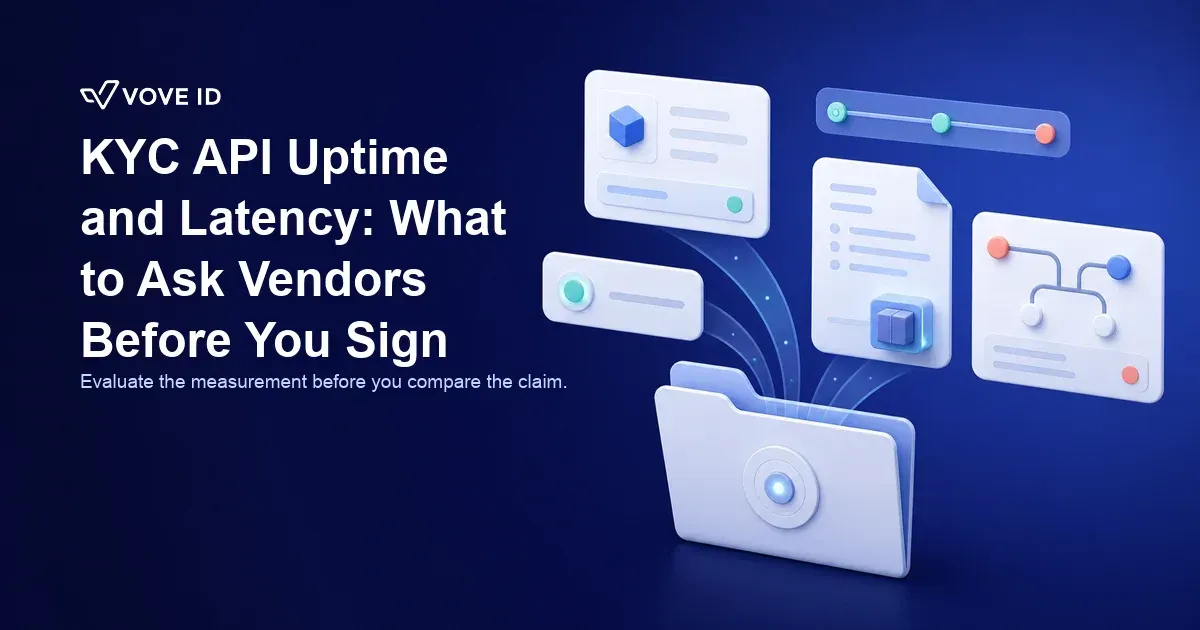
A practical buyer checklist for separating a headline reliability claim from the measurement, dependency, and incident process behind it.
Direct answer
Ask a KYC vendor to define availability and latency in writing: which endpoints count, where measurement starts and ends, which period applies, what exclusions exist, how incidents are communicated, and what evidence you can review. A percentage or response-time claim without that context does not tell a team whether its onboarding flow will behave as expected.
VOVE ID helps product, compliance, and engineering teams build identity workflows that stay reviewable when a clear case needs a decision or an exception needs attention. Before a team signs a vendor, it needs to understand the operating conditions around that workflow.
This is exactly where a procurement comparison breaks down: two vendors can use the same words while describing different services, measurement windows, and responsibilities.
For the underlying identity-control model, see our KYC requirements framework.
Uptime and latency: the labels are not the evidence
Availability is not a universal number. An IETF service-level framework describes availability as uptime divided by uptime plus downtime, and expects the associated period and allowable downtime to be stated. That framing is useful for buyer conversations because it forces the missing questions into the open: available to whom, for which function, and during what window? RFC 9543 makes the same distinction between measurable objectives and broader expectations.
Latency has the same problem. A vendor can measure a network hop, an API acknowledgement, a synchronous response, or an end-to-end verification outcome. Those are different events. A team should not compare them as if they are interchangeable.
Ask for the definition before asking for the number.
The measurement boundary: where does the clock start and stop?
Start with the customer journey. A lending or payments team cares about the time between a user starting a verification and the product receiving a usable outcome. That journey can include the customer device, the application, the API request, evidence capture, screening, a decision, and any manual-review path.
Ask the vendor which part of that journey its commitment covers. Ask whether separate services, third-party dependencies, planned maintenance, customer-side configuration errors, or document-quality issues sit inside or outside the measure. There is no single correct boundary, but there must be a documented one.
NIST's digital-identity guidance treats identity proofing as a process involving resolution, validation, and verification — not a single technical call. It also identifies completion times, step-level failure rates, and redress resolution times as useful program metrics. NIST SP 800-63 is not a private-sector service contract, but it is a helpful reminder to measure the experience that matters rather than one isolated component.
A realistic procurement failure: the headline survives, the user journey does not
A fintech selects a KYC provider after seeing a high availability figure and a fast response-time statement. The agreement does not define the endpoints in scope, percentile, sampling method, maintenance treatment, or how an unresolved verification is counted.
The team launches a new account flow. A portion of users receive API acknowledgements, but their cases await a later decision or a review queue. Support receives complaints, while engineering sees successful request logs.
Then the inconsistency appears. The procurement metric and the customer outcome describe different stages of the same workflow.
This is not a latency failure. It is a measurement-and-ownership failure.
The vendor evidence pack: ask for records, not reassurance
A useful evaluation asks a vendor to provide the evidence a technical and compliance owner can inspect. That can include a current status history, a service description, the monitoring definition, incident communications, change-notice practice, support escalation path, and sample operational reporting. The exact form depends on the buyer's risk and contract process.
Ask whether the vendor publishes a status page and how it distinguishes planned maintenance, degraded service, and an outage. Ask what time zone, reporting period, and aggregation method it uses. Ask whether the measure reflects an average, a percentile, or a target. The aim is not to force a particular answer; it is to make unlike claims comparable.
Logging matters here because a team cannot reconstruct a user-impacting event from a marketing statement. OWASP recommends designing logging and monitoring around the project's risk, making event information available to the appropriate teams, and connecting monitoring outputs with incident-response processes. See the OWASP Logging Cheat Sheet.
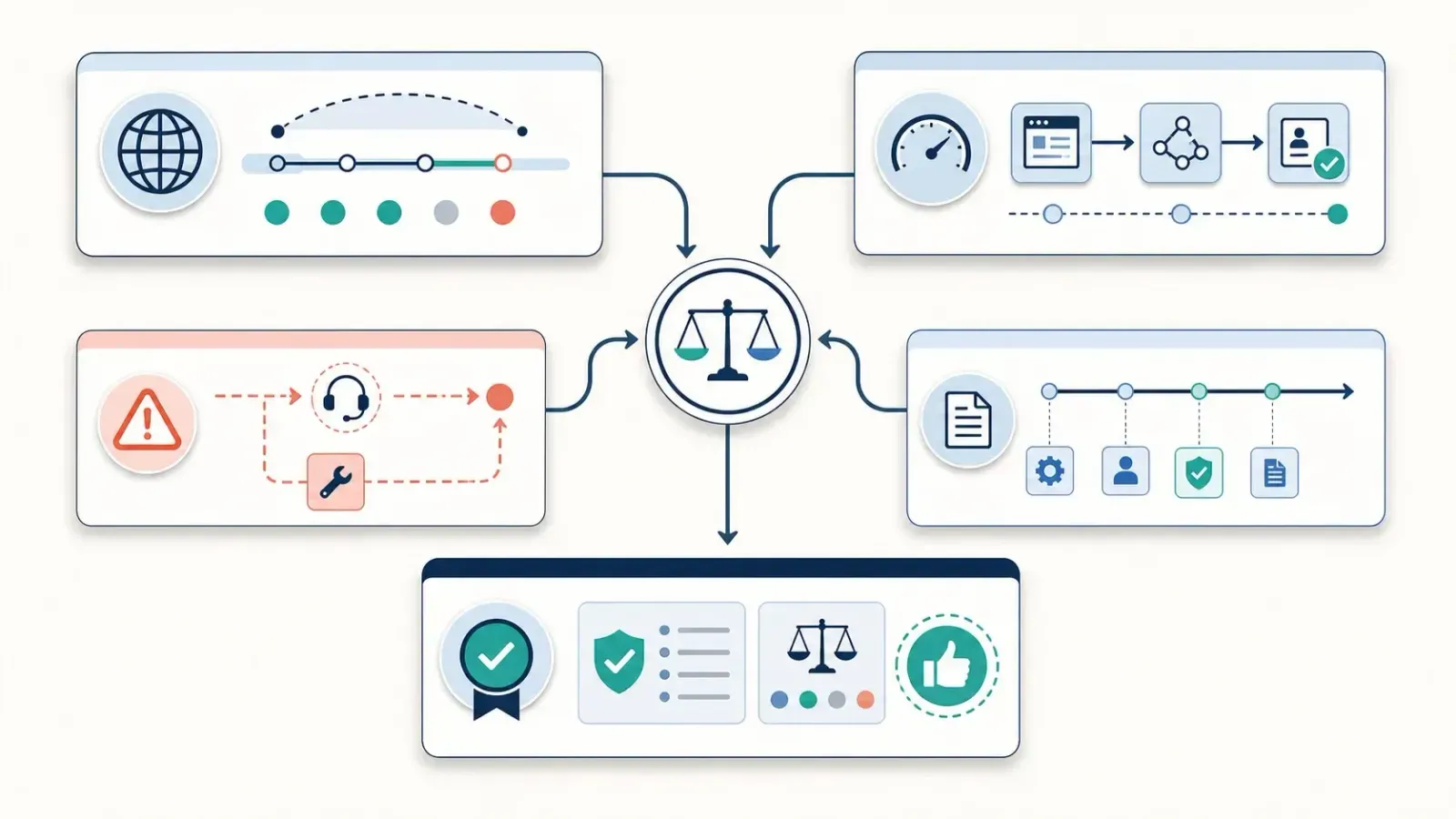
Contract and integration: turn expectations into an operating plan
The contract conversation should match the integration conversation. Decide who owns the customer message when a verification is delayed, which fallback or retry behavior is safe for the product, who can pause onboarding, and how the team will reconcile cases after an incident. Do not infer any of these behaviors from a dashboard screenshot.
Also ask for the documentation your team needs before integration: environments, authentication and key-rotation expectations, error and status semantics, webhook or polling guidance where offered, and the process for changes. The answer should be specific enough for engineering and operations to test before production.
VOVE ID can support an identity and compliance workflow with identity verification, biometric liveness, face matching, AML screening, KYB, and transaction monitoring, and can surface document-template inconsistencies, invalid MRZ checksums, barcode or QR inconsistencies, and image-manipulation signals across a wide range of document types and countries. Those capabilities don't create a universal reliability guarantee; teams should define their own service, user-experience, and escalation requirements before selecting any provider.
Practical KYC API reliability checklist
Scope and measurement
- Define the customer outcome each availability and latency measure represents.
- Request the endpoint, region, period, timezone, and exclusions behind every claim.
- Compare like-for-like percentiles, aggregation methods, and maintenance treatment.
Integration and support
- Test the documented success, pending, error, and exception paths before launch.
- Assign an owner for customer communications and case reconciliation during an incident.
- Confirm the support escalation route, incident notice method, and change-notice process.
Evidence and governance
- Retain the vendor's service description, status history, and agreed measurement definitions.
- Log the application events needed to connect a user report to a verification case.
- Review the service evidence at renewal and after material product changes.
Q&A
What uptime question should a KYC API buyer ask first?
Ask what the availability figure includes and excludes. A useful answer names the service scope, measurement period, maintenance treatment, and the event that counts as unavailable.
Is API response time the same as verification completion time?
No. An API response can acknowledge a request while the wider identity workflow still needs a decision, additional evidence, or manual review. Define the stage your product actually needs.
Should a fintech require a public status page?
It can be useful, but a status page alone is not a control. Teams still need a documented incident path, their own application logs, and a plan for users and cases affected by degradation.
FAQ
What evidence should a vendor provide for a reliability claim?
Ask for the written definition, reporting period, scope, exclusions, status or incident history where available, and the support or escalation process that applies when the measure is missed.
Can a vendor promise the same latency for every verification?
Not responsibly without defining the workflow and dependencies. Evidence quality, the decision path, and external services can change the time a product needs to reach a usable outcome.
Conclusion
KYC API uptime and latency are not headline numbers. They are definitions, boundaries, evidence, and incident responsibilities that must fit the customer journey.
Teams should evaluate the whole operating model before they sign. Procurement, integration, monitoring, and case recovery are one workflow.
Want to see how VOVE ID can support a fit-for-purpose identity and compliance workflow with reviewable case evidence?
This article is intended for general informational purposes only and does not constitute legal, financial, or regulatory advice. KYC/KYB/AML requirements may vary depending on jurisdiction, industry, and specific business circumstances. For up-to-date and binding compliance obligations, readers should refer to the relevant regulatory authorities or consult qualified professionals.