Building an MLRO Function From Scratch: What Small Fintechs Need First
KYC document types are not a dropdown menu — they're evidence choices tied to risk, jurisdiction, and a specific onboarding decision. Here's how to design the policy and workflow around them.
Direct answer
An MLRO function starts with a named, appropriately empowered owner who can translate the fintech's risk assessment into controls, review exceptions, and escalate suspicious activity through the required local route. The exact appointment, reporting, and filing rules depend on the jurisdiction and license, so teams must validate the local rulebook before launch.
VOVE ID helps payments and BaaS teams put identity verification, AML screening, KYB, and transaction monitoring into one operational workflow. The first failure is rarely a missing policy. It is an unclear decision owner when a case stops looking routine.
This is exactly where early compliance functions lose control over risk.
The MLRO role: ownership before headcount
MLRO commonly means money laundering reporting officer, but the title and formal appointment requirements vary by jurisdiction. What does not vary is the operating need: someone must own financial-crime controls, challenge weak evidence, and make sure suspicious activity reaches the right internal and external channel.
FATF's international standard expects financial institutions to maintain internal policies, procedures, controls, compliance-management arrangements, staff screening, training, and independent testing. That does not prescribe a team size. It does require an operating system, not a policy folder.
This means one thing: founders cannot outsource accountability to a vendor, a checklist, or a part-time inbox. A small team can centralize work, but it must make ownership visible.
For the underlying framework, see our AML requirements explained.
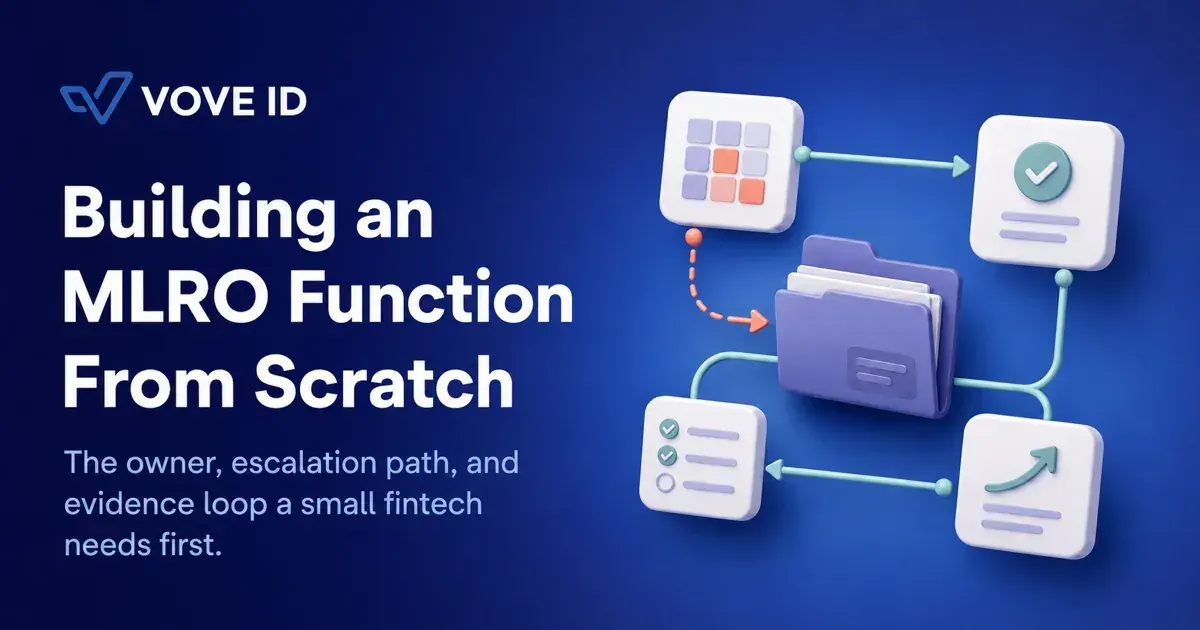
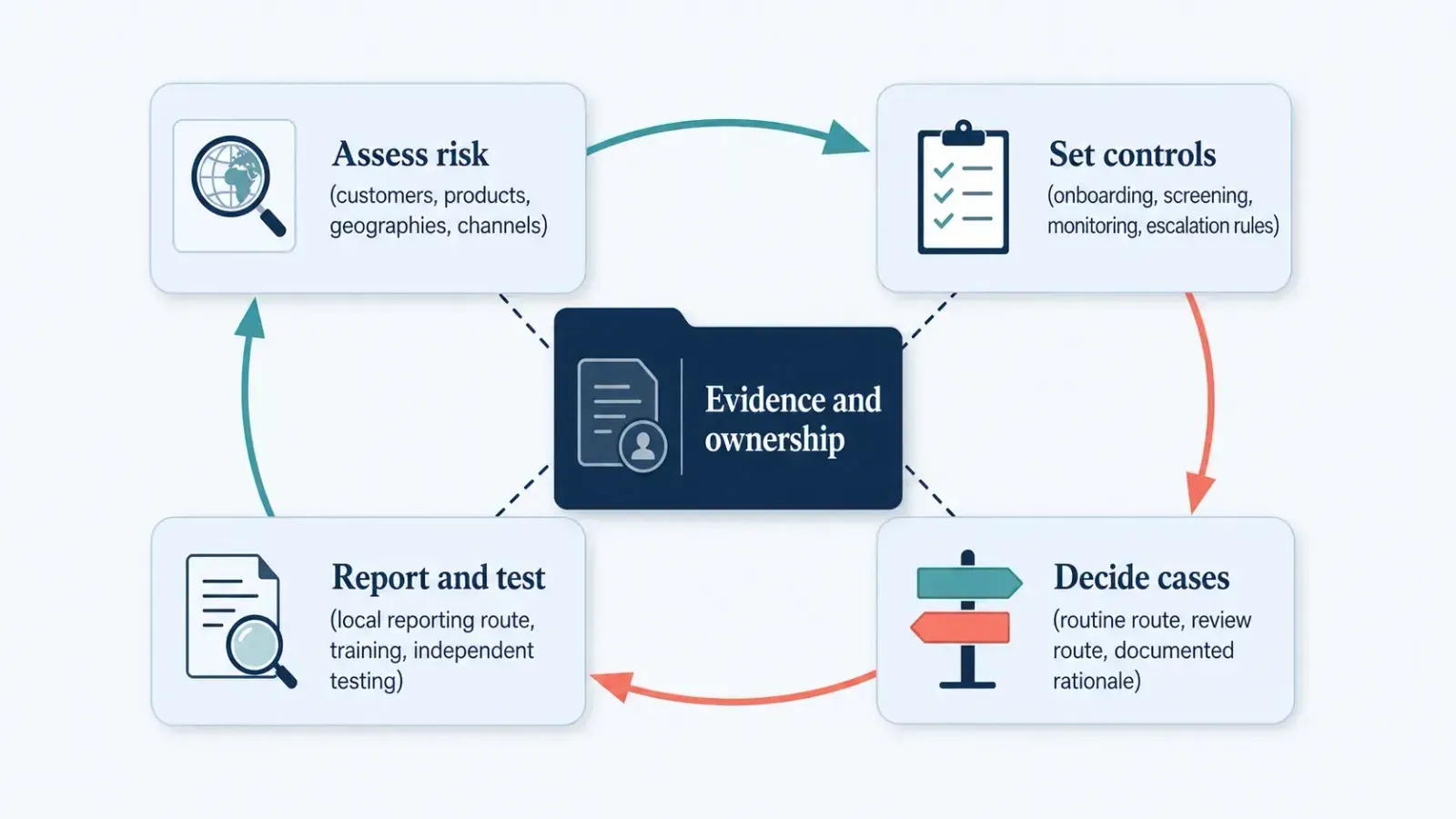
What the first operating model needs: a practical control loop
Start with the services actually offered. A BaaS provider onboarding program managers faces different exposure from a wallet that serves consumers, even if both call the same KYC API.
Document the customer types, countries, products, payment flows, distribution partners, and high-risk triggers. Then assign a control and an owner to each material risk: onboarding, screening, monitoring, escalation, reporting, training, and testing.
The MLRO does not personally clear every alert. The role designs the decision rules, approves the escalation threshold, and can see whether the queue, evidence, and decisions match the firm's risk appetite.
A realistic early-stage failure: the merchant that does not fit
A payment platform is onboarding a small online marketplace before its launch date.
Received:
- A company registration extract
- A director's identity document
- A short ownership declaration
- A projected-volume estimate from the sales team
Then the inconsistencies appear. The legal entity is clear, but the proposed payment activity, ownership information, and countries served do not fit the initial risk profile.
Sales asks for a quick approval. Operations holds the file. Nobody knows who can require further evidence, who decides whether enhanced due diligence applies, or who records the rationale.
The platform either approves without a defensible decision or creates an invisible delay. This is not a staffing failure. It is an ownership-and-escalation failure.
How VOVE ID supports the function: evidence that stays with the case
VOVE ID supports identity verification, biometric liveness detection, face matching, AML screening, KYB, and transaction monitoring. It can help teams detect document-template inconsistencies, invalid MRZ checksums, barcode or QR inconsistencies, and image manipulation.
Those checks do not replace an MLRO's judgment or local reporting duties. They give the function structured evidence to assess: the submitted document, identity signals, the entity and ownership workflow, screening outcome, and the reason a case moved to review.
That makes the hand-off clearer. Operations collects and resolves routine evidence. The MLRO or delegated reviewer owns the exceptional decision and the escalation record. Senior management remains accountable for resources and governance.
Practical MLRO-function checklist
Governance
- Name the person accountable for financial-crime controls and escalation.
- Confirm local MLRO appointment, independence, and reporting requirements.
- Give the role direct access to senior decision-makers.
Risk
- Document customers, products, geographies, channels, and delivery partners.
- Define enhanced-due-diligence triggers before onboarding begins.
- Map every material risk to a control owner and evidence source.
Operations
- Set clear thresholds for routine approval, review, and escalation.
- Record the evidence and rationale behind each exceptional decision.
- Test that cases can move from operations to the MLRO without losing context.
Assurance
- Train customer-facing and operations teams on escalation signals.
- Review alert, rejection, and exception patterns at a defined cadence.
- Arrange independent testing appropriate to the firm's scale and local obligations.
Q&A
Does every fintech need a full-time MLRO from day one?
Not necessarily. Local rules, license type, risk profile, and operating scale determine the formal requirement. The function still needs a named owner with sufficient authority and time to perform it.
Can a compliance consultant act as the MLRO?
Some jurisdictions allow outsourced support or nominated arrangements; others impose specific requirements. Confirm the local framework and make sure the firm retains effective oversight.
What should an MLRO review personally?
The role should own the risk framework, escalated cases, suspicious-activity decisions, reporting route, and control effectiveness. Routine work can be delegated only with clear controls and supervision.
Is an AML vendor a substitute for the MLRO?
No. Technology can organize checks and evidence, but it does not take the firm's regulatory responsibility or make its risk decisions.
What is the first document an MLRO function should create?
Start with a practical risk assessment and a control map. These define what the function needs to detect, who acts, and what evidence supports each decision.
When should a fintech file a suspicious activity report?
The trigger, recipient, confidentiality requirements, and timing are set by local law. Establish the internal escalation route before a suspicious case arises and obtain local legal advice where needed.
Conclusion
An MLRO function is not a senior title added after growth. It is the operational point where risk becomes an accountable decision.
Small fintechs should start with ownership, a documented risk model, controlled case escalation, and evidence that survives a hand-off. Policies, technology, and reporting are one workflow.
Want to see how VOVE ID supports the identity, KYB, screening, and case evidence behind a fit-for-purpose compliance workflow?
This article is intended for general informational purposes only and does not constitute legal, financial, or regulatory advice. KYC/KYB/AML requirements may vary depending on jurisdiction, industry, and specific business circumstances. For up-to-date and binding compliance obligations, readers should refer to the relevant regulatory authorities or consult qualified professionals.