A Field Guide to Document Types: What KYC Systems Check For
KYC document types are not a dropdown menu — they're evidence choices tied to risk, jurisdiction, and a specific onboarding decision. Here's how to design the policy and workflow around them.
Direct answer
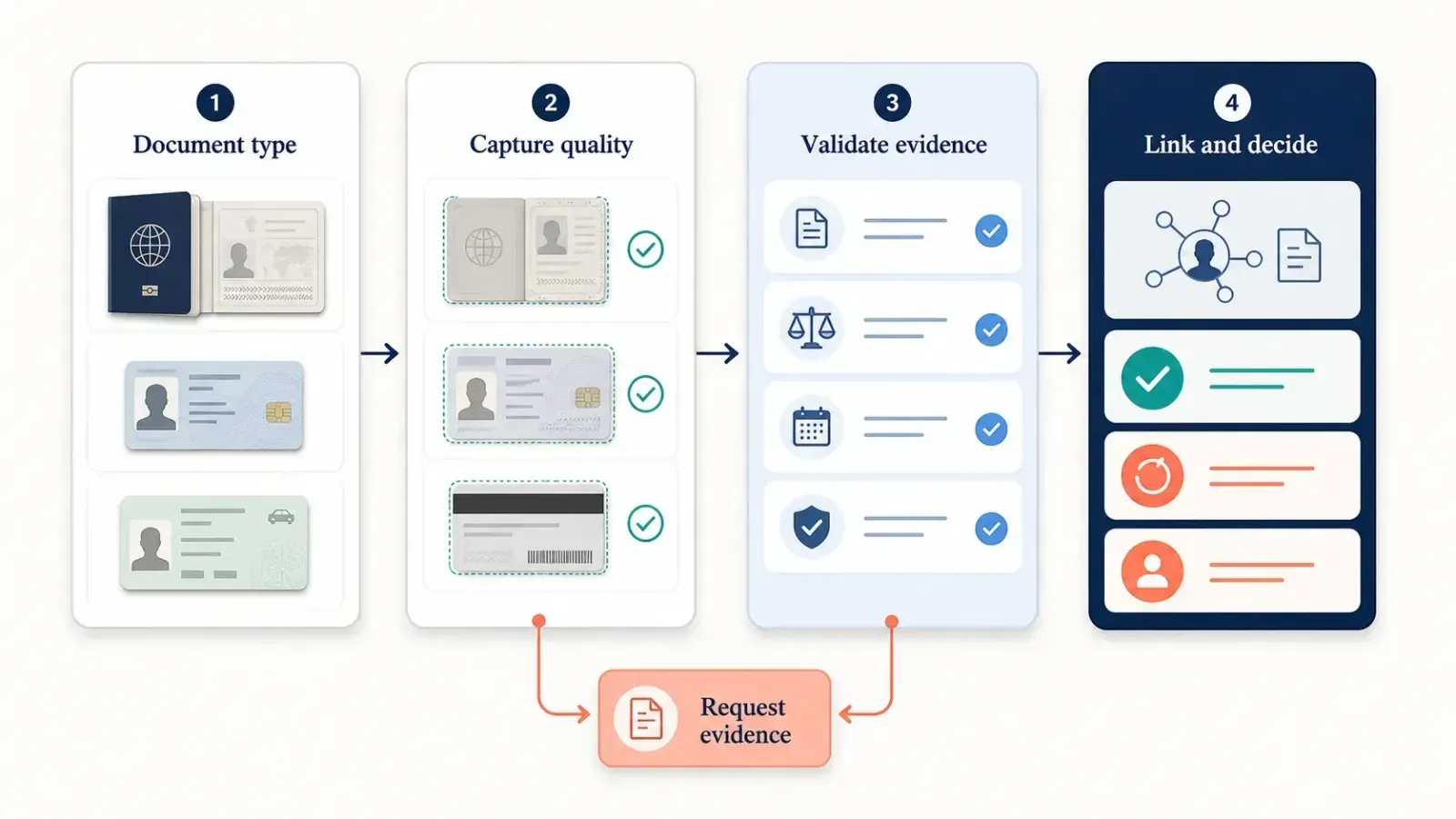
KYC systems typically assess whether a submitted identity document is acceptable for the policy, readable, internally consistent, and credible enough to support the claimed identity. The document type matters, but the workflow also needs to check evidence quality, expiry, security signals, the link to the applicant, and a defined route for exceptions.
VOVE ID helps fintech teams verify people across remote onboarding flows where document variety and evidence quality change by market. Treating every document image as equivalent creates a gap between collection and a defensible decision.
This is exactly where document verification breaks down.
Document type is a policy decision: what the evidence is meant to prove
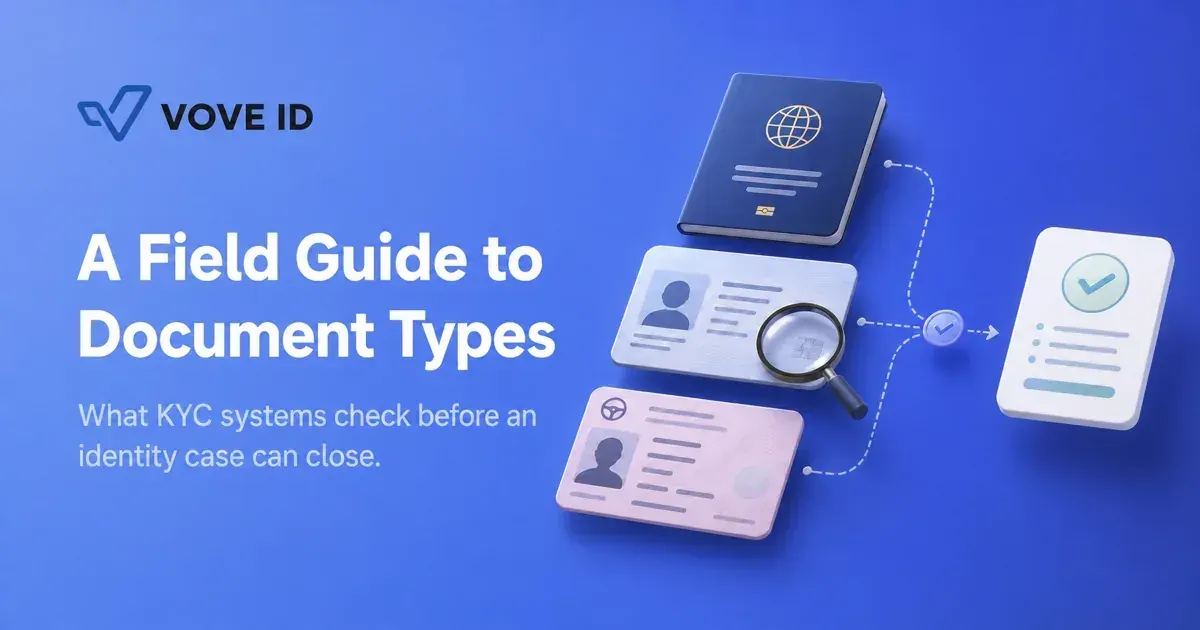
Passports, national identity cards, residence permits, driving licenses, and proof-of-address records do not prove the same things. A passport can offer strong identity evidence for cross-border onboarding, while a local license may be useful only where the policy and jurisdiction permit it.
The right question is not, "Can the system read this?" It is, "Does this evidence meet the product's required level of confidence and the applicable rule?" NIST's identity-proofing guidance separates evidence validation from verification for exactly this reason.
For machine-readable travel documents, ICAO Doc 9303 sets international specifications for document formats and security mechanisms. That standardization helps structure some checks. It does not make every document, issuer, or onboarding use case interchangeable.
For the underlying identity-verification framework, see our KYC requirements explained.
What a KYC workflow checks: the evidence around the image
The first layer is collection quality. The document must be fully visible, readable, and captured in a way that preserves the fields and features needed for review.
The second layer is document consistency. A workflow can examine the document template, printed fields, expiry information, machine-readable-zone structure where present, and barcode or QR consistency where available. Those signals help determine whether the evidence warrants approval, retry, or review.
The third layer is identity linkage. A document describes a person; it does not prove that the person submitting it is the holder. Remote onboarding may need a live capture and face matching, subject to the product, risk, and local requirements.
This means one thing: an OCR result is a data-extraction outcome, not a final identity decision.
A realistic onboarding failure: the clear photo that cannot close the case
A cross-border wallet receives a sharp image of a driving license from a new customer.
Received:
- A front image with readable name and date of birth
- A partially cropped reverse side
- A selfie captured in low light
- A declared address in another country
Then the gap appears. The license may be a legitimate document, but the onboarding policy does not permit it as standalone evidence for this product and geography. The reverse-side data is incomplete, and the selfie does not produce enough usable evidence to link the applicant to the document.
If the workflow accepts the readable fields, it mistakes collection for verification. If it simply rejects the customer, it loses the chance to request the correct evidence with a clear reason.
This is not an OCR failure. It is an evidence-policy failure.
How VOVE ID approaches document evidence: checks plus a review path
VOVE ID supports document verification, biometric liveness detection, and face matching. It can help teams detect document-template inconsistencies, invalid MRZ checksums, barcode or QR inconsistencies, and image manipulation.
The workflow should keep these signals together with the original submission and the decision reason. A clear case can move forward under the team's rules. An incomplete, conflicting, or risk-sensitive case can request another capture or move to review rather than disappearing into an undifferentiated failure state.
That separation matters for operations. Product teams can improve the capture experience, risk teams can tune the exception rules, and reviewers can explain what evidence was missing without treating every document as a binary pass or fail.
Practical KYC-document checklist
Policy
- Define accepted document types by product, customer segment, and jurisdiction.
- Specify when one document is insufficient and when supporting evidence is required.
- Set a documented route for expired, damaged, or unfamiliar documents.
Collection
- Ask for every required side or page before submitting the case.
- Check that key fields and document edges are visible and legible.
- Give customers a specific retry reason when capture quality is inadequate.
Verification
- Check document format, consistency, expiry, and relevant security signals.
- Treat OCR extraction as one input to a decision, not the decision itself.
- Link document evidence to the applicant when the risk model requires it.
Operations
- Preserve the evidence and rationale for approvals, retries, and escalations.
- Route exceptions to reviewers with the missing-evidence reason visible.
- Review failure patterns by document type and market without weakening controls.
Q&A
Which documents can a KYC system accept?
That depends on the jurisdiction, product, customer type, and risk policy. A team should maintain an approved evidence policy rather than assume one global document list is sufficient.
Is OCR the same as document verification?
No. OCR extracts text. Document verification assesses whether the submitted evidence is acceptable and credible enough for the policy, using multiple signals and an exception path.
Why are both sides of an ID card often required?
Different fields and security features can appear on each side. The policy should state when both sides are needed and what to do when a capture is incomplete.
Can a selfie replace an identity document?
No. A selfie or liveness check can help link a person to a session or document. It does not replace the identity evidence required by the relevant onboarding policy.
What is an MRZ check?
The machine-readable zone is the structured text area found on many travel documents. Its format and check digits can provide consistency signals, but an MRZ check alone does not prove the whole identity decision.
What should happen when a document is not supported?
The workflow should say whether to request an alternative, route the case to review, or stop the application. The result should be based on documented policy, not an unexplained technical error.
Conclusion
KYC document types are not a dropdown menu. They are evidence choices tied to risk, jurisdiction, and a specific onboarding decision.
Teams should design the policy first, collect complete evidence, validate the document signals, and link the evidence to the applicant where needed. Collection, verification, and case management are one workflow.
Want to see how VOVE ID brings document verification, liveness, face matching, and reviewable evidence into one workflow?
This article is intended for general informational purposes only and does not constitute legal, financial, or regulatory advice. KYC/KYB/AML requirements may vary depending on jurisdiction, industry, and specific business circumstances. For up-to-date and binding compliance obligations, readers should refer to the relevant regulatory authorities or consult qualified professionals.