NGOs and Humanitarian Remittances: KYC When Standard ID Documents Are Missing
When standard ID is missing, humanitarian teams need a documented, policy-led way to decide what evidence counts — not an unrecorded workaround.
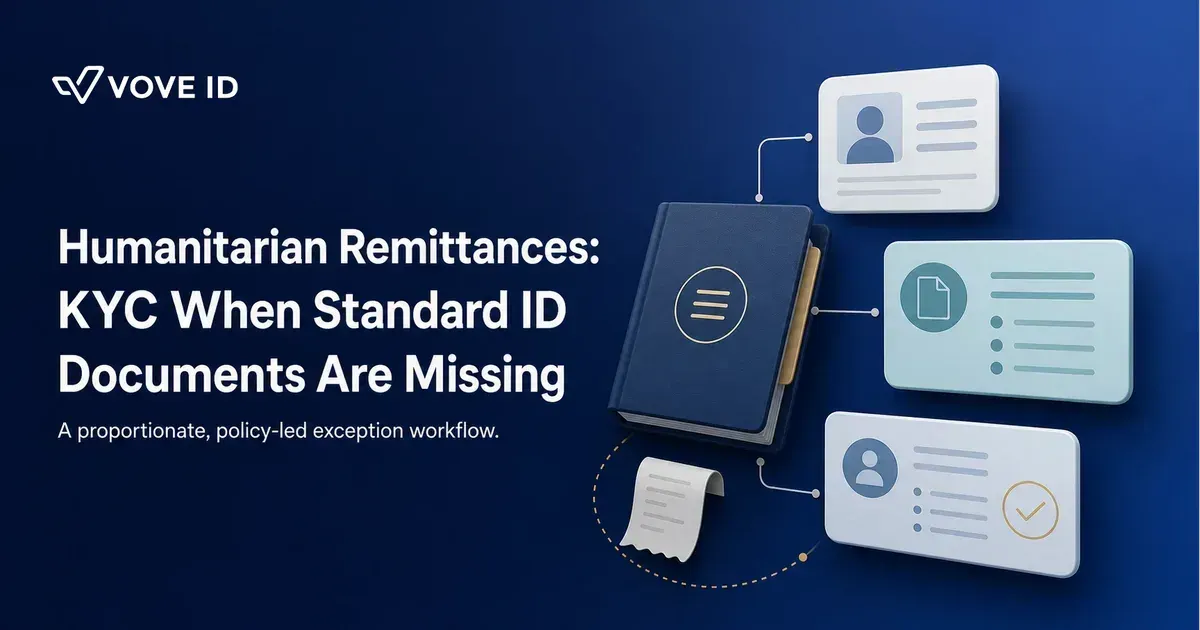
How payment and program teams can use a proportionate, policy-led evidence process without promising that any alternative document will be accepted.
Direct answer: When standard ID documents are missing, a humanitarian payment team needs a documented, risk-based route for deciding what evidence its policy permits, who can review it, and when the case must be escalated. Missing ID does not remove legal obligations or justify an undocumented workaround.
VOVE ID helps NGOs and humanitarian payment teams organize identity and compliance evidence where access to formal documents can be uneven and every exception needs an accountable decision.
This guide reflects the state of practice as of 7 August 2026. It is informational, not legal advice — the correct approach depends on the program's jurisdiction, funding and payment structure, partner roles, applicable sanctions and AML/CFT obligations, and the rights and safety of affected people.
Programs run into trouble at the same point: missing documentation gets treated as an automatic failure, or the exception gets handled outside the case record altogether.
Humanitarian context: proportionate controls protect access and accountability
Identity gaps are real. The World Bank's Principles on Identification frame access, privacy, and inclusion as design requirements for trusted identification systems. They do not create a blanket substitute for applicable customer-due-diligence rules.
The FATF's NPO best practices emphasize focused, proportionate, and risk-based measures for the relevant subset of non-profit organizations. FATF also warns that poorly applied standards can disrupt legitimate NPO activity.
This means one thing: a responsible process should be strict about the decision record and proportionate about the evidence it asks a person to produce.
For the underlying identity-verification framework, see our KYC requirements explained: the identity-verification framework for fintech and regulated platforms.
The policy question: what evidence is permitted for this program?
Do not begin with a list of assumed alternative documents. Acceptance depends on the program's legal and risk framework, partner agreements, and the particular payment route.
Begin instead with the decision boundary. Define when standard ID is required, when an exception may be requested, what approved evidence can be considered, who can approve it, and what outcomes must be escalated or declined.
The purpose is not to manufacture certainty. It is to make the limits of the evidence visible and ensure a reviewer can explain the decision.
VOVE ID supports identity verification, biometric liveness, face matching, AML screening, KYB, and transaction monitoring across a broad range of document formats and countries; whether a particular document or exception is suitable remains a policy and compliance decision for the accountable team.
A realistic program failure: assistance is ready, but the exception is not
A humanitarian program prepares a cross-border disbursement for a household affected by displacement. The program record shows eligibility, but the person cannot present the standard identity document the payment route normally expects.
- The field team records a request for an exception.
- The payment partner asks for a decision basis.
- The evidence and program notes are held in separate systems.
Then the delay becomes a control problem. The field team cannot see what the reviewer needs, the reviewer cannot see the program context, and the payment team cannot tell whether an exception has been approved.
This is not only a document problem. It is a case-management problem.
Exception handling: make the decision visible, bounded, and reviewable
An exception route should be narrow enough to prevent informal approvals and usable enough that legitimate cases do not disappear into email. It should protect sensitive personal information and limit access to people with a defined role.
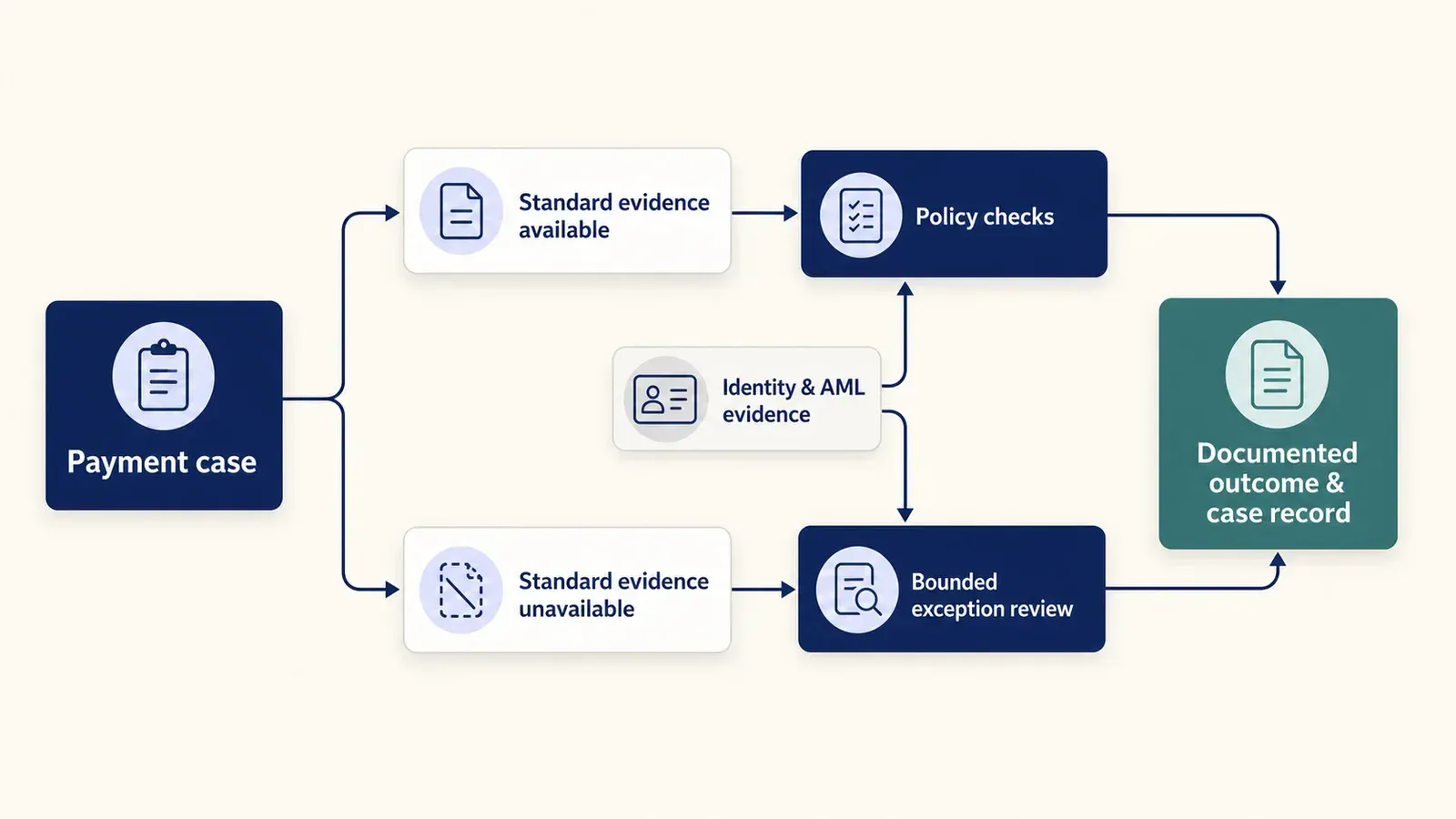
Capture the reason standard evidence is unavailable, the permitted evidence actually reviewed, the risk or sanctions-screening context required by policy, the reviewer, and the time-bound outcome. A risk signal requires assessment; it is not a conclusion about the person.
For how sanctions and risk-screening signals fit into a broader compliance program, see our AML requirements explained: the compliance operating system for regulated financial institutions.
Manual review may be used where the customer's compliance team has sufficient evidence to approve a verification. The team should also define when manual review is not enough and a payment must wait, escalate, or follow another lawful route.
How VOVE ID supports the workflow: evidence inputs, not eligibility promises
VOVE ID can provide identity, liveness, face-matching, AML-screening, and business-verification inputs within an approved workflow. It also helps detect document-template inconsistencies, invalid MRZ checksums, barcode or QR inconsistencies, and image manipulation as detection aids, not guarantees.
The accountable organization decides what a given result means, what data it may collect and retain, and whether a case meets program, partner, and legal requirements. That separation matters most when the evidence is incomplete.
Practical humanitarian-remittance KYC checklist
Program design
- Map the program, payment partner, jurisdiction, and applicable escalation routes.
- Define the standard-evidence route before payments begin.
- Document the narrow conditions under which an exception can be requested.
Review and safeguarding
- Limit sensitive evidence access to authorized reviewers.
- Record the evidence considered, decision owner, rationale, and expiry or revisit date.
- Separate a screening signal from the final eligibility or payment decision.
Operations and audit
- Give field, payments, and compliance teams one case status they can understand.
- Preserve the record needed to explain a hold, approval, or escalation.
- Test the workflow against a realistic missing-document case before a live disbursement.
FAQ
Does missing standard ID mean a person must always be excluded?
No single answer applies. The organization must follow applicable law and its approved policy, which may require an exception review, a different lawful route, or a decision not to proceed.
Can an NGO accept any alternative document?
No. The evidence accepted must be defined by the relevant policy, partner arrangements, and legal obligations. This article does not confirm support for any specific alternative document.
Why is a case record important in humanitarian payments?
It lets the accountable team explain what was known, who decided, what safeguards applied, and why the outcome followed the policy.
What is a proportionate KYC control in a humanitarian setting?
It is a risk-based control that meets applicable obligations while avoiding unnecessary barriers to legitimate assistance. Proportionate does not mean undocumented or automatic.
When should a case be escalated?
Escalate when the available evidence falls outside the approved exception route, a risk signal requires specialist assessment, or the team cannot make a defensible decision under policy.
Conclusion
Humanitarian KYC isn't a trade-off between weak controls and denied access — it's a disciplined way to handle incomplete evidence without hiding the decision.
Teams should define the exception route before the emergency case arrives, protect sensitive information, and keep one record of the evidence and outcome. Inclusion, safeguarding, and auditability are one workflow.
Want to see how VOVE ID supports identity and compliance evidence in policy-led payment workflows?
This article is intended for general informational purposes only and does not constitute legal, financial, or regulatory advice. KYC/KYB/AML requirements may vary depending on jurisdiction, industry, and specific business circumstances. For up-to-date and binding compliance obligations, readers should refer to the relevant regulatory authorities or consult qualified professionals.