MiFID II Suitability Checks: Where Onboarding Becomes a Compliance Event
When a retail investor claims moderate risk and immediately selects a high-risk position, the question isn't whether they filled out the form. It's whether the platform acted on the answer.
VOVE ID helps investment platforms run MiFID II suitability in markets where the regulator now treats suitability as the heart of the compliance file. On paper, the test is a form. In practice, it's the audit's first stop.
This guide covers how to build a defensible MiFID II suitability process. For the underlying identity and onboarding framework that suitability sits inside, see our KYC Requirements Explained 2026.
Direct answer
MiFID II suitability checks turn onboarding into a compliance decision because the platform must prove the product fits the investor's knowledge, experience, financial situation, and risk tolerance. A defensible suitability process stores the decision logic — not just the user's form submission.
What MiFID II suitability actually requires
Suitability is not a decorative questionnaire at the end of onboarding. It is where a platform decides whether a retail investor should be allowed into a product, advised toward a product, or blocked from it.
For investment platforms, that means collecting and assessing:
- investment knowledge
- investment experience
- financial situation
- investment objectives
- risk tolerance
- ability to bear losses
- product complexity
These fields can't sit in isolation. They have to feed a decision that can be explained later.
Risk tolerance: the field that is rarely defensible
Risk tolerance often looks simple in product design. A user selects conservative, moderate, or aggressive. The platform stores the answer and moves on.
That's not enough when behavior contradicts the answer.
If a user claims a moderate risk profile and immediately selects a high-risk position, the platform needs a policy-backed response — warn the user, require additional confirmation, route the case for review, or block the investment. The key is consistency. The audit problem is not only whether the user answered the question. It's whether the platform acted on the answer.
When the user's tolerance and behaviour disagree
Consider a retail investor who joins an alternative investment platform and declares a moderate risk profile.
Three days later, the investor tries to enter a high-risk position. The platform allows the trade because the suitability questionnaire was treated as a form submission, not a live decision input.
An AMF inspector later asks how the platform reconciled the moderate risk profile with the high-risk behaviour. The team can show the form, the timestamp, and the checkbox. It cannot show the decision logic.
That is where onboarding becomes a compliance event. The question is no longer "did the user complete the form?" It is "why did the platform allow this outcome?"
How VOVE ID logs suitability so it survives an audit
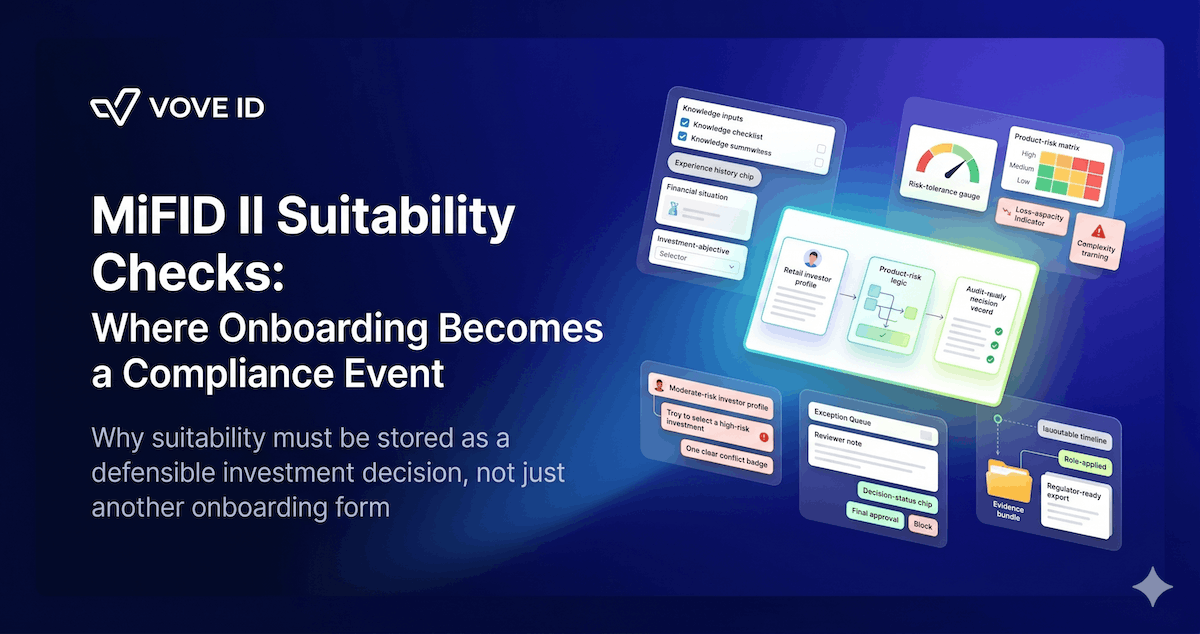
VOVE ID treats suitability as a decision record inside the onboarding journey. The platform collects the required investor inputs, connects them to product risk, triggers additional checks when answers conflict, and stores the decision trail in one place.
That trail should show:
- what the investor answered
- which product or risk category was being assessed
- which rules were applied
- whether any contradiction was detected
- what action the platform took
- who reviewed the exception, if review was required
- what final decision was made
This gives compliance teams something stronger than a completed questionnaire. It gives them a record of judgment.
For a full breakdown of the AML and transaction monitoring layer that sits alongside suitability in a compliant investor file, see our AML Requirements Explained 2026.
Where suitability should sit in the onboarding flow
Suitability should not be hidden after identity verification or bolted onto the first trade. It should sit at the point where the platform knows enough to make a decision.
A practical flow looks like this:
- Verify identity and residency
- Screen the investor
- Identify the relevant product and jurisdiction
- Collect knowledge, experience, objectives, and risk tolerance
- Compare the investor profile against product risk
- Trigger warnings, review, or rejection where needed
- Store the decision and evidence
That structure keeps suitability close to the product decision while preserving the audit trail from onboarding.
Checklist: Knowledge, experience, risk profile
Use this checklist to assess whether a suitability process is defensible:
- Knowledge: Does the investor understand the product category?
- Experience: Has the investor used similar products before?
- Risk profile: Does the stated tolerance match the selected product?
- Loss capacity: Can the investor bear the downside described?
- Jurisdiction: Does the correct country or entity rule apply?
- Contradictions: Are conflicting answers detected and handled?
- Evidence: Is the final decision stored as a decision, not just a form?
- Review: Are edge cases routed to the right reviewer?
Q&A
What is a MiFID II suitability check?
A MiFID II suitability check assesses whether an investment product is suitable for a client based on their knowledge, experience, financial situation, investment objectives, and risk tolerance.
Is a suitability questionnaire enough?
No. A questionnaire is only the input. The platform still needs decision logic that explains how those answers affected the onboarding or investment outcome.
Why does suitability matter during onboarding?
Because onboarding is where the platform first decides whether the investor can access certain products. If suitability is handled later or stored separately, the audit trail becomes fragmented.
How does VOVE ID help with suitability checks?
VOVE ID connects identity, jurisdiction, product risk, suitability inputs, exception handling, and audit evidence inside one onboarding record — making the suitability decision easier to operate and easier to defend.
Conclusion
MiFID II suitability is where retail onboarding stops being a checklist. It becomes a compliance decision that must be consistent, explainable, and retrievable.
Platforms that store suitability as a form will struggle when behaviour and risk profile diverge. Platforms that store suitability as a decision will have a file the regulator can read.
Need to make MiFID II suitability defensible end-to-end?
This article is for informational purposes only and does not constitute legal or regulatory advice. MiFID II obligations vary by product type, client category, and operating jurisdiction. Consult qualified legal counsel for guidance specific to your situation.