Polish KNF and EMI Licensing: The Hidden AML Bar for Foreign Founders
Why a Polish EMI application has to prove a workable AML operating model, not just describe one, for foreign founders in 2026.
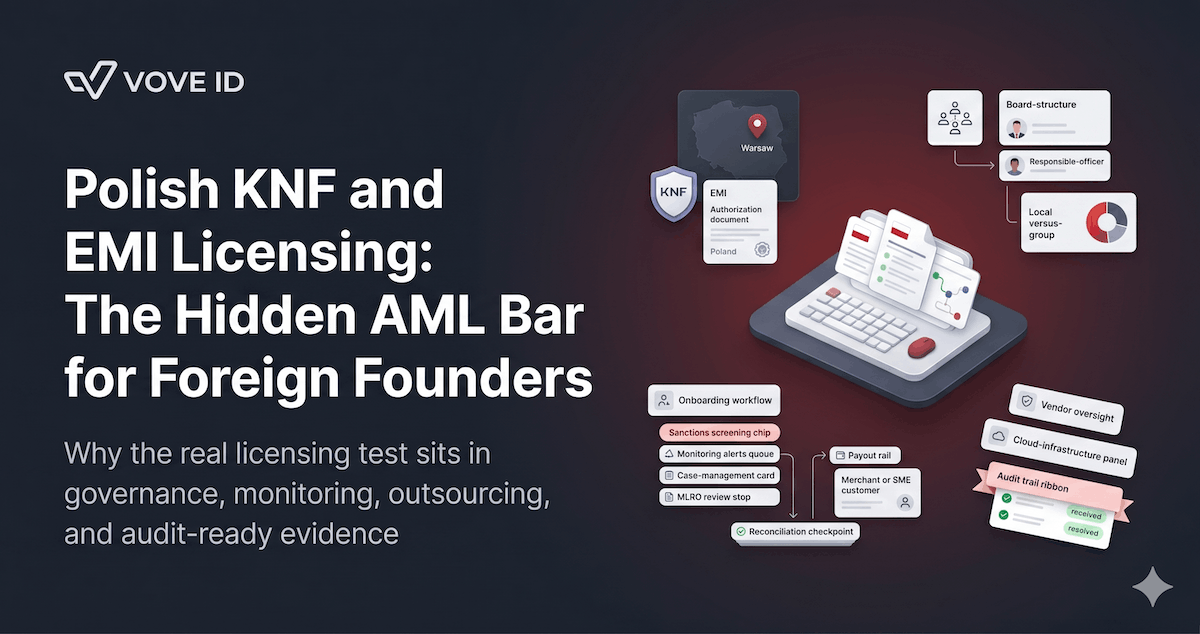
For foreign founders, EMI licensing in Poland rarely fails because the business model sounds too ambitious. It fails because the AML file reads like a licensing deck while the KNF will read it like a live operating system. In 2026, that hidden bar sits in governance, outsourcing control, safeguarding logic, customer-risk design, and the ability to prove how the file will actually run once volume arrives.
What is the hidden AML bar for foreign founders seeking EMI licensing in Poland? As of 15 June 2026, it is the gap between a file that describes an electronic money institution and a file that proves the institution can be supervised. In practice, the pressure lands on AML ownership, local accountability, safeguarding and funds-flow logic, outsourcing control, MLRO coverage, and evidence quality across cross-border payment activity. A foreign-founded EMI can have a credible commercial plan and still stall if the AML operating model depends on thin local staffing, unclear group dependencies, or controls that do not match the real customer and corridor mix.
Poland still makes strategic sense for founders building regulated payments infrastructure.
It is a large EU market. It has real domestic payment depth. It gives a team a route into the wider European payments perimeter without pretending that growth can happen outside supervision.
That is exactly why the licensing file gets read so closely.
The commercial case may be regional. The supervisory question is always local first.
This is where many foreign founders get the Polish EMI story wrong.
They assume the hard part is explaining the product.
In practice, the harder part is proving who owns the AML system, how escalations work, how safeguarding interacts with transaction flows, and whether the team can still explain the same file six months after launch.
Why Poland keeps attracting foreign-founded EMI projects
The attraction is easy to understand.
Poland gives founders a serious domestic market, strong payment adoption, and a credible EU-regulated base for wallet products, merchant acquiring support layers, payout infrastructure, embedded finance, and cross-border treasury flows.
That is the business side.
The compliance side is different.
A Polish EMI is not only a passport option. It is a supervised financial institution with AML, safeguarding, complaints, governance, and audit-trail responsibilities that have to survive real scrutiny once the institution starts moving customer funds.
This means one thing.
A foreign founder is not only applying for permission to launch.
The founder is presenting a future supervisory file.
For the underlying KYB obligations that sit beneath this governance question, see KYB requirements explained.
The KNF problem is not paperwork alone
Teams often talk about the application as if it were mainly a documentation exercise.
That is too shallow.
The licensing file does include formal documents, policies, programme descriptions, governance materials, outsourcing details, and financial projections.
But the real AML question sits underneath all of them:
can this institution actually run the controls it says it will run?
That question gets sharper when the founders, engineering team, vendors, or core operational staff are spread across several countries.
The more international the setup becomes, the less forgiving the file is toward:
- weak decision ownership
- unclear local escalation routes
- generic risk assessments
- copied policy language
- undocumented reliance on group entities or contractors
Foreign founders often underestimate that because the product feels digital and borderless.
The supervisory file does not.
It still needs named owners, clear accountabilities, readable flows, and a real explanation of how the institution will detect, escalate, and close AML risk inside the Polish regulated perimeter.
That detection-and-escalation logic is the core of how AML requirements work in practice, and it has to be visible in the file from day one.
Where the hidden AML bar usually appears
The hidden bar is not one rule.
It is a cluster of operating questions.
1. Governance: who really owns AML in Poland?
Many foreign-founded applications describe a strong leadership team and then quietly assume the governance details can be solved later.
That is a mistake.
The file needs to show who owns AML day to day, who signs off on risk decisions, who can stop or restrict a customer relationship, and how local accountability works when the founders and product leads sit in another country.
This is where foreign-founder applications often start leaking.
The chart looks clean.
The operating line does not.
If the Polish entity relies too heavily on informal founder judgement, part-time compliance coverage, or undocumented group support, the AML design stops looking institutional.
It starts looking provisional.
2. Risk assessment: the customer and corridor map has to be real
A weak EMI application describes broad risk categories.
A stronger one maps the actual business.
That means explaining:
- what products will be offered first
- which customer segments will be onboarded
- which geographies matter at launch
- which corridors create higher sanctions, fraud, or laundering exposure
- where agents, merchants, distributors, or programme partners sit inside the flow
If the startup says it will serve EU merchants, freelancers, marketplaces, or cross-border treasury clients, the risk file has to break that down properly.
Otherwise the AML framework looks detached from the business plan.
This is one of the most common hidden failures.
The commercial deck is precise.
The AML risk assessment is generic.
That mismatch is fatal because it tells the supervisor the controls were not designed from the product outward.
This is also where customer-level identity verification has to line up with the risk model — see KYC requirements explained for how onboarding evidence supports that mapping.
3. Outsourcing: group support is still outsourcing risk
Foreign-founded EMI projects often rely on a mixed operating stack:
- group engineering in one country
- outsourced monitoring or support in another
- third-party onboarding tools
- external payment processors
- sanctions vendors
- cloud-based case systems
None of that is unusual.
What matters is whether the file treats those dependencies as supervised control dependencies rather than procurement decisions.
The hard question is not whether a vendor exists.
It is whether the institution can explain:
- what the vendor does
- what the Polish entity still owns
- how failures are detected
- how escalation works
- how the institution would continue operating if the dependency fails
The more cross-border the group model becomes, the more important that answer gets.
4. Safeguarding and AML cannot be designed separately
Many early EMI files treat safeguarding as a finance or treasury section and AML as a compliance section.
That split is too neat for real operations.
In practice, the same payment flows create both safeguarding and AML questions:
- where funds enter
- where they are held
- when they are released
- who can move them
- what exceptions or reversals look like
- which counterparties touch the funds path
If the safeguarding narrative and the AML narrative describe different flows, the institution has a structural problem before it goes live.
This is exactly the kind of gap that looks small in a document and large in supervision.
5. Monitoring ownership: who reads the alerts when the business is asleep?
This is where international teams often get exposed.
The file says monitoring exists.
The harder question is who actually reads and closes the queue when the business is operating across time zones, payment events continue after local office hours, and the Polish regulated entity is relying on teams elsewhere for support.
That means the application should be able to explain:
- alert ownership
- escalation thresholds
- review SLAs
- MLRO or equivalent oversight
- manual-review fallback
- case-closure standards
If the alert queue depends on one or two people who also do licensing, partnerships, and support, the problem is not staffing optics.
The problem is that the AML system is not believable at scale.
6. Evidence quality: the future audit trail starts inside the application
The KNF file does not end at authorisation.
It is the first version of the institution's future supervisory record.
That means the institution should already be thinking in terms of evidence:
- what customer events will be logged
- what screening decisions will be stored
- how overrides will be justified
- how complaints, restrictions, and escalations will connect to one case file
- how the institution will reconstruct a transaction or onboarding decision later
Teams that treat evidence design as a post-launch task usually create avoidable remediation work for themselves.
A realistic Polish failure: when the file looks strong and the operating model does not
Imagine a foreign-founded startup applying for a Polish EMI licence.
The commercial proposition is compelling:
- multi-currency wallets for SMEs
- embedded collections
- contractor payouts across several EU markets
- fast API-first integration
The application deck is polished.
The governance paper looks complete.
The AML policy is long and technically correct.
Then the operating questions start.
The MLRO-equivalent coverage is split between Warsaw and another EU city.
Sanctions screening is vendor-led, but the escalation logic is not fully documented.
Monitoring will be handled by a small team that also owns customer operations.
The safeguarding narrative describes one funds path, while the product workflow diagram implies another.
The risk assessment says the institution serves EU SMEs, but the business plan quietly depends on higher-risk cross-border corridors and marketplace sub-merchants that were not broken out cleanly in the AML model.
Nothing here looks dramatic in isolation.
Together, it creates one message:
the institution understands the product better than it understands the supervised operating model.
That is the hidden AML bar in practice.
The file does not fail because the team lacks ambition.
It fails because the control stack still reads like a startup assumption set.
What a stronger EMI file looks like before submission
A stronger Polish EMI application usually does six things better.
1. It names real control owners
The file shows who owns onboarding, monitoring, sanctions, case escalation, safeguarding interaction points, and complaints.
Not in theory.
In an operating line the supervisor can actually follow.
2. It matches risk design to the launch plan
If the institution wants cross-border SME flows, embedded finance, treasury products, or marketplace activity, the AML file should reflect exactly that.
The risk model should not sound like a generic wallet business if the launch plan is more complex.
3. It treats outsourcing as a supervised dependency
Vendors, affiliates, processors, case tools, and operational partners should be mapped with clear ownership, oversight, fallback, and audit visibility.
4. It joins safeguarding and AML into one funds-flow story
The application should present one consistent explanation of:
- where funds sit
- where they move
- who authorises changes
- where transaction risk can appear
5. It proves the alert queue is survivable
A serious file explains how alerts are triaged, escalated, reviewed, documented, and closed across business hours, staff absence, and growth.
6. It designs evidence before launch
The startup should know what a regulator, auditor, or banking partner will need to re-read later, and should build the data model around that requirement now.
How VOVE ID helps foreign-founded EMI teams close the gap
VOVE ID helps EMI applicants turn AML from a policy annex into an operating system.
For a Polish licensing context, that usually means:
- structuring onboarding, screening, and review into one controlled workflow
- tying customer risk, transaction context, and case decisions into one record
- preserving reviewer logic, timestamps, and escalation notes for later re-readability
- supporting sanctions and KYB controls without splitting the file across disconnected systems
- giving the institution a cleaner handoff between launch planning and supervised day-one operations
That is the real advantage.
The application becomes easier to defend because the operating model already exists in a more concrete form.
Practical checklist
Governance
- Name one accountable owner for onboarding, monitoring, and AML escalation inside the Polish entity.
- Show how local decision ownership works when founders or operators sit abroad.
- Document review coverage for evenings, absences, and growth periods before launch.
Risk design
- Map the actual launch customer types, corridors, and counterparties instead of using a generic risk template.
- Separate low-risk domestic flows from higher-risk cross-border or marketplace exposure.
- Align the AML risk assessment with the business plan, pricing model, and go-to-market path.
Outsourcing
- List every vendor, affiliate, or partner that touches onboarding, screening, monitoring, support, or payments execution.
- Define what the institution still owns when a third party performs part of the workflow.
- Build fallback and oversight logic for each critical dependency.
Operations
- Join safeguarding, transaction flows, and AML controls into one consistent operating map.
- Define alert triage, escalation thresholds, and case-closure standards before filing.
- Preserve customer, transaction, complaint, and screening evidence in one reconstructible case file.
Q&A
Is Poland still attractive for foreign founders building an EMI in 2026?
Yes.
Poland is still a serious market and a credible regulated base. The mistake is assuming attractiveness reduces supervisory depth. It does not.
What usually slows a foreign-founded Polish EMI application first?
The file usually slows where governance and AML operations stop being concrete.
That includes local accountability, outsourced dependencies, alert ownership, and mismatches between the risk model and the actual commercial plan.
Does a foreign founder need a separate Polish-only operating stack?
Not necessarily.
But the Polish regulated entity still needs clear local accountability, explainable funds flows, defensible AML ownership, and evidence quality that does not depend on informal group knowledge.
What is the biggest AML mistake in an EMI licensing file?
Treating AML as a policy section instead of a live workflow.
The stronger file explains how onboarding, monitoring, safeguards, escalation, and case closure will work in production, not just on paper.
Conclusion
The hidden AML bar in a Polish EMI application is not hidden because the rules are secret.
It is hidden because many founders prepare for licensing as a document exercise when the KNF is really reading for operational credibility.
The teams that get further are the ones that can show governance, monitoring, safeguarding, and evidence as one system before the first customer ever arrives.
Want to see how VOVE ID helps foreign-founded EMI teams turn AML into a supervised operating model from day one?
This article is provided for general informational purposes and does not constitute legal, regulatory, or compliance advice. Businesses should consult qualified professionals regarding their specific obligations.