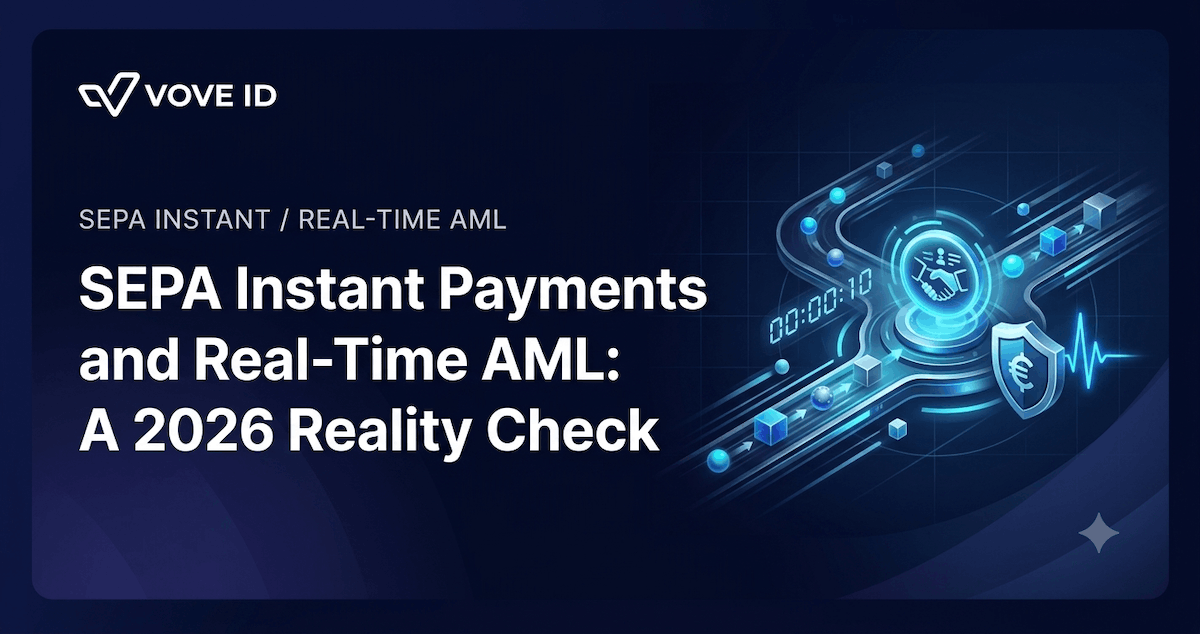
SEPA Instant Payments and Real-Time AML: A 2026 Reality Check
When a SEPA Instant payment settles in 10 seconds, AML controls that used to sit in review queues have to move before release. Here's what that control sequence needs to contain.
VOVE ID helps PIs and EMIs run real-time AML on SEPA Instant in markets where the settlement window is shorter than the legacy AML pipeline. When funds become available in ten seconds, AML controls that used to sit in review queues have to move before release — with clear logic for sanctions exposure, beneficiary verification, escalation, and post-event follow-up.
This article covers what SEPA Instant requires of the AML control sequence: the regulatory timeline, what the pre-clearance stack needs to contain, and what happens when the screening decision arrives after settlement. For the underlying AML framework that governs these obligations, see our AML Requirements Explained 2026.
What SEPA Instant actually requires in 2026
The operational bar is already higher than many fintech teams assume.
The European Central Bank defines instant payments as credit transfers that make funds available in a payee's account within ten seconds of the payment order. The Instant Payments Regulation, adopted 13 March 2024, is designed to accelerate rollout across Europe. For euro-area Member States, the ECB's implementation table shows that receiving instant payments and pricing parity applied from 9 January 2025, while sending instant payments and verification of payee applied from 9 October 2025. EMIs and PIs in euro-area Member States have explicit deadlines on 9 April 2027 for receiving and sending.
By 30 June 2026, many payment firms are in a transition window. The direction is already fixed.
Three controls from the same ECB guidance matter immediately:
- Instant credit transfers must be supported by PSPs that already send and receive standard credit transfers
- Verification of payee must be offered to the payer free of charge
- PSPs offering instant credit transfers must verify at least daily whether any payment service users are subject to targeted financial restrictive measures
That combination changes the design problem. The system cannot rely on post-settlement review as the primary AML control. Pre-payment decisioning becomes the first line.
Real-time AML: rules, scoring, and screening in 10 seconds
Most legacy AML stacks were built for queues. SEPA Instant requires a stack built for deadlines.
The first layer is pre-clearance screening: sanctions checks, internal blocklists, beneficiary verification, device and behavioral signals, and corridor-specific rules that should stop the payment before release.
The second layer is real-time decisioning. The system has to combine rules, thresholds, customer risk score, payment context, and match confidence fast enough to decide whether the transfer should pass, be stepped up, or be stopped. If a name match is ambiguous, the operating model needs a defined fallback — not a plan to review it later after the funds are already available to the recipient.
The third layer is post-event investigation. This still matters, but it becomes the backstop, not the main brake. Once a payment has settled, the team is managing remediation, reporting, partner communication, and potential exposure. The event itself can no longer be prevented.
A real-time AML stack for SEPA Instant needs:
- sanctions and watchlist screening before release
- verification-of-payee logic wired into the payment flow
- hard-stop and soft-stop thresholds with clear ownership
- latency budgets across every vendor dependency in the decision chain
- case management that records why the payment passed, was escalated, or was blocked
The failure mode: when a sanctions match arrives after settlement
A French PI switches on SEPA Instant for a fast-growing merchant base. Conversion improves. The problem is that the sanctions logic still runs as a background batch with a light synchronous check on top.
A transfer is initiated to a beneficiary name that produces a fuzzy sanctions match. The payment clears in seconds. Four seconds later, the deeper screening layer returns a result strong enough to require intervention.
The payment is no longer a review item. It is an operational incident. The PI now has to decide whether related funds can be frozen, how the event is documented, what partners need to be told, whether a suspicious activity report is required, and how to explain why the stronger signal arrived only after settlement.
That is the real 2026 risk. Not that a firm overlooked AML entirely, but that it kept AML in the wrong position in the timeline.
How VOVE ID places AML inside the 10-second window
VOVE ID helps payment teams place the essential checks ahead of the rail rather than behind it.
Beneficiary verification, sanctions screening, customer risk rules, payment-context scoring, and alert routing can sit inside one decision path. Low-risk payments pass fast. Ambiguous or higher-risk payments can be stepped up, delayed for review, or blocked with a documented reason.
The same case file carries the full trail: who the customer is, what the payment looked like, which controls fired, how the match was resolved, and what the reviewer decided. That is what matters when a partner bank, supervisor, or auditor asks whether an instant product still produces explainable compliance decisions.
For firms moving toward the 9 April 2027 EMI/PI deadlines, the extra runway is useful only if it is used to redesign the control flow — not to postpone the same queue-based AML model until the deadline forces a rebuild under pressure.
Checklist
- Identify which payment flows must clear synchronously and which can be stepped up
- Place sanctions, beneficiary, and internal risk checks before release where the risk justifies it
- Define hard-stop versus soft-stop thresholds before go-live, not after the first incident
- Wire verification of payee into the user journey and the audit trail
- Test the full latency budget end to end, including every vendor dependency
FAQ
Is SEPA Instant just faster SEPA?
No. It changes the compliance timeline. The payment is still a credit transfer, but the control model has to shift from queue-first to decision-first. The underlying obligations don't change; the sequencing does.
Can post-settlement monitoring handle this on its own?
No. Post-settlement monitoring remains necessary, but it cannot be the primary safeguard for a flow that settles in seconds. By the time the monitoring fires, the money is already gone.
Are EMIs and PIs already in scope?
Yes, with their own milestones. The ECB's current table shows 9 April 2027 as the key receiving and sending deadline for EMIs and PIs in euro-area Member States. That timeline doesn't leave room for a last-minute control redesign.
Running SEPA Instant on a legacy AML stack and know the queue-based model won't hold? VOVE ID puts the screening and decisioning logic inside the payment window so the compliance decision travels with the transfer, not behind it.
This article is intended for general informational purposes only and does not constitute legal, financial, or regulatory advice. KYC/KYB/AML requirements may vary depending on jurisdiction, industry, and specific business circumstances. For up-to-date and binding compliance obligations, readers should refer to the relevant regulatory authorities or consult qualified professionals.