VOVE ID vs Persona for African and MENA Startups: A Procurement Guide
Use a controlled pilot to test the documents, review paths, and controls your African or MENA launch actually requires.
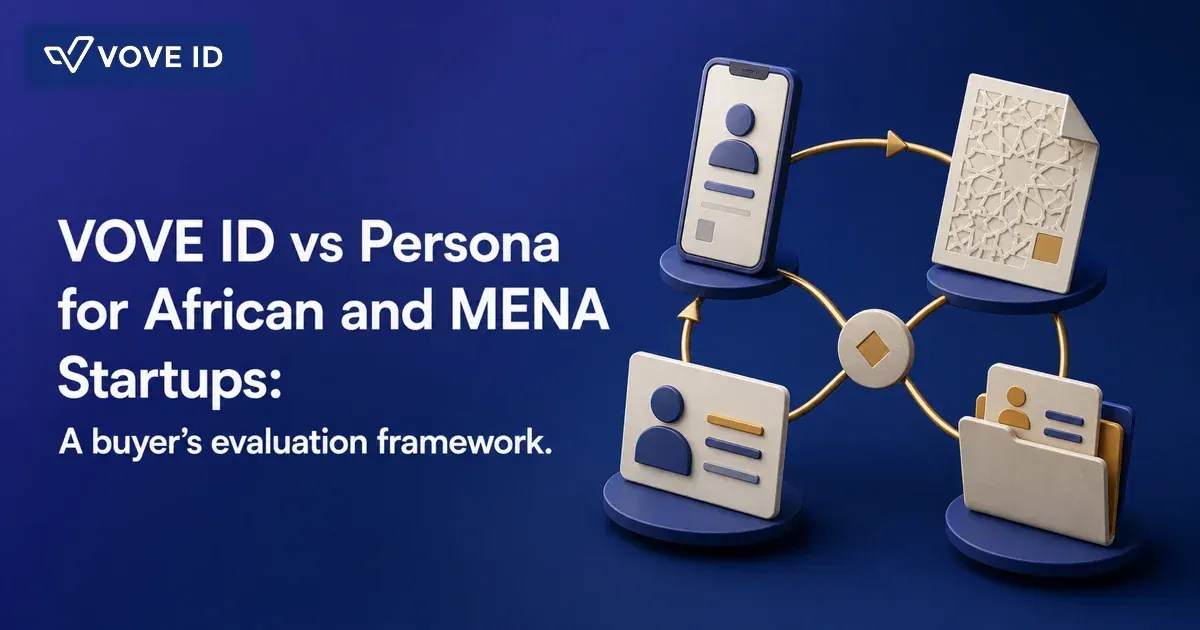
African and MENA onboarding does not become reliable because a vendor offers a flexible flow. It becomes reliable when the team proves that its documents, policy, and review process work together.
VOVE ID helps African and MENA fintech teams verify identity and build a reviewable compliance workflow across varied documents and onboarding conditions. The real risk appears when a team adopts a flexible flow without confirming what the flow can prove in its own markets.
Persona and VOVE ID approach identity verification as configurable product infrastructure. A startup should compare them through the launch evidence its team needs to operate, rather than through a claim that one is universally better.
This is exactly where onboarding control breaks down.
Persona's public model: configurable identity infrastructure
Persona's public documentation describes verification methods including government ID, selfie, document, and database checks. Its API documentation also describes hosted, embedded, and mobile integration patterns, with workflows and status updates.
That flexibility can be relevant to a startup with a defined product and risk model. It still does not remove the local work. Persona's own guidance on global identity verification notes that regulations, documents, fraud patterns, and data sources differ across markets.
For VOVE ID, the approved fact base includes identity verification, biometric liveness, face matching, AML screening, KYB, and audit-ready logging, with document coverage spanning a broad range of document types and countries (exact figures available on request). Teams should validate the exact product configuration and documents they need before they launch.
For a full breakdown of identity-verification controls, see our KYC requirements framework.
African and MENA onboarding: where a generic flow meets local reality
The hard part is rarely adding an ID-upload screen. It is deciding what happens after the upload.
An African or MENA startup can face different identity documents, Arabic or Latin scripts, residency evidence from cross-border customers, varied mobile-capture quality, and policy exceptions that require human review. The team needs to know which proof is sufficient for its regulated activity and how the resulting decision reaches product, operations, and audit teams.
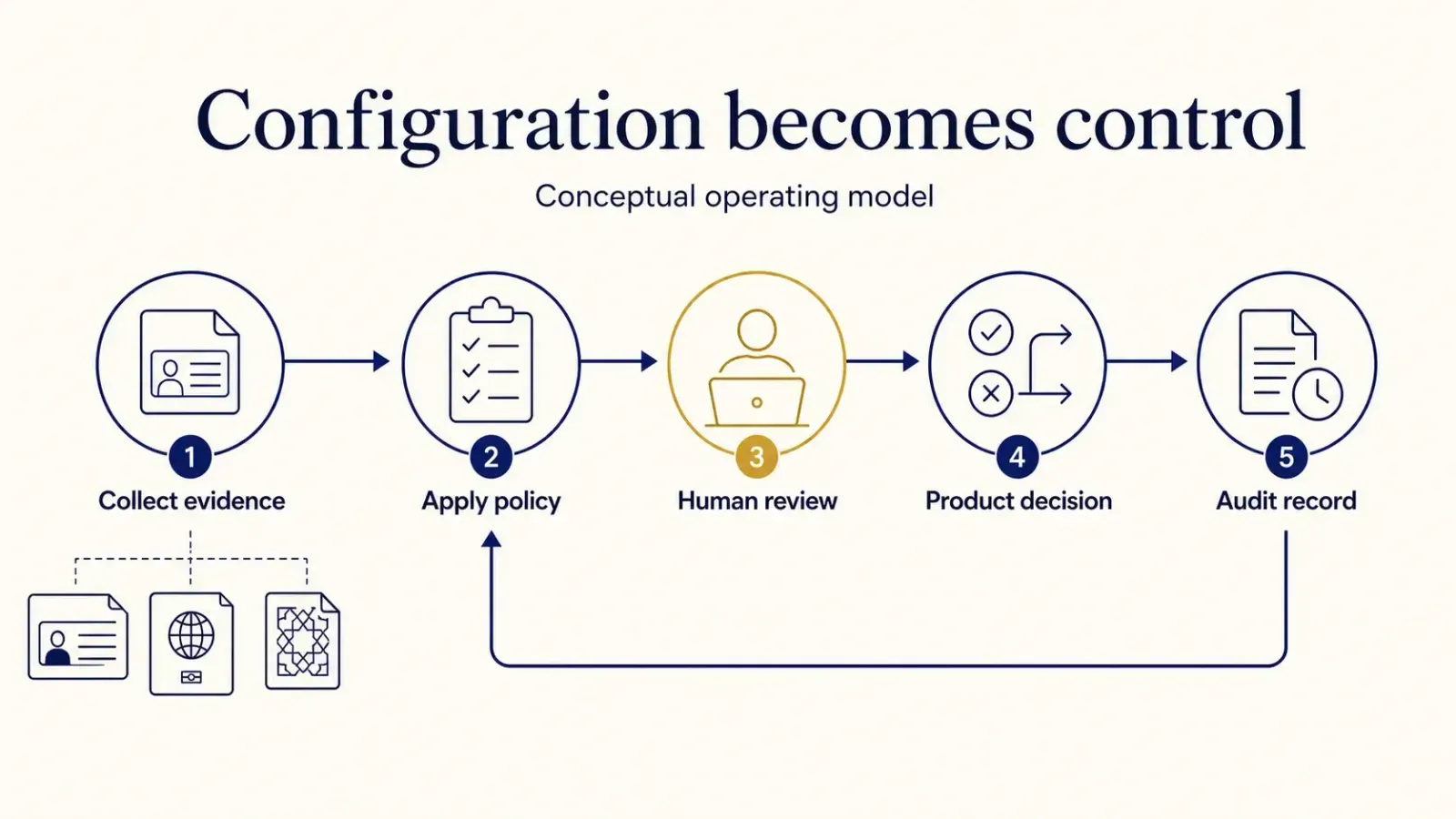
On paper, a configurable workflow solves this with options. In practice, options must become a controlled policy: what to request, when to request it, who reviews the exception, and what evidence remains after a decision.
This means one thing: configuration is only valuable when it produces a repeatable decision record.
A realistic scenario: the remittance startup expanding its corridor
A remittance startup launches in the Gulf and begins onboarding customers who send funds to East and West Africa. Product wants a short mobile flow. Compliance needs stronger evidence for selected risk scenarios.
The team receives:
- A national ID from a Gulf customer using Arabic script
- A passport from a diaspora customer with a residence document
- A low-light mobile capture from a recipient in a launch market
- A screening alert that needs documented human disposition
- A case where the customer must supply a second document
Then the real operating questions appear.
Which evidence is enough for the policy? How does the product communicate a review without promising a result? Where does the reviewer record rationale? Which event returns to the application when a case closes?
This is not a form-design problem. It is a decision-orchestration problem.
The buyer's framework: match configuration to control
| Evaluation area | The buyer must prove | Pilot evidence to collect |
|---|---|---|
| Identity evidence | Exact launch documents work in expected scripts and capture conditions | Approved test-pack outcomes and exception notes |
| User journey | The flow requests evidence at the right risk moment | Hosted, embedded, or mobile flow walkthrough |
| Compliance policy | Reviewers can apply and document the intended rule | Policy mapping and completed case record |
| Product integration | Decision states return correctly to the application | Webhook or event test, including retry and review states |
| Operating ownership | Teams know who handles inconclusive and escalated cases | RACI and escalation exercise |
The matrix is not a capability claim about Persona or VOVE ID. It is the minimum evidence a startup should require from any shortlisted provider.
How VOVE ID fits: turn identity checks into a reviewable workflow
VOVE ID is relevant when a startup needs identity verification, biometric liveness, face matching, AML screening, KYB support, and audit-ready logging in its operating flow. The value is not the presence of isolated checks. It is the ability to connect an onboarding decision to the evidence a compliance team needs later.
For Arabic-language documentation, VOVE ID supports document OCR in Arabic. That can be useful for a MENA launch, but it should be tested against the specific document types, capture conditions, and acceptance policy the startup will use.
The rollout should focus on a shared test pack and a small number of measurable decision states. That gives engineering, product, and compliance one language for discussing acceptance, review, and escalation.
Comparing providers without picking a named competitor first? See our KYC vendor RFP checklist for a vendor-neutral version of this evaluation.
Practical vendor-evaluation checklist
Identity and documents
- Test the exact national IDs, passports, and residence documents in each launch market.
- Include Arabic-script and low-quality mobile captures where relevant.
- Define approved alternatives when primary evidence is unavailable.
Product flow
- Map every request for evidence to a documented risk reason.
- Test hosted, embedded, or mobile journeys with product and compliance together.
- Write clear customer messaging for pending and further-review states.
Risk and review
- Document the reviewer decision and evidence requirements for each exception.
- Confirm how screening alerts enter the case process.
- Keep an audit-ready record of final disposition and rationale.
Launch operations
- Assign an owner for product events, reviewer queues, and customer escalation.
- Run a pilot with real operating hours and a defined fallback process.
- Review commercial terms against both low- and high-volume launch scenarios.
FAQ
Does Persona support multiple identity-verification methods?
Persona's documentation describes government-ID, selfie, document, and database verification methods. A team should verify coverage and the precise configuration needed for its own launch markets.
Does a configurable flow solve regional onboarding by itself?
No. Regional onboarding still depends on acceptable identity evidence, local policy, capture conditions, and a functioning exception process.
When is VOVE ID a relevant option for an African or MENA startup?
VOVE ID is relevant when the team needs its approved identity, liveness, face-matching, AML, KYB, and audit-log capabilities, and wants to test them against the startup's live-market workflow.
What should a first pilot measure?
Measure whether approved documents can enter the intended flow, whether review states reach the right owners, and whether every final decision leaves usable evidence.
Conclusion
VOVE ID versus Persona is not a question of who has more configuration. It is a question of whether configuration becomes control.
African and MENA startups need a workflow that joins evidence collection, policy, review, product events, and audit records. Those are not separate tasks. They are one operating system.
Want to test VOVE ID against your launch documents and review process?
This article is intended for general informational purposes only and does not constitute legal, financial, or regulatory advice. KYC/KYB/AML requirements may vary depending on jurisdiction, industry, and specific business circumstances. For up-to-date and binding compliance obligations, readers should refer to the relevant regulatory authorities or consult qualified professionals.