KYC & AML Compliance in Sweden (2026): Digital Onboarding for Financial Services
Automated onboarding can pass every check and still fail the case file. Here is how Swedish fintechs keep the relationship explainable.
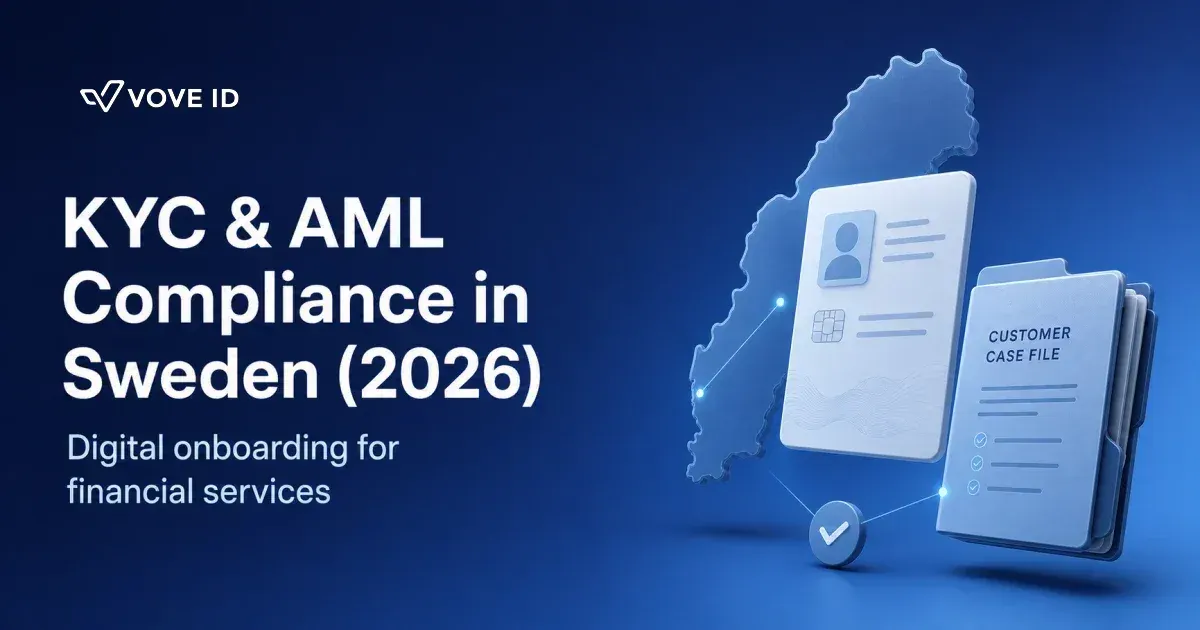
Swedish financial-services teams need digital onboarding that produces a risk-based, explainable customer relationship, not only a completed identity check.
The operating answer
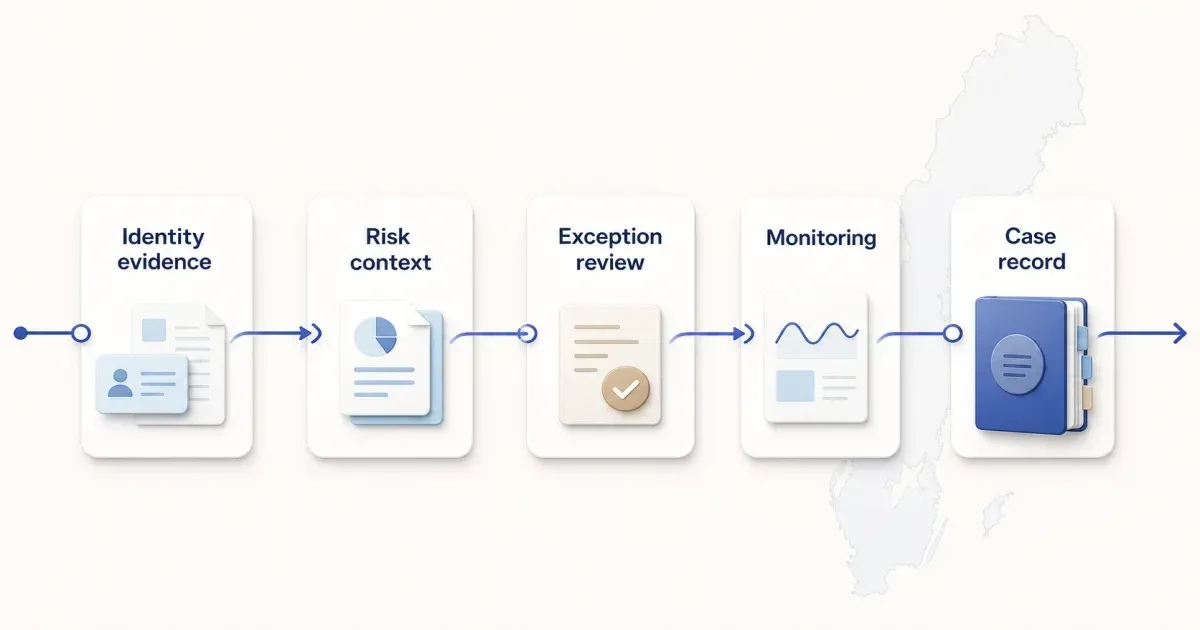
A Swedish financial-services business needs risk-based AML/CFT controls that identify and verify customers, assess the relationship, monitor for changes and unusual activity, and maintain an accountable reporting route. Digital onboarding works when the evidence, review decisions, and later monitoring history remain connected in the customer case.
VOVE ID helps financial-services teams connect identity evidence, screening context, exceptions, and reviewer actions within a single workflow. The failure mode isn't the digital flow itself — it's a customer accepted through it whose risk decision the team can no longer explain once a question comes back later.
Establish the Swedish perimeter
Sweden's AML/CFT framework includes the Anti-Money Laundering and Counter-Terrorist Financing Act (2017:630) and Finansinspektionen's AML regulations, FFFS 2017:11. Finansinspektionen states that the regulations cover risk assessment and procedures, identity verification, monitoring and reporting, and internal control for firms within scope.
For a payment, e-money, lending, investment, or other regulated financial product, the first operational task is to confirm the authorization and supervisory perimeter. The control design needs to follow the actual service, customers, distribution model, and cross-border footprint, not a generic fintech checklist.
Onboarding, compliance governance, and product design have to share the same understanding of the relationship being opened — a control built after the product is live tends to miss exactly the cases it was meant to catch.
For the underlying identity-control model, see our KYC requirements framework.
Build the relationship record
Digital onboarding should collect evidence that supports a decision. Teams need enough context to identify and verify the customer, assess the purpose and intended nature of the relationship, apply risk-based measures, and explain exceptions.
For a business customer, that means a connected view of the entity, representatives, beneficial owners where relevant, expected activity, source evidence, screening context, risk rationale, and decision owner. A completed document capture is only one input to that record.
The EBA's remote customer-onboarding guidelines set common EU expectations for risk-sensitive initial CDD and for assessing remote-onboarding tools. The useful question for a Swedish fintech isn't whether the flow is fully automated — it's whether it has an evidence standard and a clear exception path.
For the broader entity- and beneficial-ownership model, see our KYB requirements framework.
Case note: automation without an accountable exception
A Stockholm payment platform onboards a small online marketplace that will pay sellers in several countries. The business submits a company and representative record, identity evidence for the authorized signatory, a beneficial-ownership declaration, and an expected seller-payout profile.
Then the inconsistency appears. The signatory's identity result is complete, but the ownership declaration and expected payout pattern sit in different systems. A reviewer sees an alert but cannot see the relationship context that explains whether it is material.
The account is approved, then reopened when seller payouts diverge from the original profile. This is not a liveness or document-verification failure. It is an ownership, evidence, and case-management failure.
Make human judgment traceable
VOVE ID supports identity verification, biometric liveness, face matching, AML screening, KYB, and transaction monitoring, and can help teams surface document-template inconsistencies, invalid MRZ checksums, barcode or QR inconsistencies, and image manipulation across a wide range of document types and countries.
Manual review may be used when a customer's compliance team has sufficient evidence to approve a verification. That makes the decision record essential: the case should show what the reviewer saw, what was resolved, and who accepted the residual risk.
Connect alerts to the original decision
Finansinspektionen's rules place monitoring and reporting inside the same AML/CFT control framework as risk assessment, identity verification, and internal control. The customer relationship should therefore be treated as a living record, not a one-time approval.
Sweden's Financial Intelligence Unit sits within the Swedish Police Authority. The Police states that reporting is made through its goAML system, and that information from reporting entities feeds the FIU's work against money laundering and terrorist financing. A firm needs a documented internal escalation route before a concern reaches that stage.
In practice, teams should define trigger events for changed activity, ownership, document information, risk indicators, or other material context. Each trigger should create a case that retains the original relationship profile, the new evidence, the review outcome, and the responsible owner.
For the broader screening, case-management, and escalation model, see our AML requirements framework.
Make retrieval part of the control design
Remote onboarding concentrates sensitive identity evidence in digital systems. Access controls, retention decisions, vendor governance, and audit trails must therefore be designed around the customer case. The precise legal basis and retention duties depend on the firm's activities and circumstances, so teams should confirm current requirements with qualified Swedish advisers.
The operational test: can a compliance reviewer retrieve the evidence, risk rationale, exception decision, monitoring history, and escalation path without reconstructing the case from disconnected tools? If not, the workflow has a control gap.
Field checklist
Governance
- Confirm the firm's Swedish authorization and AML/CFT perimeter.
- Assign accountable owners for risk assessment, exceptions, monitoring, and escalation.
- Keep procedures aligned with current law, FI regulations, and supervisory guidance.
Digital onboarding
- Define evidence standards for automated outcomes and manual exceptions.
- Connect identity, authority, ownership, relationship purpose, and risk evidence.
- Record the reason for every approval, rejection, and residual-risk decision.
Monitoring and reporting
- Define triggers for material activity, ownership, and documentation changes.
- Compare new information with the customer relationship profile.
- Maintain a tested internal route for the applicable goAML reporting process.
Records and audit
- Retain source evidence, reviewer actions, and decisions together.
- Restrict sensitive identity and case information by role.
- Test whether a reviewer can reconstruct a customer case without email searches.
Questions teams ask before launch
Which AML rules matter most for Swedish financial firms?
The Anti-Money Laundering and Counter-Terrorist Financing Act (2017:630) and Finansinspektionen's FFFS 2017:11 regulations are central references. The exact obligations depend on the firm's activity and supervisory perimeter.
Can a fully digital flow complete customer due diligence?
It can collect important identity evidence, but a complete process also needs risk assessment, relationship context, exception management, monitoring, and retrievable records.
When should a digital onboarding case be escalated?
Escalate when evidence is inconsistent, authority or ownership cannot be resolved, the relationship purpose is unclear, or the available information falls outside the firm's risk policy.
Where are suspicious activity reports made in Sweden?
The Swedish Police states that reporting to the Financial Intelligence Unit is made through goAML. Firms should use their approved internal procedures and current official guidance for the applicable reporting decision.
The operating position
Swedish AML compliance doesn't come down to how automated the onboarding flow is. It comes down to whether the identity evidence, risk decision, and monitoring history that follow it stay connected in one case as the relationship changes.
Financial-services teams need identity, risk, reviewer judgment, activity, and reporting evidence to stay connected as the relationship changes. Collection, verification, review, and case management are one workflow.
This article is intended for general informational purposes only and does not constitute legal, financial, or regulatory advice. KYC/KYB/AML requirements may vary depending on jurisdiction, industry, and specific business circumstances. For up-to-date and binding compliance obligations, readers should refer to the relevant regulatory authorities or consult qualified professionals.