Freelancer Marketplaces: KYC at Payout for Cross-Border Talent
A verified worker isn't a fixed payout destination — here's how marketplaces review a changed payout method before releasing funds on an established account.
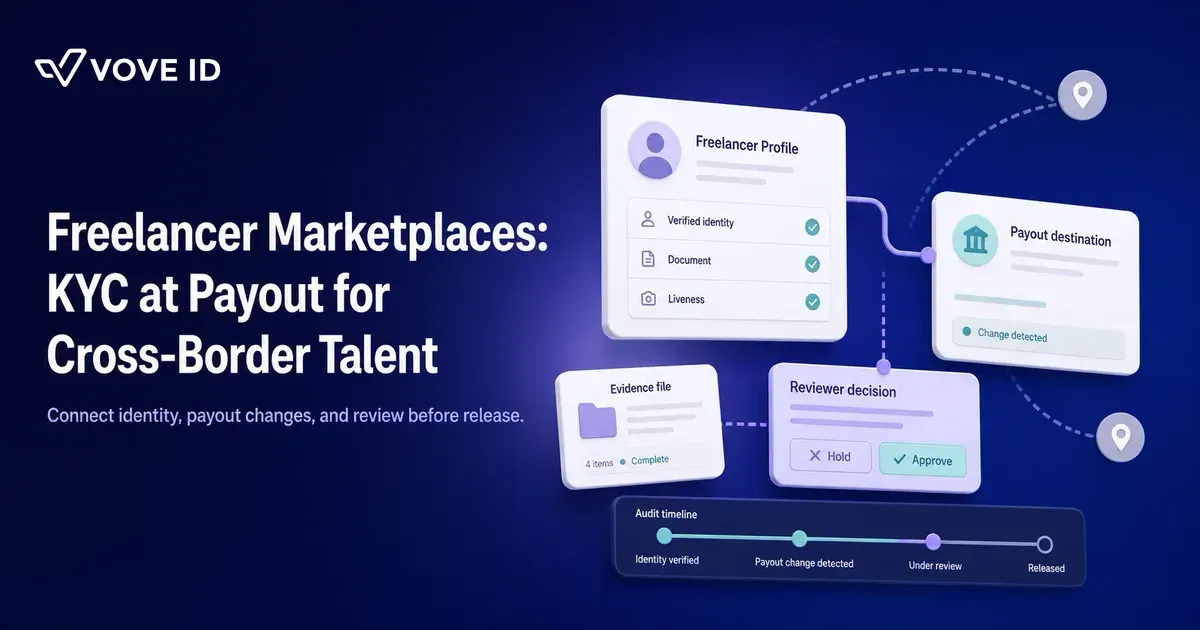
Why the payout moment needs a clear identity decision, account-control evidence, and a review path that does not strand legitimate workers.
Direct answer: A freelancer marketplace should treat payout as a controlled identity event, not only a payments event. It needs a policy-based check of the worker, the payout instruction, risk signals, and any exception before releasing funds.
VOVE ID helps freelancer marketplaces organize identity and compliance evidence when cross-border talent needs to be paid without losing control of who receives the funds.
This guide reflects the state of practice as of 7 August 2026. It is informational, not legal advice — the required checks depend on the marketplace's jurisdiction, payment role, customer relationship, corridors, and local rules.
The gap shows up at the same point every time: the work is complete, but the team cannot actually explain whether the payout recipient is the verified worker.
Payout context: the identity decision happens after the work is done
Cross-border marketplaces often verify a worker during sign-up, then allow the payout profile to change later. That separation creates a control gap. A bank account, wallet, or payout method can change even when the marketplace account does not.
This is a different moment than first-time payout activation, where the open question is whether a newly onboarded worker's identity file is complete enough to release a payout at all. Here, the worker is already established and verified — the risk is that the destination attached to that verified identity has quietly drifted.
For how platforms handle the earlier activation moment — releasing a first payout to a newly onboarded worker — see our KYC for gig-economy payouts.
The FATF Recommendations set a risk-based international framework; Recommendation 10 covers customer due diligence, including identifying and verifying the customer and beneficial owner where relevant. Local implementation determines what applies to a particular marketplace and payment flow.
For how this fits into a broader compliance program, see our AML requirements explained: the compliance operating system for regulated financial institutions.
This means one thing: a payout instruction should be assessed in the context of the worker's identity record, not as a detached payment preference.
For the underlying identity-verification framework, see our KYC requirements explained: the identity-verification framework for fintech and regulated platforms.
The payout control: connect worker, account, and case record
The useful question is not whether every freelancer needs the same check. It is whether the marketplace can explain why this person, using this payout instruction, is allowed to receive this payment.
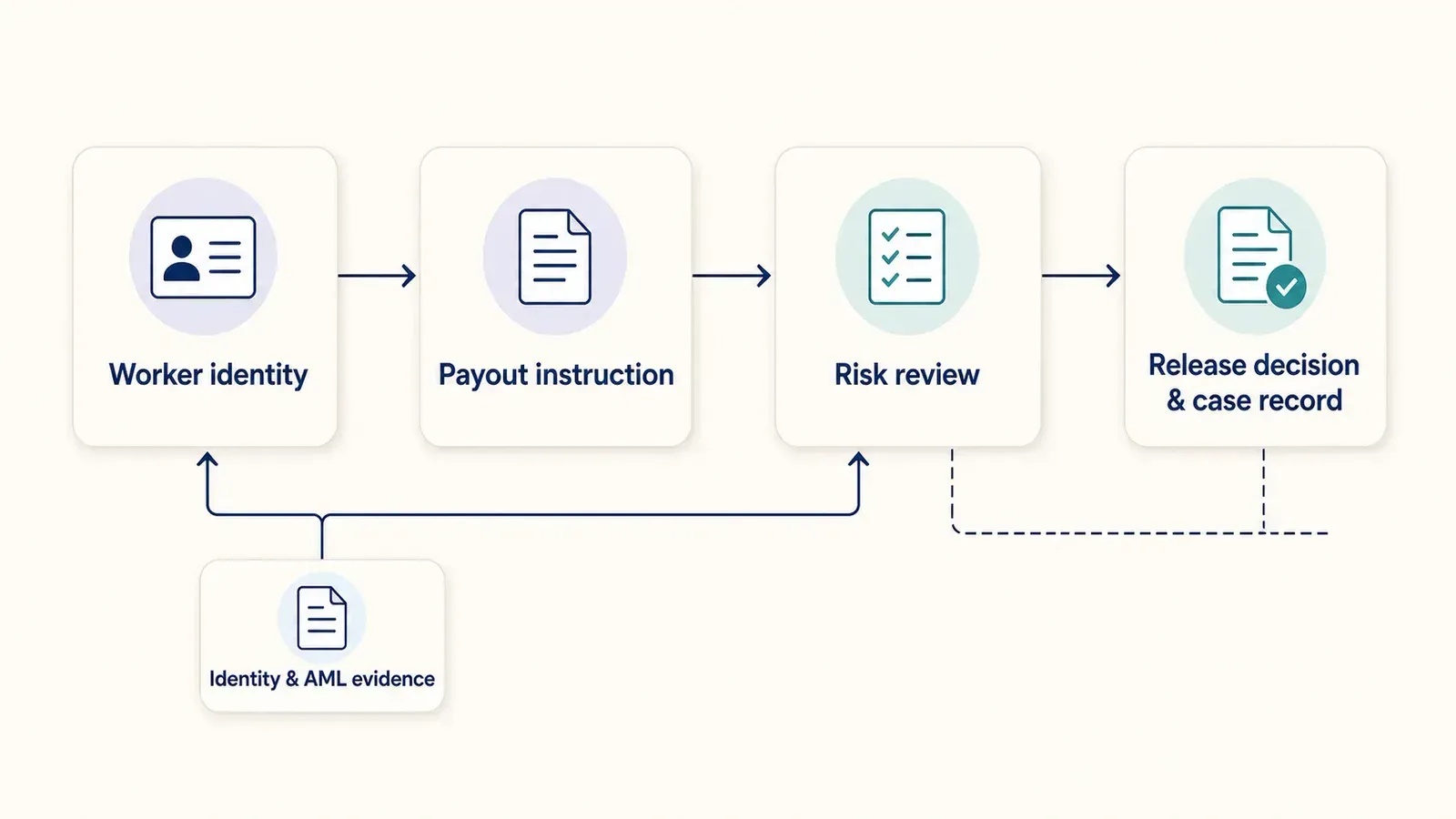
Start with a stable worker identity record. Then link the selected payout method, any profile or instruction change, relevant screening result, reviewer action, and release decision to the same case.
Do not turn every change into an automatic rejection. Define the events that create a review: a material identity mismatch, a changed payout destination, a risk signal, or evidence that the policy requires a fresh decision.
VOVE ID supports identity verification, biometric liveness, face matching, AML screening, KYB, and transaction monitoring, giving marketplaces the inputs to set policy, scope, and an accountable review process around each payout.
A realistic payout failure: the completed project and the changed destination
A design marketplace approves a freelancer at sign-up and later receives a payout request after a completed client project.
- The freelancer account is verified.
- The payout method was changed shortly before the release window.
- The name on the destination evidence does not clearly connect to the account holder.
Then the inconsistency appears. Support sees a routine account update, payments sees a valid payout instruction, and the compliance reviewer sees neither context in one place.
The payment is delayed because the team must reconstruct the record across queues. This is not a payment failure. It is a case-linking failure.
Exception handling: protect legitimate talent without making exceptions invisible
Cross-border talent does not arrive with identical documents, banking relationships, or access conditions. A workable control model therefore needs a defined exception route rather than an informal workaround.
The route should say who can request an exception, what evidence the policy allows, who can approve it, how the decision is recorded, and when the worker must be reviewed again. The evidence can be limited, but the decision cannot be unexplained.
Manual review is useful when the customer's compliance team has sufficient evidence to approve a verification. It should record the rationale and the accountable reviewer, not replace the policy.
How VOVE ID supports payout readiness: evidence before release
VOVE ID can provide identity, liveness, face-matching, AML-screening, and business-verification inputs within a marketplace workflow. The marketplace remains responsible for its eligibility rules, payment controls, and regulatory obligations.
The operational goal is a retrievable case record: worker evidence, payout instruction context, risk signal, review outcome, and release or hold rationale. That reduces avoidable back-and-forth when a payout needs to be explained.
Practical freelancer-marketplace payout checklist
Identity and account control
- Link each payout instruction to the worker's identity record.
- Define which profile and destination changes require a fresh review.
- Record the basis for accepting or rejecting a payout exception.
Risk and review
- Apply screening and escalation rules according to the approved risk policy.
- Keep risk signals separate from final decisions until a reviewer assesses them.
- Give support and payments teams one clear route into the case record.
Audit and operations
- Preserve the evidence available at the time of payout release.
- Record the reviewer, outcome, and rationale for holds and overrides.
- Test whether a second reviewer can reconstruct the payout decision.
FAQ
Should KYC happen only when a freelancer signs up?
No. A marketplace should define events that require it to reassess the identity or payout decision, especially when payout instructions or risk context change.
Does a changed bank account automatically mean fraud?
No. It is an event that may require policy-led review. The marketplace should assess the context and retain the outcome.
Who owns the final payout decision?
The marketplace or regulated payment party responsible under the relevant arrangement owns it. A verification provider supplies evidence and workflow inputs; it does not replace accountable judgment.
What makes a cross-border payout record audit-ready?
It connects the worker identity, payout instruction, relevant risk evidence, reviewer action, and release decision in a retrievable history.
Can a marketplace support legitimate exceptions?
Yes, when its policy defines the evidence, authority, and record required for an exception. The control is the documented decision, not a promise that every case will pass.
Conclusion
Freelancer-marketplace compliance doesn't end at sign-up with an automatic payment on the other side — it's an ongoing ability to explain why the verified worker is allowed to receive a particular payout.
Teams should connect identity, payout changes, risk context, and reviewer decisions before release. Collection, verification, and payout control are one workflow.
Want to see how VOVE ID supports identity and compliance evidence for cross-border marketplace payouts?
This article is intended for general informational purposes only and does not constitute legal, financial, or regulatory advice. KYC/KYB/AML requirements may vary depending on jurisdiction, industry, and specific business circumstances. For up-to-date and binding compliance obligations, readers should refer to the relevant regulatory authorities or consult qualified professionals.