KYC for Gig-Economy Payouts: Enabling Rapid Worker Activation
A verified ID is not enough to release a payout. Here is how gig platforms keep worker identity, payout destination, and exceptions connected.
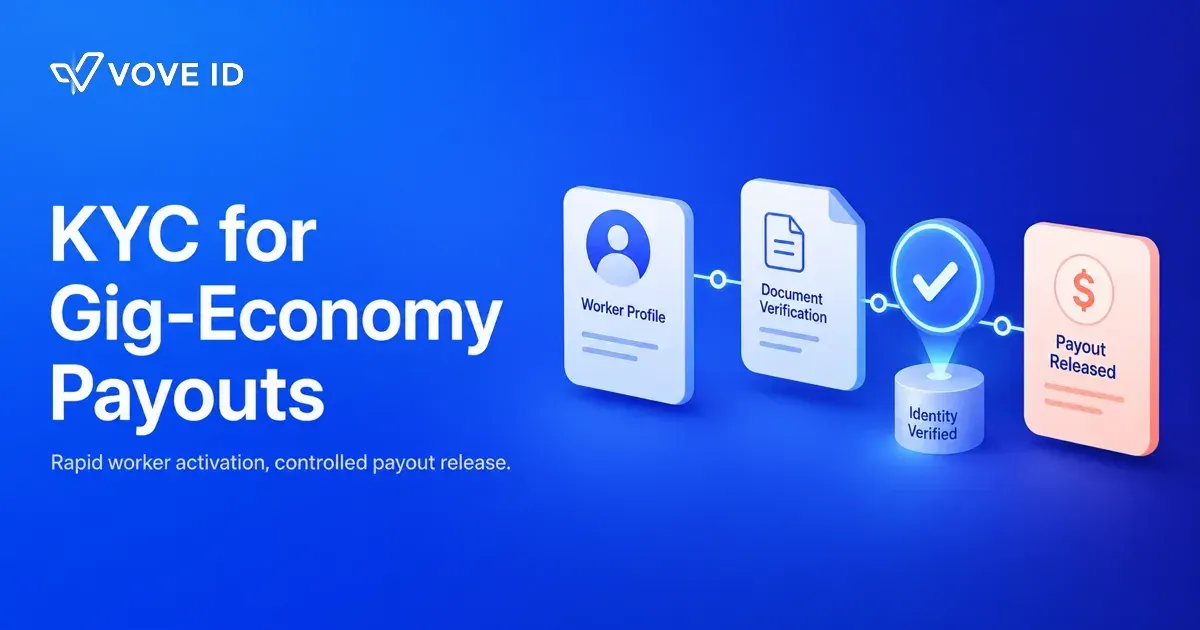
A payout workflow moves faster when identity evidence, risk decisions, and exceptions stay in one controlled file.
Direct answer
Gig-economy platforms need KYC that confirms the worker behind a payout instruction before the platform activates a payout route. The right sequence isn't simply "verify at sign-up" — it's collect evidence, assess risk, approve or route exceptions, then release payout access under the rules that apply to the platform and market.
VOVE ID helps payment and BaaS teams verify workers before payout activation across document, biometric, screening, and case-management steps. The difficult part isn't collecting an ID image — it's keeping the identity decision connected to the person, the payout account, and the review trail.
This is where worker activation breaks down.
For the underlying identity-control model, see our KYC requirements framework.
Payout activation: identity is a release control
On paper, a gig platform onboards a worker, lets them accept jobs, and pays them after the first completed shift. In practice, the payout event creates the operational deadline. A worker may have already completed work before the team knows whether the identity file is sufficient, whether the account details create a mismatch, or whether the case needs review.
Activation has to be designed as a controlled release, not as an optimistic sign-up state.
The FATF's standards place customer due diligence inside a risk-based framework. Its 2025 financial-inclusion guidance also stresses proportionate controls rather than automatic exclusion. For a payout platform, that principle translates into a workflow that separates a low-risk, evidence-complete worker from a case that needs more information or a manual decision.
The exact trigger and evidence requirements depend on the jurisdiction, the platform's regulated role, and its payout partner. Teams should map these rules before making activation promises in the product.
The operational gap: fast onboarding, disconnected evidence
Most worker journeys split four records across separate systems: the profile created in the marketplace, the identity evidence captured during onboarding, the payout destination supplied by the worker, and the decision record held by operations or a payment partner.
When those records don't join cleanly, a reviewer may approve an exception without knowing that the payout destination changed after the first check.
A realistic payout failure: the courier who cannot be released
A delivery platform onboards a courier ahead of a weekend demand spike. The courier submits a national ID, a selfie, and payout-account details. The identity session completes, but the account holder name doesn't match the name on the worker profile.
The platform has received a worker profile and phone number, national ID image, selfie capture, payout-account details, and a first-shift completion record.
Then the inconsistency appears. The better path holds the payout route, asks for the specific missing evidence, records the reason, and sends the case to an accountable reviewer when policy requires it.
This is not a verification failure. It is a collection and decisioning failure.
The activation flow: one decision, clear ownership
A practical workflow has five states: profile created, evidence collected, checks completed, exception reviewed where required, and payout route released.
VOVE ID can support identity verification, biometric liveness, face matching, AML screening, KYB, and transaction monitoring as parts of that workflow, and can help identify document-template inconsistencies, invalid MRZ checksums, barcode or QR inconsistencies, and image manipulation across a wide range of document types and countries. Those signals inform a decision; they aren't a guarantee that a worker or payout is legitimate.
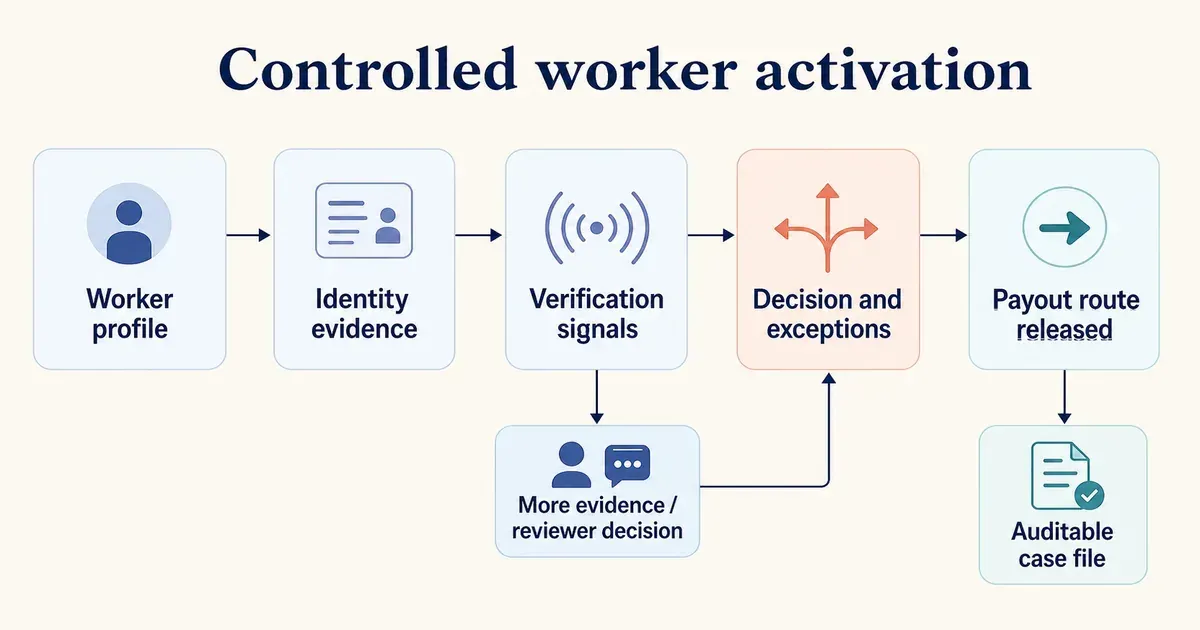
For each case, define decision ownership and the evidence needed to move forward. Product owns the worker message, compliance owns policy, and operations owns timely case handling.
For the broader screening and case-management model, see our AML requirements framework.
What "rapid" should mean in practice
Rapid activation means the standard path is understandable and the exception path is deliberate. It doesn't mean every worker receives the same decision without regard to evidence or risk.
Use clear product states. "More information needed" is better than silently failing a worker. Make the next evidence request specific and avoid asking a worker to repeat a completed step.
The 2025 FATF financial-inclusion guidance is useful context: a risk-based approach can allow proportionate treatment of lower-risk situations while reserving enhanced measures for higher-risk cases. It doesn't replace national rules or a platform's own risk assessment.
How VOVE ID fits: a file teams can operate
VOVE ID helps teams turn worker activation from a sequence of disconnected checks into a traceable case. Document evidence, liveness and face-matching results, screening outputs, and reviewer action can remain connected to the onboarding decision.
Teams still need policy for payouts, account changes, escalation, and record retention. The goal isn't to make compliance invisible — it's to make the standard route quick, the exception route accountable, and the decision record available when a partner or regulator asks how the payout was released.
Practical gig-payout KYC checklist
Onboarding
- Define the identity evidence required before a payout route can be released.
- Link the worker profile, verification session, and payout destination to one case ID.
- Explain the next step when a worker needs to provide more evidence.
Risk
- Set documented triggers for account-name mismatches, repeat attempts, and material profile changes.
- Apply enhanced review only where the risk assessment or local rules require it.
- Reassess the case when the worker changes a payout destination or key identity details.
Operations
- Give each exception a named queue and accountable owner.
- Record the reason, evidence, decision, and reviewer action in the case file.
- Test that support teams can explain a hold without exposing unnecessary personal data.
Audit
- Retain evidence according to the applicable legal and contractual requirements.
- Reconcile released payout routes against approved identity cases.
- Review exception patterns for workflow gaps, not only individual errors.
FAQ
Must KYC happen before a worker can accept a job?
Not always. The required timing depends on local law, the platform's business model, and the service or payout activity. Teams should distinguish work access from payout release and document the control points that apply to each.
Is a verified ID enough to release a payout?
No. A platform also needs a policy for the relationship between the identity case and the payout destination, plus an exception path for mismatches, changes, or risk flags.
Can a manual review make worker activation faster?
It can prevent a case from getting stuck when the compliance team has enough evidence to make a decision. It should operate under documented authority, evidence standards, and audit logging.
Conclusion
KYC for gig payouts is not a signup feature. It is a release control for a person, a payout route, and a decision that must be explainable later.
Teams should build the normal path for speed and the exception path for control. Collection, verification, payout release, and case management are one workflow.
This article is intended for general informational purposes only and does not constitute legal, financial, or regulatory advice. KYC/KYB/AML requirements may vary depending on jurisdiction, industry, and specific business circumstances. For up-to-date and binding compliance obligations, readers should refer to the relevant regulatory authorities or consult qualified professionals.