KYC for Mobile-Money Platforms: Beyond the SIM-Card Proxy
A phone number is a signal, not proof of identity. Here is how mobile-money platforms build a KYC workflow that doesn't stop at the SIM record.
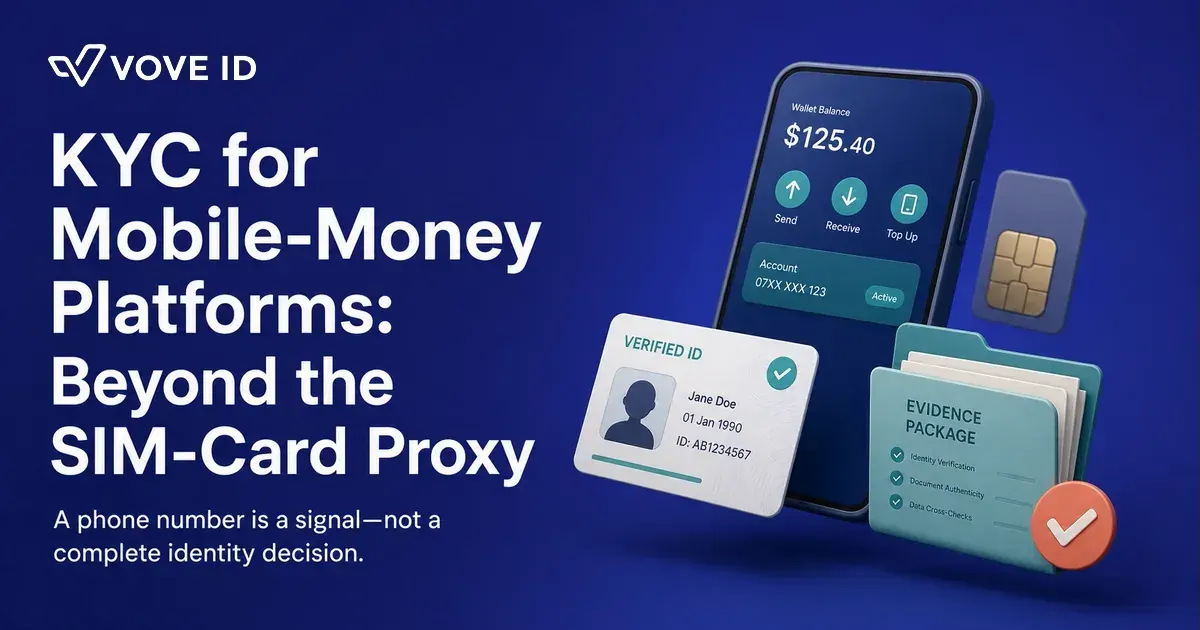
Why a registered SIM can support onboarding context but cannot replace a risk-based customer due-diligence workflow.
Direct answer
KYC for mobile-money platforms should establish who controls the account, collect evidence appropriate to the product and risk, and keep that evidence available for review. A SIM registration record can be a useful signal, but it does not by itself prove that the active wallet user is the enrolled subscriber or that the account's risk is understood.
VOVE ID helps mobile-money and payment teams verify people before they activate or pay out a wallet. The common mistake is treating possession of a phone number as completed identity work.
This is exactly where payout controls fail: the platform can reach a device without building an auditable understanding of the person using it.
For the underlying identity-control model, see our KYC requirements framework.
SIM registration: a useful signal, not a KYC decision
SIM registration and customer due diligence solve different problems. A telecom process links a subscriber record to a mobile connection under the rules that apply in that market. A financial-services workflow must decide whether the platform has enough reliable information to open, limit, monitor, or escalate an account.
The Financial Action Task Force (FATF) expects a risk-based approach to financial integrity and financial inclusion. Its guidance also notes that identity assurance and digital-ID suitability must be assessed in context, not assumed from a digital channel alone. FATF's digital identity guidance is a useful starting point for teams designing remote onboarding.
A mobile number can inform the case, but the workflow still needs evidence, decision rules, and a record of why the decision was appropriate.
The onboarding sequence: prove, decide, retain
The exact permitted documents, tier limits, and reporting duties come from the license, regulator, and country rules that govern the service. Teams should map those local obligations before setting automated approval rules.
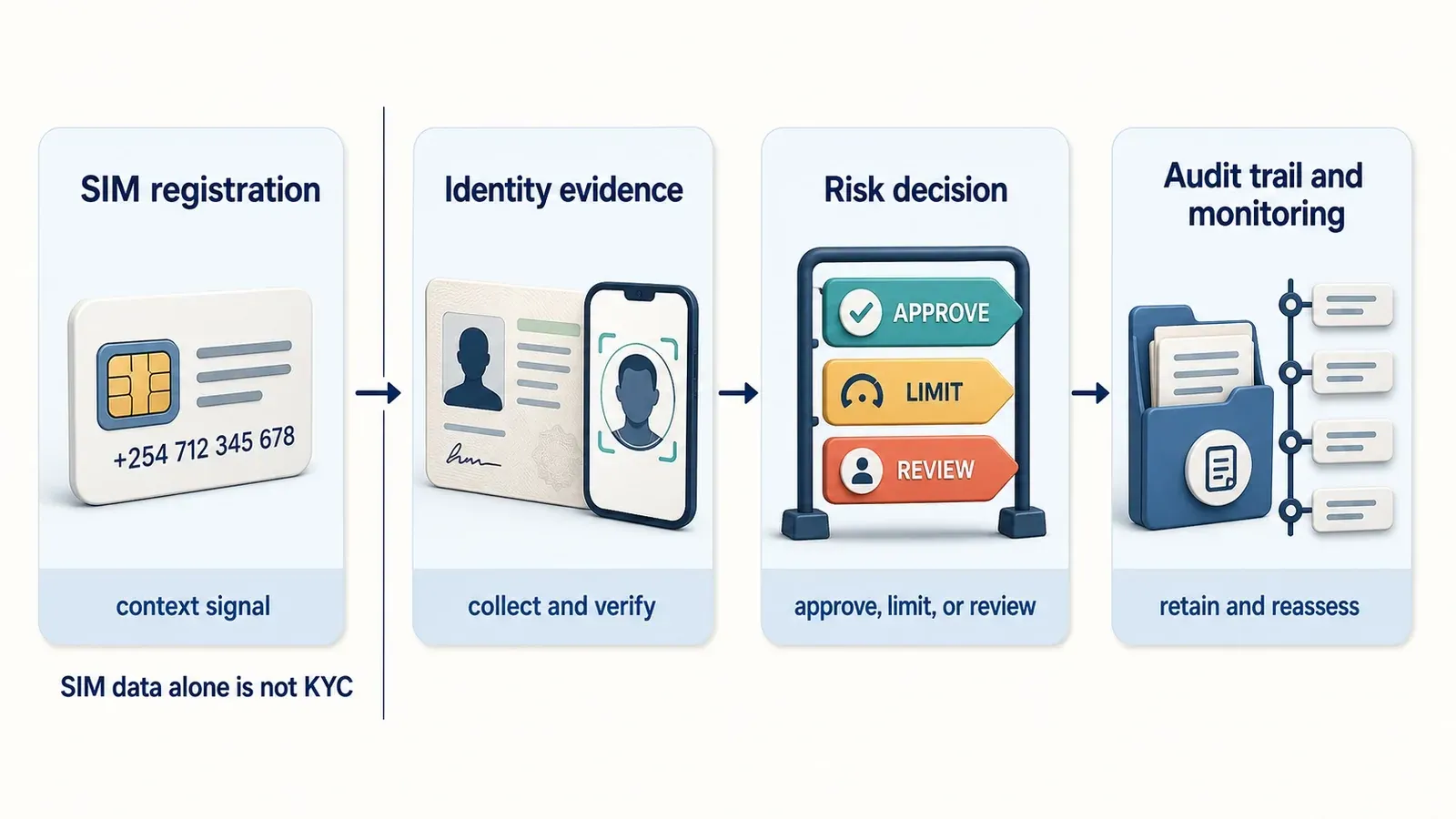
In practice, a mobile-money KYC flow needs four distinct stages:
- Collect the identity evidence and the account context required for the intended wallet tier.
- Verify document and biometric evidence where the risk model and local rules call for it.
- Decide whether to approve, restrict, request more information, or send the case to review.
- Retain and monitor the decision evidence, changes to the account, and activity that requires reassessment.
FATF's guidance for mobile and other new payment products frames AML/CFT controls around a proportionate, risk-based assessment of the product, participants, and delivery channel. It does not turn a phone number into a universal identity credential. See FATF's payment-services guidance.
A realistic failure: the wallet and subscriber do not match
A payout platform lets contractors receive earnings through mobile wallets. It receives a phone number, a basic profile, and a statement that the number has been registered.
The platform activates the wallet without checking the identity evidence required for its risk tier. Later, an account-change request redirects earnings to a different device while the profile details remain unchanged.
Then the inconsistencies appear. The number is a communications route, not proof that the person requesting the payout still controls the financial relationship. The team cannot show what it verified, which rule approved the wallet, or why the later change did not trigger review.
This is not a SIM-registration failure. It is a collection, decisioning, and evidence-retention failure.
Remote KYC: design for exceptions before launch
Remote onboarding should not assume every case completes automatically. A small number of well-defined exception paths protects conversion and control better than an opaque reject queue.
Teams should define which evidence is required for each product tier, when a mismatch triggers another attempt, and who can approve an exception. They should also make material account changes — such as a changed payout destination, device pattern, or identity detail — visible to the risk team.
VOVE ID can support this operating model with identity verification, biometric liveness, face matching, AML screening, and audit-ready verification evidence, and can help surface document-template inconsistencies, invalid MRZ checksums, barcode or QR inconsistencies, and image-manipulation signals across a wide range of document types and countries. Those signals aid a decision; they are not a guarantee that an account is safe.
For the broader screening and case-management model, see our AML requirements framework.
How VOVE ID approaches this: one workflow, not a SIM lookup
VOVE ID gives a platform a way to separate collection from approval. A team can collect the evidence its local program requires, apply liveness and face matching where appropriate, screen according to its configured AML rules, and route evidence-rich exceptions to manual review.
Manual review remains part of a controlled workflow when the customer's compliance team has sufficient evidence to approve a verification. AML screening is customer-configurable and its data is refreshed daily. The platform still owns its risk rules, customer classification, and regulatory reporting duties.
Practical mobile-money KYC checklist
Policy and scope
- Map wallet tiers and product limits to the applicable local requirements.
- Document why SIM data is used and what decision it cannot make alone.
- Define the evidence required before first activation and first payout.
Onboarding and exceptions
- Collect identity evidence separately from the mobile number.
- Route document, biometric, or profile mismatches to explicit review rules.
- Require a controlled path for changes to payout details or account control.
Monitoring and audit
- Preserve the evidence, decision, reviewer actions, and timestamps for each case.
- Reassess accounts when risk-relevant details or behavior change.
- Escalate suspicious activity through the process required in the relevant jurisdiction.
Q&A
Is SIM registration the same as KYC?
No. SIM registration can identify or validate information about a subscriber under telecom rules, while KYC is the wider financial-services process of establishing and managing a customer relationship on a risk-based basis.
Can a mobile-money platform use remote identity verification?
It can where its local framework permits it and the platform can demonstrate that the method and evidence are appropriate for the risk. Teams should confirm the applicable regulator's rules before launch.
When should a payout account be reviewed again?
Review should follow the platform's risk policy. Changes to identity details, payout instructions, account control signals, or activity can all justify reassessment.
Conclusion
Mobile-money KYC is not a SIM lookup. It is a documented decision about whether the platform understands the person, product use, and risk well enough to activate or continue the relationship.
Teams need a workflow that keeps a phone number in its proper place: a helpful signal inside a controlled identity and compliance process. Collection, verification, exceptions, and monitoring are one workflow.
Want to see how VOVE ID supports country-aware identity checks and reviewable onboarding decisions?
This article is intended for general informational purposes only and does not constitute legal, financial, or regulatory advice. KYC/KYB/AML requirements may vary depending on jurisdiction, industry, and specific business circumstances. For up-to-date and binding compliance obligations, readers should refer to the relevant regulatory authorities or consult qualified professionals.