Why Lithuania Became Europe's Fintech License Hub — and What It Costs in Compliance
Lithuania remains a serious fintech jurisdiction in 2026. The Bank of Lithuania's inspection posture means the compliance cost now sits in operational evidence, not just policy.
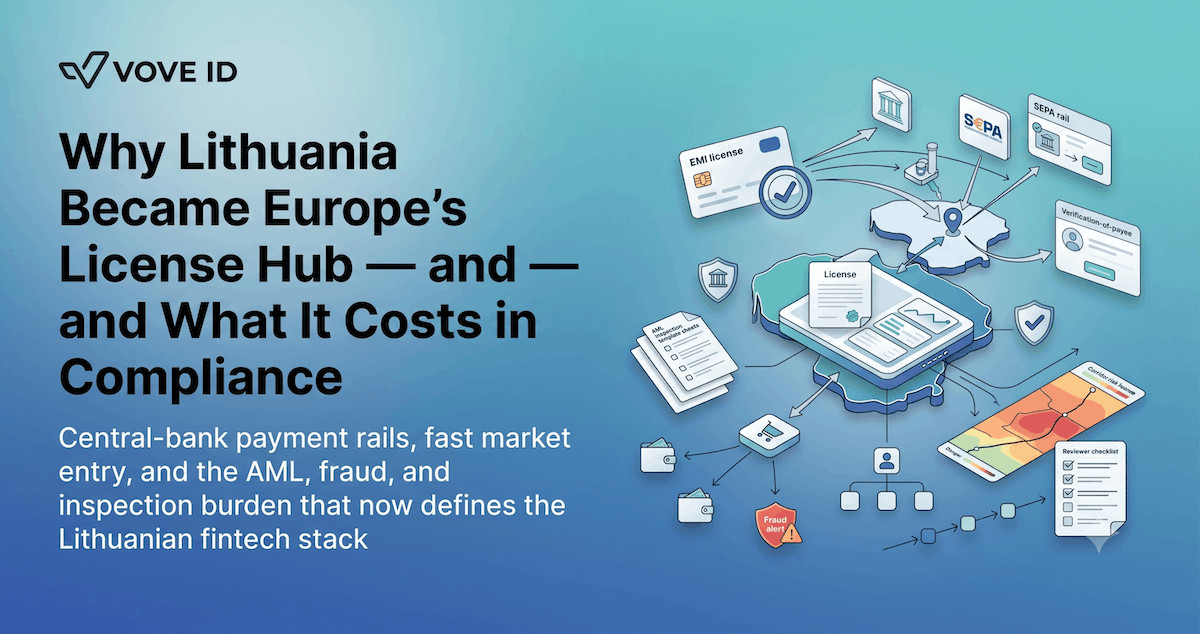
Lithuania is still one of the fastest ways to launch a serious European payments business. But in 2026, the hard part is not the licence — it is what happens after.
VOVE ID helps EMIs, PIs, and cross-border fintechs build the operational controls that make a Lithuanian licence worth holding.
This guide covers the compliance reality of operating under the Bank of Lithuania in 2026: the supervisory posture, the evidence standard, and where most licensed firms lose the plot. For the underlying AML and KYB frameworks, see our AML Requirements Explained: 2026 and KYB Requirements Explained: 2026.
Why Lithuania became a real licence hub
The structural advantage is not only licensing. It is the surrounding infrastructure.
The clearest example is CENTROlink, the Bank of Lithuania's payment infrastructure for EEA-licensed payment service providers. As of the Bank of Lithuania's update on 20 May 2026, the CENTROlink community included more than 200 financial institutions from more than 20 countries, with more than 140 active participants. The system gives firms a route into SEPA payments through one central-bank-managed platform.
That matters because a licence without operational rails is just a document.
The Bank of Lithuania also confirmed on 26 March 2026 that 379.7 million payments were processed through CENTROlink in 2025 — up 28.9% year over year — and that instant payments made up 68% of all payments in Lithuania that year. The Verification of Payee (VoP) service was also introduced in CENTROlink during 2025.
That combination explains Lithuania's appeal:
- founders can think beyond a domestic market from day one
- EMIs and PIs can build around central-bank-grade payment infrastructure
- cross-border products can launch with SEPA access in mind instead of bolting it on later
- the market has real density in payments, compliance, and fintech operations
The "Lithuania hub" thesis is infrastructure plus licensing plus ecosystem.
The mistake founders still make
Some founders still read Lithuania through an older lens: fast, flexible, comparatively easy.
That reading is incomplete in 2026.
Lithuania is attractive because it is scalable — if you are already serious about controls.
On 23 January 2026, the Bank of Lithuania published its inspection plan for the year. It expected to conduct around 20 inspections and visits, with a focus on compliance with anti-money laundering and counter-terrorist financing requirements. One electronic money institution and one payment institution were selected for routine inspections. The Bank also published standardised templates to be used during AML/CTF inspections.
That is an important signal. Lithuania is not saying: come fast and work out the controls later. It is saying: if you want to operate here, be ready to show how the controls actually work.
What the real compliance cost looks like
The cost is usually misunderstood.
Founders think about licence fees, external counsel, AML policy drafting, one MLRO hire. Those are real, but they are not the hard part.
You need inspection-ready evidence, not only policies
The Bank of Lithuania's 2026 inspection templates tell you what the regulator wants to see: processes, clients, operations, and structured evidence.
A payments startup cannot rely on a clean policy set if the live workflow is fragmented across one onboarding vendor, one sanctions tool, one transaction-monitoring layer, one support inbox, and one spreadsheet of escalations. That stack may be enough to go live. It is usually not enough to explain a relationship, a transaction pattern, or an alert decision end to end.
In Lithuania, that gap is the cost.
Payment operations now sit closer to fraud controls
The Bank of Lithuania's March 2026 CENTROlink update makes clear the ecosystem is already absorbing newer payment-control layers such as Verification of Payee. That pushes payment firms toward a more operationally mature model:
- name-check and payee verification logic
- cleaner beneficiary-data handling
- better fraud escalation
- clearer audit records around payment warnings and overrides
If a firm wants the benefits of Lithuania's payment infrastructure, it also inherits the need to operate credibly inside that infrastructure.
Governance has to keep up with cross-border scale
The licence is Lithuanian. The customer base is not.
The product may immediately touch merchants in several EU states, senders and beneficiaries in different corridors, safeguarding banks outside Lithuania, and outsourced compliance or support functions in other jurisdictions.
That means the governance challenge starts early. The business needs clear answers:
- who owns AML decisions across time zones?
- who can freeze or escalate a suspicious client?
- how quickly can the firm produce a defensible file?
- how are payment operations, fraud, and AML connected?
- what happens when the declared use case and real transaction behaviour diverge?
That staffing, documentation, and operating discipline is the real cost of using Lithuania properly.
For a full breakdown of AML programme requirements — risk assessment, transaction monitoring, sanctions logic, and escalation standards — see our AML Requirements Explained: 2026.
What a realistic Lithuania failure looks like in 2026
A newly licensed EMI in Vilnius serving SMEs across several European corridors. The founders did many things right: they obtained the licence, integrated to payment rails, outsourced basic screening, hired a lean compliance lead.
Six months later, the business gets supervisory scrutiny.
The regulator asks for a coherent sample of files showing how customers were risk-rated at onboarding, why certain corridors were allowed, how beneficial owners were identified for higher-risk businesses, how suspicious payment patterns were escalated, and whether the firm's transaction controls matched its stated risk appetite.
The answers exist — but they exist in fragments. Onboarding data in one system. Sanctions decisions in another. Case notes in Slack. Corridor logic in an analyst's spreadsheet. Exception approvals in email.
Now the firm has a compliance problem even if no underlying customer was obviously illicit.
Why? Because in Lithuania in 2026, the question is not only whether the business had controls. It is whether the business can prove how those controls operated.
What to build before treating Lithuania as a launchpad
Onboarding that produces a usable case file
The onboarding flow should create a file that captures: customer type, intended activity, ownership and control structure, sanctions and PEP outcome, risk tier, and review path — not just a verified identity.
For a full breakdown of what a production-grade onboarding record looks like for individuals and legal entities, see our KYC Requirements Explained: 2026 and KYB Requirements Explained: 2026.
Corridor-level risk visibility
Cross-border payment businesses rarely fail because "payments" went wrong in general. They fail because one corridor, one customer segment, or one counterparty type changed the firm's risk profile faster than the controls adapted.
Unified evidence across onboarding, AML, and payments
By the time an inspection starts, it is too late to stitch together a narrative from five systems. The control record should already be unified.
Review capacity for edge cases
Lithuania is a poor fit for founders who want to automate everything and think about human escalation later. A credible Lithuanian operating model still needs alert ownership, response SLAs, senior approval thresholds, and documented closure notes.
Why the jurisdiction still holds
Lithuania is still one of the best places in Europe to build a payments company that wants EU credibility, cross-border reach, real payment infrastructure, and a regulator that understands fintech.
The real pitch in 2026 is better than "fast licence":
Lithuania gives you serious rails for a serious business, and it expects serious controls in return.
How VOVE ID gets the Lithuanian stack inspection-ready
VOVE ID helps EMIs, PIs, wallet products, and cross-border fintechs turn compliance into an operating workflow instead of a paper layer.
For Lithuania-focused teams, that means KYC and KYB that create a usable case file from day one, sanctions and PEP screening tied to the onboarding decision, beneficial-owner review that can survive later questions, risk-based escalation for higher-risk corridors and counterparties, and audit records that connect customer onboarding to ongoing controls.
The Lithuanian advantage is real only if the operating model is real too.
This guide reflects publicly available information as of June 2026. It is not legal advice. Firms should consult qualified counsel for jurisdiction-specific compliance decisions.