Manual vs Automated KYC: When Each Still Makes Sense
Automation and manual review are not competitors. Here is how to design the hand-off so exceptions never disappear into an inbox.
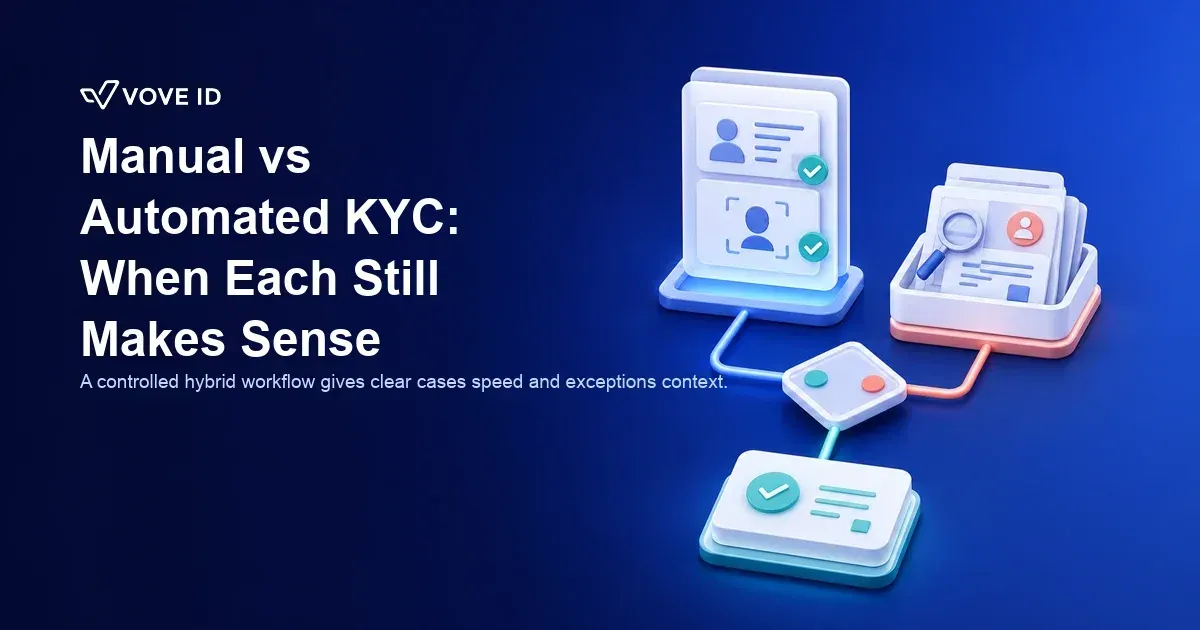
The best KYC workflow does not choose between people and automation. It defines what each is responsible for.
Direct answer
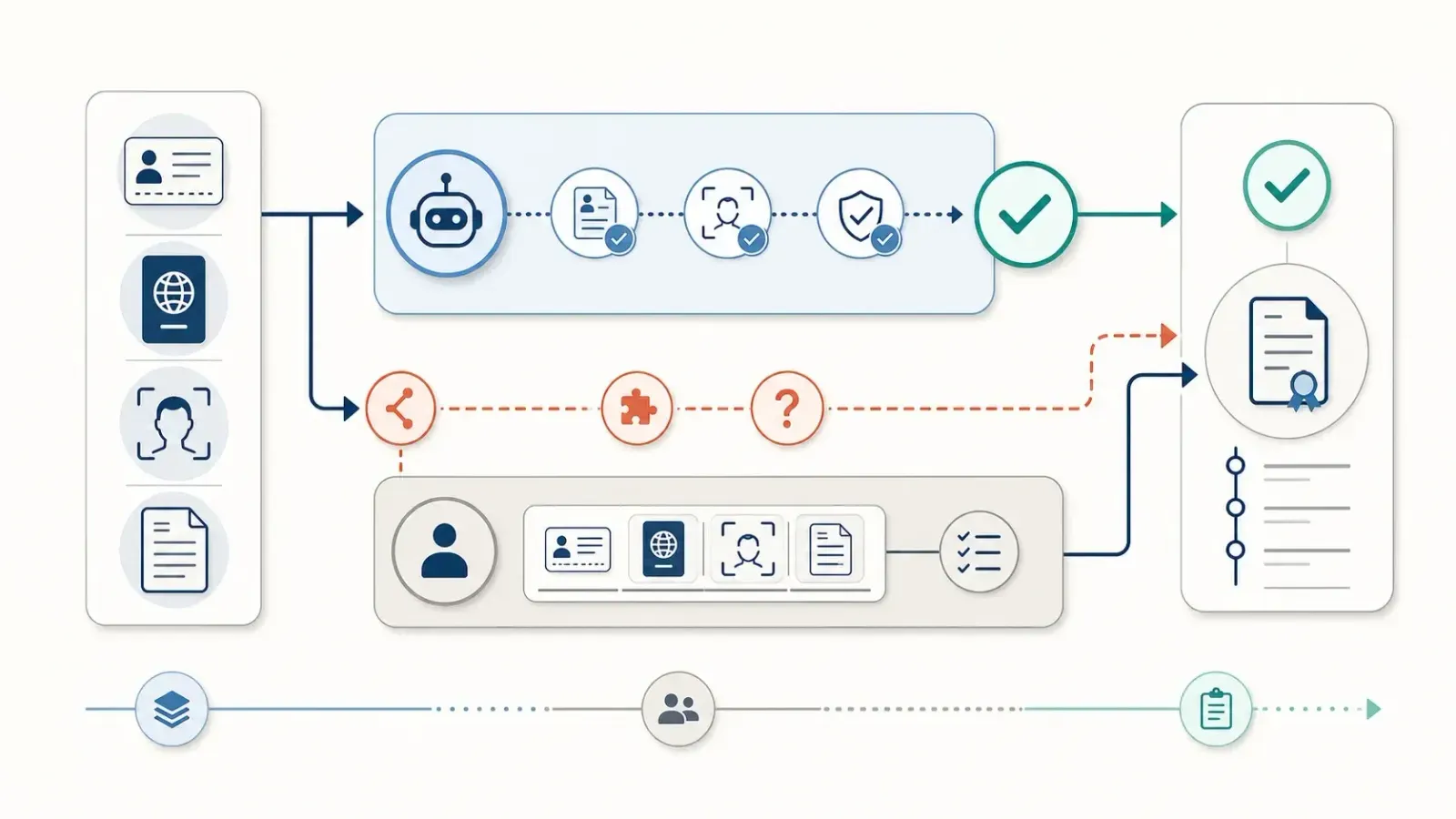
Automated KYC is best for repeatable evidence collection, validation, and routing. Manual KYC still matters when evidence conflicts, the risk is elevated, an applicant needs an exception path, or a trained reviewer must make and record a contextual decision. Most regulated teams need a controlled hybrid workflow rather than an all-manual or all-automated model.
VOVE ID helps compliance, risk, and operations teams organize identity evidence into a workflow that can handle clear cases and make exceptions visible. The common mistake is treating automation and manual review as competing systems.
This is exactly where teams create either an expensive queue or an opaque approval process.
For the underlying identity-control model, see our KYC requirements framework.
Manual versus automated KYC: the wrong comparison
Automation and manual review do different jobs. An automated flow can collect evidence consistently, run defined checks, identify mismatches, and route a case according to a policy. A reviewer can assess an ambiguity, request context, weigh permitted evidence, and document why the case was approved, restricted, or declined.
NIST describes remote unattended proofing as a process where resolution, validation, and verification are completed automatically. It separately recognizes attended models and visual inspection by a proofing agent. NIST SP 800-63A is written for federal identity systems, but the operating distinction is useful for any team: the flow, evidence, and decision ownership must be clear.
Automate the repeatable step, then design the review step before an exception arrives.
Where automation earns its place: repeatability and controlled routing
Automation makes sense when the team can define what should happen with enough precision. That often includes collecting the minimum required attributes, checking that submitted fields have the expected format, comparing data from defined sources, and creating a clear outcome when the rules are met.
It also makes the case easier to trace. A well-designed flow records what evidence arrived, which check ran, which rule selected the next step, and what the applicant sees. That record helps a team explain an outcome and find operational bottlenecks without turning every case into a spreadsheet investigation.
Automation should not silently turn uncertainty into approval or rejection. NIST's guidance requires a manual review before declining an enrollment based on a one-to-many biometric identification result, to confirm that an automated result is not a false positive. The point applies more broadly: a high-impact exception deserves an explicit route and accountable decision, not an invisible rule. See the NIST identity-proofing requirements.
Where manual review still matters: context, evidence, and redress
Manual review is appropriate when a case cannot be resolved by the approved automated rules alone. That can include conflicting identity details, difficult document quality, a high-risk customer segment, an account recovery request, a suspicious pattern, or an applicant who needs a supported exception process.
The reviewer should not work from an unstructured inbox. Give them the evidence, the triggered rule, the questions that need answering, the permitted decision options, and a place to record the rationale. The goal is consistency with room for judgment.
Manual review also supports redress. NIST expects identity services to provide a mechanism for problems such as proofing failures, delays, and difficulties, and to assess whether that mechanism resolves them. A buyer does not need to adopt NIST wholesale to see the practical lesson: every automated decision needs a visible way to resolve a legitimate exception.
A realistic failure: a clean automation rate hides an unresolved queue
A payments platform launches an automated KYC flow. Most applicants submit an identity document and complete the normal path. A smaller group has a name-format mismatch, a document image that needs closer inspection, or a business reason for an allowed alternative evidence route.
The platform has no defined review owner or evidence standard. Some cases are rejected, some remain pending, and some are approved after informal messages between teams.
Then the inconsistency appears. The automated flow is working for routine cases, but the operating model has no controlled answer for the cases that matter most.
This is not an automation failure. It is an exception-design failure.
How VOVE ID approaches this: a workflow with an explicit review path
VOVE ID can support identity verification, biometric liveness, face matching, AML screening, KYB, and transaction monitoring in a workflow that keeps evidence connected to the case, and can surface document-template inconsistencies, invalid MRZ checksums, barcode or QR inconsistencies, and image-manipulation signals across a wide range of document types and countries.
Those signals support the team's assessment. They do not replace a customer's risk policy or create a promise that every case can be resolved without judgment. Where a customer's compliance team has sufficient evidence to approve a verification, manual review can be part of the workflow. AML screening is customer-configurable and its data is refreshed daily.
For the broader screening and case-management model, see our AML requirements framework.
Governance: make the hand-off accountable
The hand-off from automation to review should have an owner, a reason code, an evidence set, and a target action. Teams should decide which cases can be resolved by a reviewer, which must be escalated, and which require the applicant to provide more information.
The audit trail needs the same care. OWASP recommends setting monitoring and reporting requirements during design, making event information available to appropriate teams, and integrating the results with incident-response processes. Those principles help a KYC team keep its controls reviewable without recording more sensitive information than is necessary. See the OWASP Developer Guide on logging and monitoring.
Practical manual and automated KYC checklist
Automation design
- Define the evidence, checks, and outcome rules for routine cases.
- Record the inputs, rule outcome, and next action for each case.
- Test pending, retry, and applicant-notification paths before launch.
Manual review design
- Define the triggers that route a case to a reviewer.
- Give reviewers a structured evidence set and permitted decision options.
- Require a recorded rationale for approvals, restrictions, escalations, and declines.
Operations and oversight
- Assign an owner and escalation path for unresolved cases.
- Monitor exception volume, queue age, and recurring evidence problems.
- Review whether automated rules and review guidance still reflect the program's risk policy.
Q&A
Does automated KYC eliminate manual review?
No. Automation can standardize repeatable work, but a regulated program still needs a controlled path for exceptions, evidence conflicts, and decisions that require human judgment.
When should a KYC case go to manual review?
Use the program's documented triggers: a material mismatch, an ambiguous result, elevated risk, an approved exception route, or an applicant problem that automation cannot resolve safely.
Is manual KYC always slower?
It is a different path, not a failed one. A clear automated route for routine cases and a structured review queue for exceptions usually gives teams more control than making every applicant wait for the same process.
FAQ
What is a hybrid KYC workflow?
It is a workflow in which defined automated checks handle repeatable cases and route exceptions to trained reviewers with the evidence and authority needed to make a documented decision.
What should be recorded in a manual KYC decision?
Record the evidence reviewed, the trigger or issue, the decision, the reviewer or authorized owner, the rationale, and the next action required by the program.
Conclusion
Manual and automated KYC are not alternatives. Automation creates consistency in the repeatable path; manual review provides accountable judgment where the case needs context.
Teams should build the hand-off as carefully as the automated check. Evidence collection, decisioning, review, and audit are one workflow.
Want to see how VOVE ID can support a fit-for-purpose identity and compliance workflow with structured reviewable decisions?
This article is intended for general informational purposes only and does not constitute legal, financial, or regulatory advice. KYC/KYB/AML requirements may vary depending on jurisdiction, industry, and specific business circumstances. For up-to-date and binding compliance obligations, readers should refer to the relevant regulatory authorities or consult qualified professionals.