Mobility and Ride-Hailing Fintech: KYC for Driver Onboarding, Safety, and Payouts
Driver KYC isn't a one-time gate — it's the case record that keeps identity, safety review, and payout access in sync as a driver's account changes state.
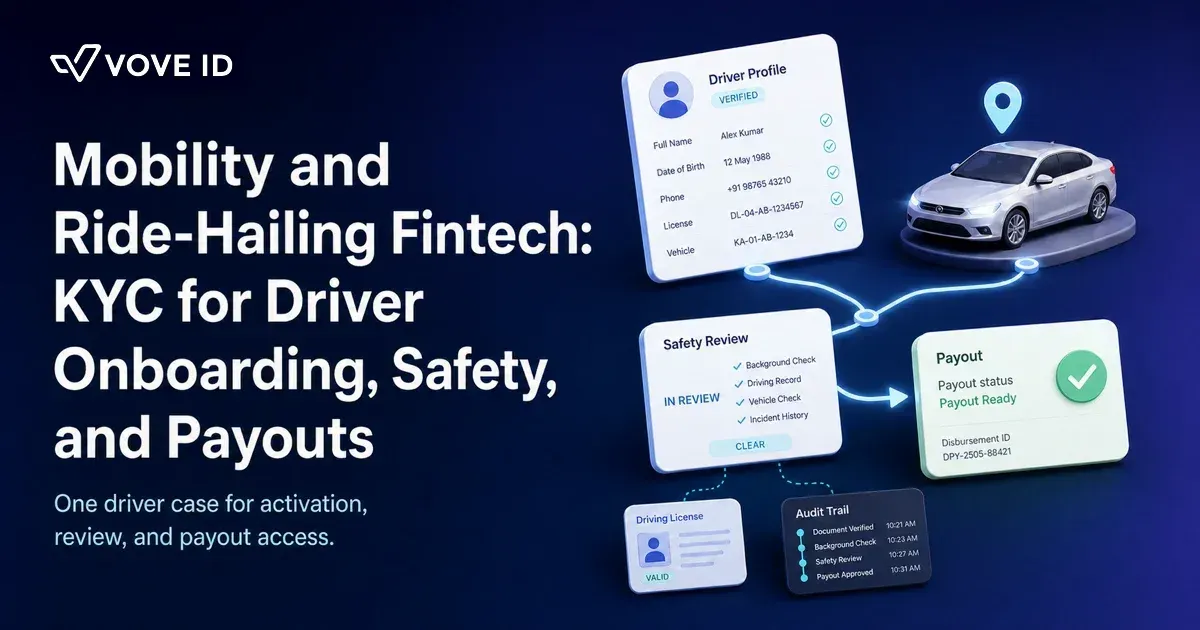
Driver KYC is not a one-time gate. It is the evidence and decision workflow that connects a driver's identity to activation, safety escalation, and payment access.
Direct answer: Ride-hailing and mobility platforms need driver KYC to function as an ongoing case record, not a single onboarding check — one that connects identity evidence to activation, safety review, and payout-readiness decisions as the driver's account changes over time.
VOVE ID helps mobility and ride-hailing teams verify drivers before they enter a marketplace and before earnings become payable. The difficult part is not collecting an ID once. It is keeping the identity evidence, risk decision, and payout rule connected when the driver's account changes state.
Driver operations tend to lose control at the same point: identity, safety, and payments each hold a partial view of the same account.
This is a different control problem than a marketplace payout-method change or a gig worker's first payout activation — a ride-hailing driver's account carries safety-specific triggers (an incident report, a vehicle or license change) that don't apply to those other worker types. For payout-activation on a newly onboarded gig worker, see our KYC for gig-economy payouts; for a payout-method change on an established marketplace account, see our KYC for freelancer marketplaces.
Driver onboarding: one identity decision, several operating consequences
A driver account can determine access to passengers, earnings, incentives, and a payout destination. When those decisions live in separate tools, a team can approve a person for one purpose while another workflow still treats the account as unreviewed.
The FATF's digital identity guidance frames digital identity in the context of customer identification and verification at onboarding, plus ongoing due diligence. That does not prescribe a single product flow for a mobility platform. It does make the operational point clear: teams need evidence that supports the decision they made and can be retrieved later.
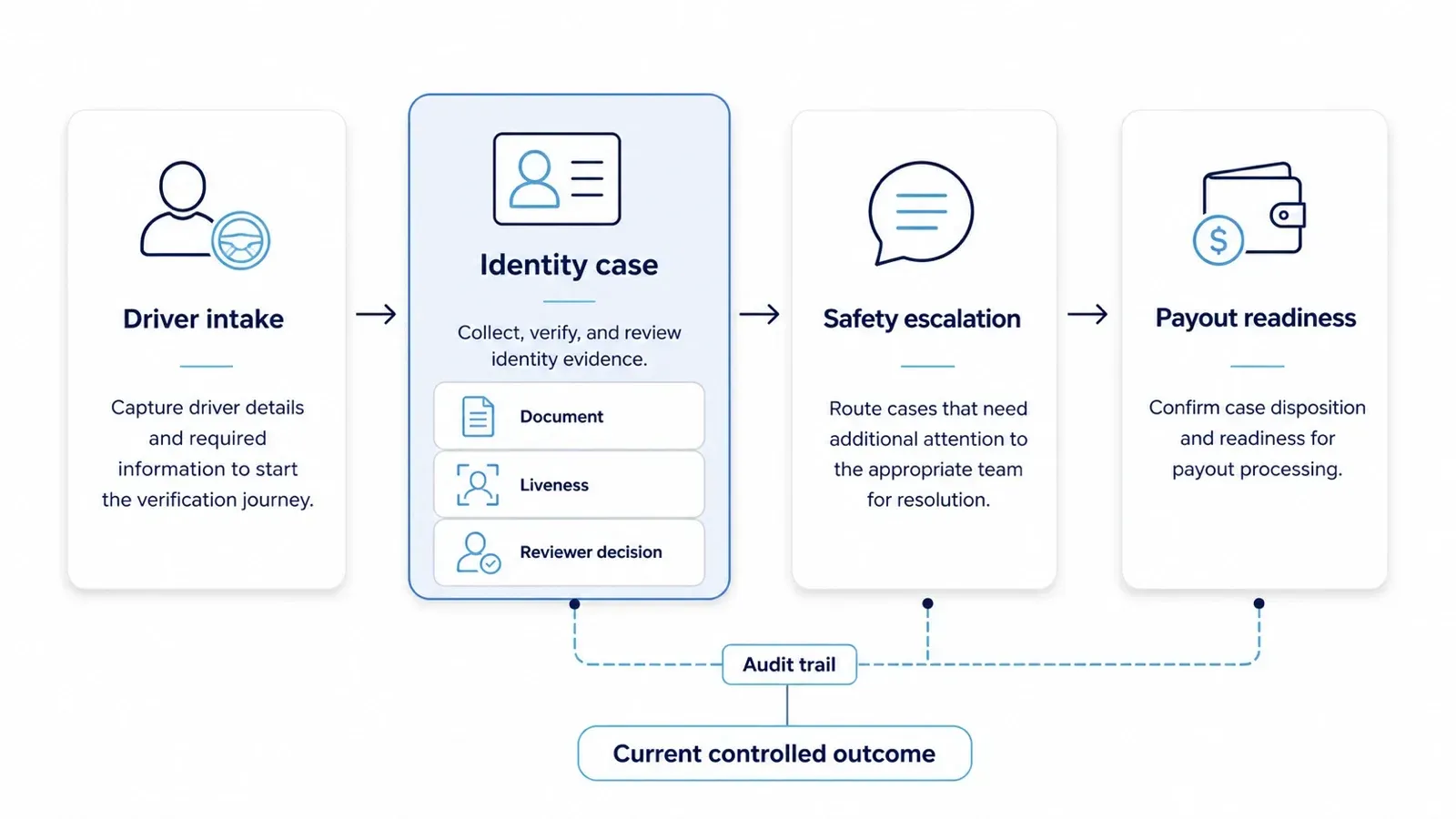
The core questions are whether the driver supplied the required evidence, whether the identity case supports activation, and whether payout can see the current case outcome rather than a stale approval flag. In short, KYC should publish a controlled case outcome, not an isolated document result.
For the underlying identity-verification framework, see our KYC requirements explained.
Safety escalation: do not force teams to rebuild the case
In a ride-hailing operation, a safety report can create urgency. The right response depends on the platform's policy, local obligations, and the evidence available. A safety report is not proof of an identity issue. It is a reason to route the account into the correct review path.
The failure pattern is familiar. Trust-and-safety staff see an account identifier, while compliance reviewers must search for documents, prior decisions, notes, and the event that prompted the review.
A better workflow attaches the escalation to the existing identity case. It gives reviewers the original evidence, the verification outcome, timestamps, and a reasoned next action: keep active, request additional evidence, restrict a capability, or escalate under the platform's policy. The decision stays attributable rather than becoming a chain of screenshots and messages.
Payout readiness: a separate control, not a duplicate onboarding flow
Payout is a high-consequence moment because it moves value. Teams often respond by rebuilding the identity process from scratch every time a driver changes a bank account, crosses a threshold, or receives an exception. That creates delay without necessarily improving the decision.
Instead, define which events require a payout-readiness check: a new payout destination, a material identity-data change, expired evidence, an unresolved review, or a policy-defined risk event. The exact triggers depend on the business and jurisdiction.
A driver's payout-readiness triggers are usually different from a marketplace freelancer's — they're more likely tied to a vehicle, license, or incident-driven account restriction than to a routine destination-only change. For how AML screening fits into that broader review process, see our AML requirements explained.
The payout system then consumes a clear, current state from the identity case. It should know whether the account is eligible, under review, or blocked by a policy rule. It should not need to interpret document images or reviewer notes on its own.
A realistic driver case: the payout exception that exposes a fragmented process
A ride-hailing platform onboards a new driver before a peak-demand period. The driver submits:
- A government-issued identity document
- A selfie for identity verification
- A payout account destination
The driver starts accepting trips. A few days later, the payout destination changes and a safety team opens an account review after a rider report.
Then the inconsistencies appear. Payouts sees a changed payment detail, safety sees an open investigation, and the identity reviewer sees an approved record but no shared view of restrictions. Each team asks for the same documents again.
This is not a document-review failure. It is a case-orchestration failure.
How VOVE ID approaches this: decisions that travel with the case
VOVE ID supports identity verification, biometric liveness, face matching, AML screening, KYB, and transaction monitoring. For driver onboarding, that lets a team collect and review identity evidence in one workflow rather than treating each document as a standalone attachment.
VOVE ID can help detect document-template inconsistencies, invalid MRZ checksums, barcode or QR inconsistencies, and signs of image manipulation. These are detection aids, not a guarantee that a document is authentic or that a driver is suitable for every operational decision. Where a compliance team has sufficient evidence, manual review may support an approval decision.
The value is the case record: evidence, review status, decision, and audit trail available to the team that needs a controlled outcome. A mobility platform still defines its own activation, safety, and payout policies.
Practical driver KYC checklist
Onboarding
- Define the identity evidence required for each driver market and product.
- Capture an explicit activation decision rather than only a document-upload result.
- Route incomplete or inconsistent submissions into a documented review queue.
Safety and risk
- Link safety escalations to the driver's existing identity case.
- Record the reviewer, reason, evidence, and account action for each exception.
- Separate an allegation or report from a verified identity finding.
Payouts and operations
- Define events that require a payout-readiness reassessment.
- Give payout systems a current eligibility state, not raw verification artifacts.
- Preserve the decision history for internal review and applicable recordkeeping.
FAQ
Should every driver complete KYC before taking trips?
The required flow depends on the platform's market, product, risk appetite, and applicable obligations. Teams should define a clear activation policy and keep the evidence that supports each outcome.
Is a safety report the same as an identity-verification failure?
No. A report can require an account review, but it does not by itself establish an identity finding. The workflow should preserve the report, route the case, and apply the platform's policy.
When should a ride-hailing platform re-check a driver before payout?
Use policy-defined events such as changed payout details, expired evidence, unresolved reviews, or material account changes. Avoid re-collecting the same evidence without a reasoned trigger.
Can document checks guarantee that a driver is safe?
No. Document and identity checks address a defined part of the decision. Safety requires its own policies, investigation process, and operational controls.
Conclusion
Driver KYC in mobility isn't a one-time onboarding screen — it's the operating record that lets teams make consistent activation, review, and payout decisions.
Teams need a workflow that keeps evidence and account actions together, especially when safety or payment exceptions create urgency. Collection, verification, and case management are one workflow.
Want to see how VOVE ID helps teams run driver identity checks with an auditable case record?
This article is intended for general informational purposes only and does not constitute legal, financial, or regulatory advice. KYC/KYB/AML requirements may vary depending on jurisdiction, industry, and specific business circumstances. For up-to-date and binding compliance obligations, readers should refer to the relevant regulatory authorities or consult qualified professionals.