Romania's Digital Lending Surge: Onboarding at Scale Under BNR Rules
Romanian digital lenders can move fast in 2026. But BNR oversight and the incoming Consumer Credit Directive mean the file behind every approval now matters as much as the decision.
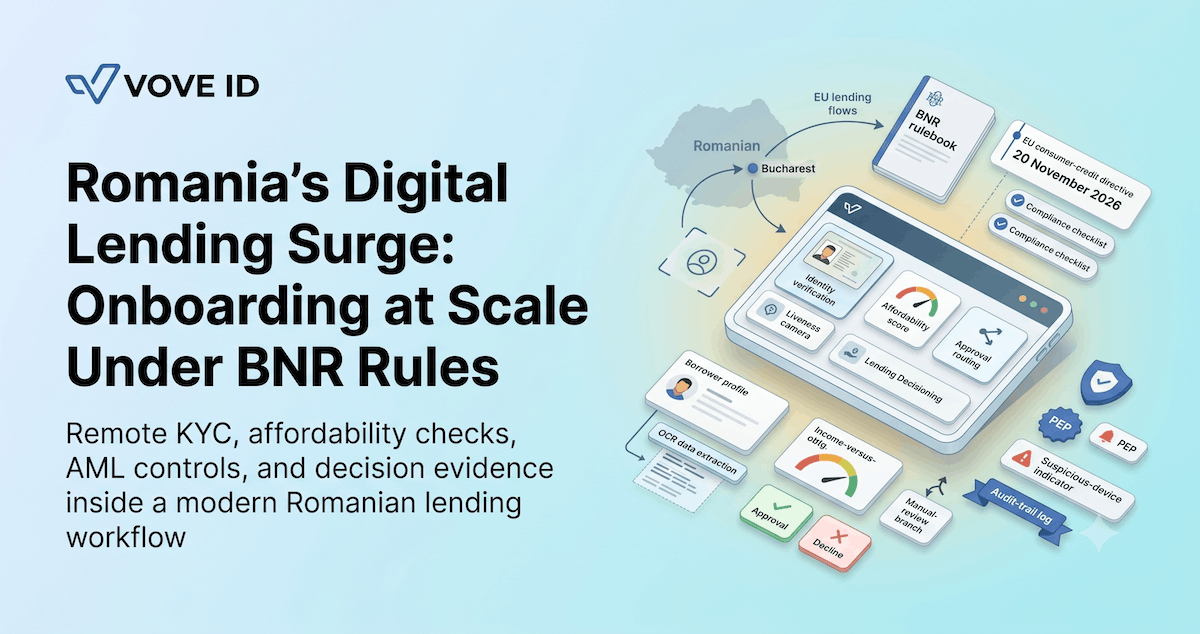
Romania is one of the more active digital lending markets in the EU for teams building fast consumer and small-ticket credit products. The market is digitising quickly, borrower appetite for fast credit is real, and cost structures are favourable compared to Western Europe.
But digital lending does not become easier as the market grows. It becomes more inspectable.
VOVE ID helps digital lenders operating in Romania build the onboarding and control infrastructure that makes scale sustainable under NBR supervision.
This guide covers what compliant digital lending looks like in Romania in 2026 — the supervisory baseline, the incoming CCD2 obligations, and where high-volume flows break down. For the underlying identity verification and AML frameworks, see our KYC Requirements Explained: 2026 and AML Requirements Explained: 2026.
The Romanian supervisory baseline
The National Bank of Romania is not a niche observer of this market.
In its 2023 Annual Report, approved on 17 June 2024, the NBR states that it carries out authorisation, regulation, and prudential supervision of credit institutions and oversees payment systems in support of financial stability. NBR supervision extends beyond banks to Romanian payment institutions, Romanian electronic money institutions, and non-bank financial institutions recorded in the relevant registers.
That matters because many digital lenders still behave as if scale postpones supervision. It does not. Scale changes the type of supervision risk you carry. If the firm is lending fast, onboarding remotely, relying on automated scoring, or using third-party data sources, then every weakness in the flow becomes easier to multiply. One weak control does not create one bad file. It creates hundreds.
Romania is digitising fast — which raises the compliance standard
The NBR's June 2024 Financial Stability Report highlighted the scale of digital change inside the Romanian market: growing customer use of digital banking channels, widespread investment in biometric customer-identification tools, and broad use of OCR-style document processing and related automation.
That matters even for non-bank lenders.
Once the market normalises remote identification and digital servicing, the regulator stops treating digital onboarding as an experimental exception. It becomes a mainstream operating model. And once it is mainstream, the standard rises.
The question is no longer: can this lender onboard remotely? It becomes: can this lender onboard remotely while preserving identity assurance, AML controls, and credit-decision evidence?
The 2026 deadline that is no longer future music
The revised EU Consumer Credit Directive has concrete dates:
- 18 October 2023 — the EU adopted Directive (EU) 2023/2225
- 20 November 2025 — Member States had to adopt and publish the measures needed to comply
- 20 November 2026 — the new rules apply
As of June 2026, Romanian lenders are in the transition window. The revised rules are not yet fully applying, but the direction is clear: stronger creditworthiness assessment expectations, more structured consumer information and disclosures, less tolerance for weakly evidenced digital lending.
Lenders waiting until late 2026 to redesign their onboarding and approval evidence are already late.
What onboarding at scale under BNR rules actually requires
Romania does not need a slower lending experience. It needs a better structured one.
Identity evidence that supports the file, not just the conversion funnel
Remote origination at scale requires document capture with authenticity checks, liveness or equivalent person-verification controls where risk warrants it, sanctions and PEP screening, and device and behavioural signals where fraud risk is meaningful.
If the lender cannot explain why a specific borrower was treated as genuine, the rest of the file becomes fragile — especially in high-volume consumer lending, salary-advance products, and short-term credit where speed can conceal weak controls.
For a full breakdown of what remote identity verification requires at the product and process level, see our KYC Requirements Explained: 2026.
Creditworthiness stored as a decision, not an impression
This is where many digital lenders fail.
They run a score. They store an output. They do not store the reasoning.
A defensible Romanian digital-lending workflow should preserve: the data used in the assessment, the time the data was collected, the rules or model path used, any manual override, and the final decision with clear ownership.
The revised CCD2 regime reinforces this logic. But lenders should already be operating this way before 20 November 2026.
Versioned decisioning and disclosure logic
When credit policy or pre-contract wording changes, the system should preserve which version applied to each borrower. Without that, the lender cannot reconstruct the file later — and under CCD2 obligations around consumer information, that is a structural gap.
The lender should be able to show what the borrower saw, when they saw it, what they consented to, and what changed before acceptance.
AML and lending signals connected, not siloed
Some teams still treat KYC as a compliance function, affordability as a credit function, and fraud as a risk function. That split breaks at scale.
A borrower can pass identity checks and still present mule-account risk, synthetic-fraud indicators, suspicious disbursement behaviour, or a mismatch between declared employment profile and observed payment pattern. If those signals do not meet in one case record, the lender may approve the loan but fail the file.
For a full breakdown of AML programme requirements — transaction monitoring, sanctions screening, and escalation standards — see our AML Requirements Explained: 2026.
Edge cases need a queue, not improvisation
At scale, exceptions are not edge cases anymore. They are a permanent category: blurry documents, low-confidence liveness results, income inconsistencies, sanctions or PEP near-matches, repeat applications from linked devices.
If those cases are handled ad hoc in chat tools and side emails, the lender is building audit gaps into the core workflow.
What a realistic Romanian failure looks like in 2026
A Bucharest-based digital lender approving several hundred borrowers a day. Fast onboarding, instant ID checks, automated decisioning, same-day disbursement.
Then an inspection or internal review samples fifty files.
The identity layer looks acceptable. The real issues are elsewhere: the score output is stored, but not the underlying affordability rationale. Manual overrides are visible in the admin panel, but not logged in the final customer file. The AML result is pass/fail, without preserved evidence on near-matches. The borrower disclosures changed mid-quarter, but the system does not show which version each user saw.
The product works. The file does not.
That is exactly the kind of failure 2026 lending teams need to design out before November.
What to build this year
One onboarding record per borrower
The lender should be able to retrieve one record showing: identity evidence, screening results, affordability inputs, consent and disclosures, decision path, and reviewer actions where applicable. Not reconstructed from five systems — retrievable as a single file.
A clean fork between auto-pass and manual review
The best lending systems are not the ones that automate everything. They are the ones that automate the right files and escalate the right ones — with owned queues, SLAs, and documented closure notes.
Disbursement monitoring linked back to origination
If post-loan behaviour sharply departs from the onboarding story, the lender should see that as one relationship problem — not as separate fraud and AML tickets.
Why this matters beyond consumer lending
The same logic applies across salary advance, merchant cash advance, embedded lending, BNPL, and small-ticket SME finance. Different products will have different rules, but the shared lesson is consistent: digital speed without file-quality discipline becomes an inspection problem.
How VOVE ID helps Romanian lenders scale cleanly
VOVE ID helps digital lenders turn onboarding into a structured control workflow instead of a stack of disconnected checks.
For Romanian lenders, that means identity verification and liveness built for remote origination, AML and sanctions checks tied to the same borrower record, risk-based escalation for higher-risk applications, audit logs that preserve what data was used and when, and one operational trail from onboarding through review and disbursement readiness.
That is what matters in a market where scale is real, and where the regulator will eventually ask not only whether you lent fast — but whether you lent well.
This guide reflects publicly available information as of June 2026. It is not legal advice. Firms should consult qualified counsel for jurisdiction-specific compliance decisions.